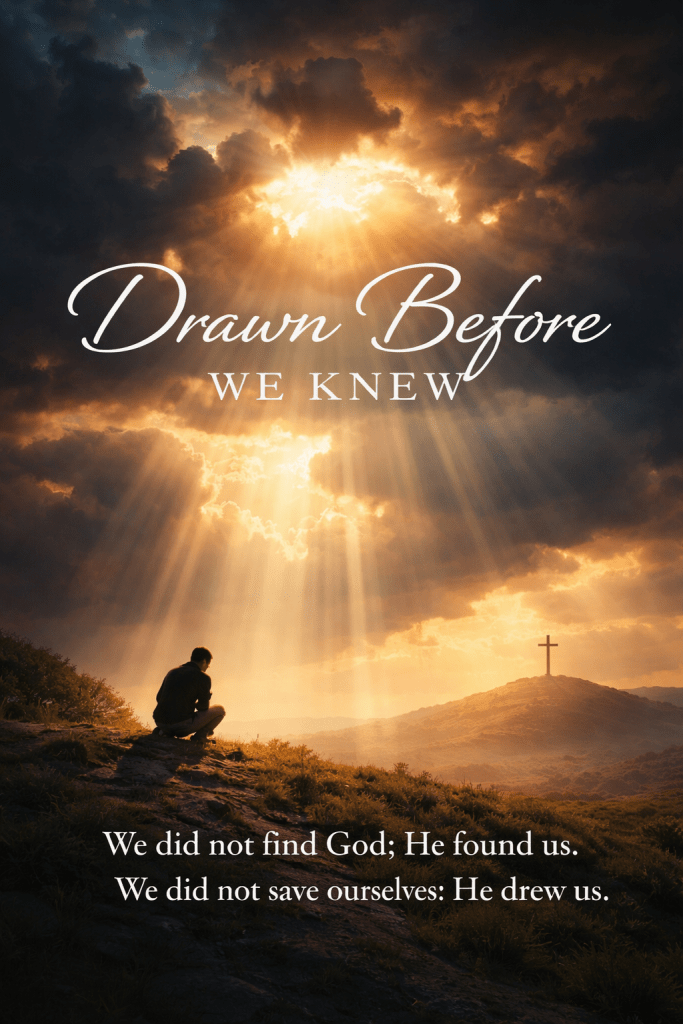
Salvation does not begin with man climbing toward God. It begins with God stepping toward man.
Jesus said, “No man can come to Me, except the Father which hath sent Me draw him” (John 6:44). If He had not awakened us, we would still be asleep. If He had not called, we would not have answered. If He had not drawn us, we would never have come. From first conviction to final glory, it is His work. “We love Him, because He first loved us” (1 John 4:19).
And yet Scripture also says that the Lord is “not willing that any should perish, but that all should come to repentance” (2 Peter 3:9). So why are not all saved? Why does not every heart respond to that gracious drawing?
The Word of God places two truths side by side. God chooses. Man responds. Jesus said, “Ye have not chosen Me, but I have chosen you” (John 15:16). Yet the invitation still stands, “Whosoever will, let him take the water of life freely” (Revelation 22:17).
Romans 8:29 tells us, “For whom He did foreknow, He also did predestinate.” But what does that mean in its fullness? Did He choose because He knew we would believe? Or do we believe because He first set His affection upon us? Ephesians 1:4 declares that He “chose us in Him before the foundation of the world.”
If you try to press too deeply into that mystery, you begin to feel the limits of your own mind. “O the depth of the riches both of the wisdom and knowledge of God! How unsearchable are His judgments, and His ways past finding out!” (Romans 11:33).
There comes a point where reasoning kneels.
If we could fully chart the mind of God, He would not be worthy of awe. “For My thoughts are not your thoughts, neither are your ways My ways, saith the Lord” (Isaiah 55:8–9).
So instead of arguing our way through what He has not completely uncovered, we bow.
I may not understand every detail of how His choosing and my believing meet. But I know this: “By grace are ye saved through faith; and that not of yourselves: it is the gift of God” (Ephesians 2:8). I did not save myself. He opened my eyes. He softened my heart. He brought me near. “It is God which worketh in you both to will and to do of His good pleasure” (Philippians 2:13).
And when that settles into your soul, it does not create pride.
It creates gratitude.
“Lord, I do not understand it all. But I thank You for drawing me. I thank You for choosing me. I thank You for saving me.”
And that is where theology becomes worship.

 The Solid Rock
Leave a comment