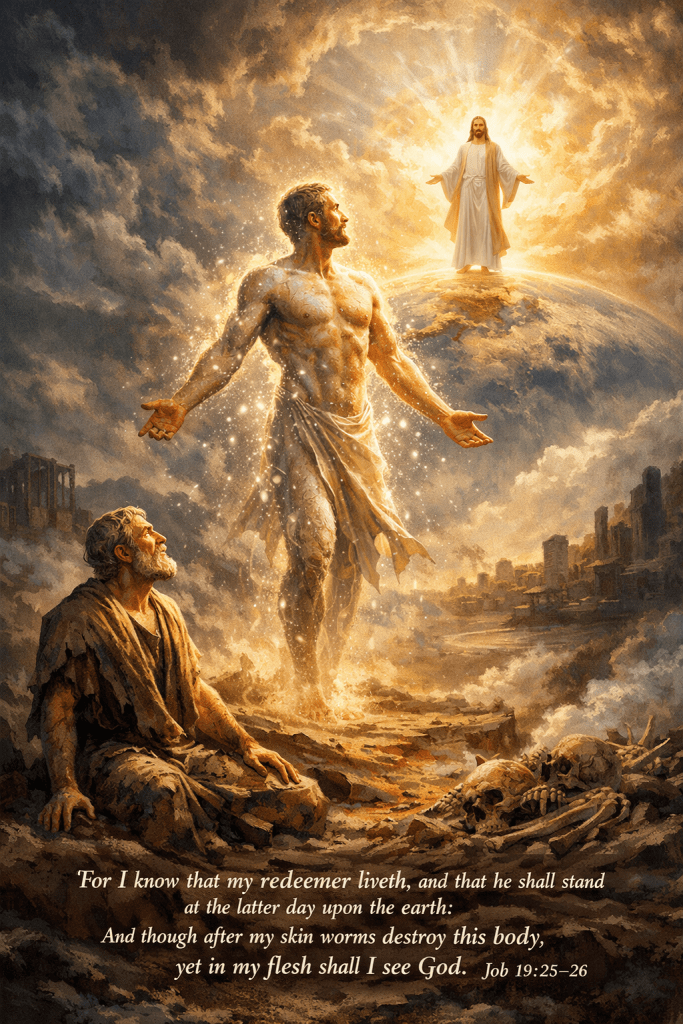
In the middle of loss, confusion, and physical agony, Job makes one of the most powerful declarations in Scripture:
“For I know that my redeemer liveth, and that he shall stand at the latter day upon the earth:
And though after my skin worms destroy this body, yet in my flesh shall I see God.”
— Job 19:25–26
Notice the progression.
In chapter 9, Job said, “I wish I had a daysman.”
In chapter 16, he longed for an advocate.
But here in chapter 19, he no longer says I wish.
He says, I know.
The word redeemer speaks of one who buys back what has been lost, who restores what has been forfeited. Through suffering, Job’s understanding deepens. His body is breaking down, yet his faith is building up.
And then he says something astonishing:
“In my flesh shall I see God.”
That is resurrection language.
Job is not speaking about a vague spiritual existence. He is declaring that though his present body will decay, he will one day stand again — embodied, restored, alive in a way far greater than before.
Scripture tells us this mortal will put on immortality. This corruptible will put on incorruption. The weakness we feel now will be replaced with glory. No more sickness. No more fatigue. No more decay. A body suited for eternity. A body capable of standing in the presence of God.
The very flesh that was once reduced to dust will be raised in power.
Job did not understand all the mechanics. But he knew this: death is not the end. The Redeemer lives. And because He lives, we will live also — not as shadows, but in glorified, resurrected bodies.
That is not wishful thinking.
That is resurrection certainty.

 The Solid Rock
Leave a comment