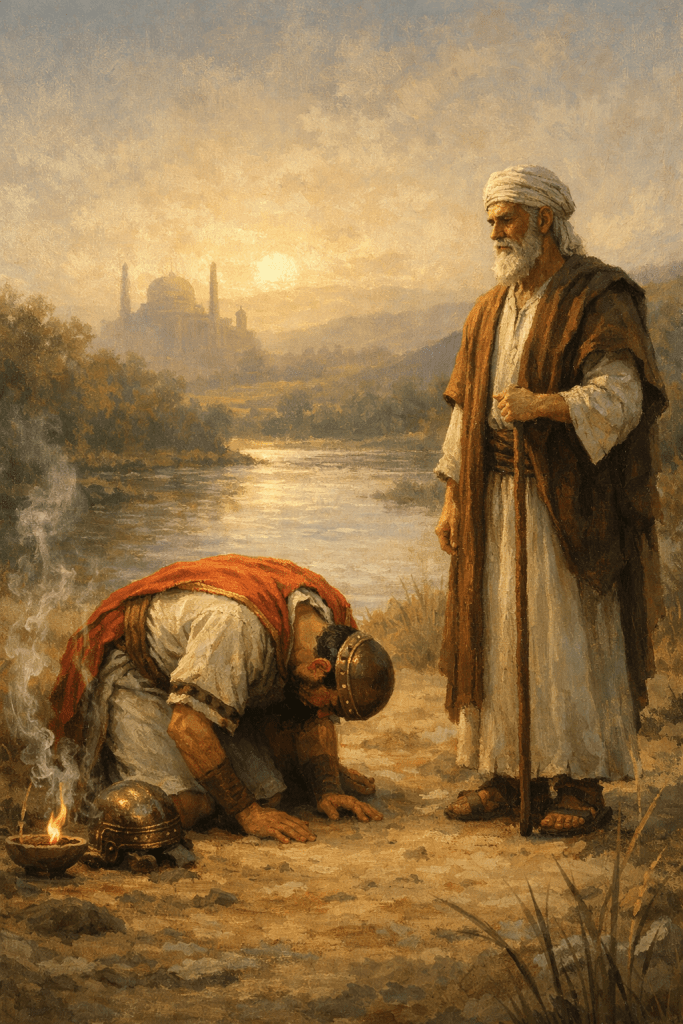
In 2 Kings 5, we meet Naaman, the commander of the army of Syria. He is a powerful man, respected and accomplished — but he is also a leper. Through the testimony of a captive Israelite servant girl, Naaman hears that there is a prophet in Israel who can help him. Desperate, he travels to see Elisha.
After some humbling moments — including being told to wash seven times in the Jordan River — Naaman obeys. His leprosy is cleansed. His flesh becomes like that of a child. And more importantly, his heart turns toward the God of Israel. He declares, “Now I know that there is no God in all the earth, but in Israel.”
Then he makes a strange request.
He asks for two mule loads of dirt from Israel so he can build an altar back home. In his understanding, gods were tied to geography. He wants Israelite soil so he can properly worship Israel’s God.
Then he adds something even more troubling. He explains that when his master enters the temple of Rimmon — the national storm god of Syria — he, as commander, must accompany him and bow in support of the king. He asks the Lord to pardon him in this matter.
And Elisha’s response?
“Go in peace.”
Why doesn’t Elisha correct him on the spot?
Why doesn’t he give him a full theology lecture about God not being confined to dirt?
Why doesn’t he forbid him from bowing in the temple of a false god?
Because Naaman is a newborn believer.
He has just come to faith. The leprosy is gone. His heart has turned. But his understanding is still forming.
Elisha recognizes something many mature believers forget: you do not treat an infant like a veteran.
A Bruised Reed
Of Jesus it was written:
“A bruised reed He will not break, and smoking flax He will not quench.” (Isaiah 42:3)
When there is even the faintest flicker of faith, the Lord protects it. He does not crush it under the weight of immediate perfection.
Growth is progressive. Sanctification is progressive.
Yes, the Holy Spirit convicts.
Yes, He refines.
Yes, He exposes error.
But He does so over time.
Application to False Doctrine
Now let’s bring this into situations like instant sanctification or other doctrinal extremes.
When someone sincerely believes they have reached a place of no longer sinning, our instinct may be to immediately dismantle the system.
But wisdom asks:
- Is this person arrogant or simply immature?
- Are they hardened, or are they just newly convinced?
- Is the Spirit already working beneath the surface?
The Holy Spirit does not need our anxiety.
He does not require our aggressive correction to accomplish His work.
We preach the gospel. We speak truth in love. We model humility. And we trust the Spirit to deal with “Rimmon” in due time.
The Danger on Both Sides
There are two errors:
- Ignoring false doctrine completely.
- Crushing young believers under a lifetime of accumulated convictions.
Elisha chose neither. He did not affirm Rimmon. But he did not overwhelm Naaman either.
There is a difference between tolerating rebellion and shepherding immaturity.
Final Thought
If sanctification were instant in the experiential sense, the New Testament would not speak so often about growth, renewal of the mind, putting off the old man, pressing toward the mark.
God works deeply — but He works patiently.
Our role is not to replace the Holy Spirit.
It is to preach good news, walk gently, and trust that the same God who began a good work will complete it.
And sometimes, the most Spirit led response is simply:
“Go in peace.”

 The Solid Rock
Leave a comment