
Matthew 27:46
And about the ninth hour Jesus cried with a loud voice, saying, Eli, Eli, lama sabachthani? that is to say, My God, my God, why hast thou forsaken me?
The darkest moment in history begins with a quotation.
Jesus does not invent new words from the cross. He reaches back into Psalm 22 and pulls it forward. He is not confused. He is not defeated. He is identifying Himself with prophecy.
When He cries, “My God, My God…,” heaven is silent because sin is being transferred. Fellowship is not broken relationally — it is interrupted judicially. The Holy One is standing in the place of the unholy.
But Psalm 22 does not end in despair.
It ends in victory.
And buried inside that psalm is a sentence that almost feels strange.
Psalm 22:6
But I am a worm, and no man; a reproach of men, and despised of the people.
A worm.
The Hebrew word is tola.
Not a garden worm.
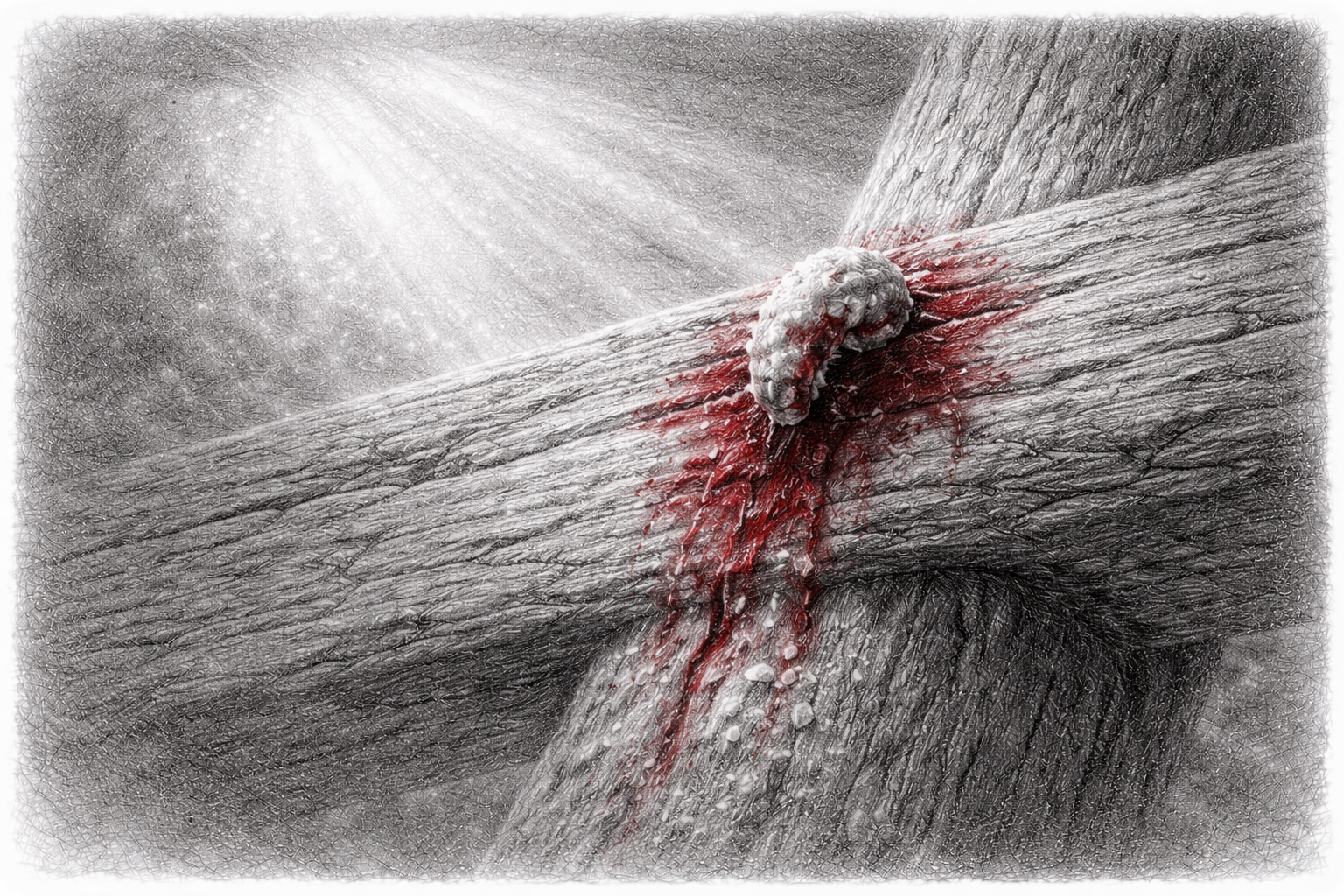
A crimson worm.
In ancient days, the tola was used to produce scarlet dye for kings and priests. But its life tells a deeper story.
The mother climbs onto wood and attaches herself. Once fastened, she cannot remove herself. She dies there. As she dies, crimson flows out and stains the wood beneath her. Her young live from what pours out of her.
She gives life by dying fixed to the tree.
And after about three days, something remarkable happens. The body dries. It turns white. It flakes away like snow. The crimson stain remains, but the worm is gone.
Creation was preaching long before Calvary.
Listen now to Isaiah.
Isaiah 1:18
Come now, and let us reason together, saith the LORD: though your sins be as scarlet, they shall be as white as snow; though they be red like crimson, they shall be as wool.
Scarlet.
Crimson.
Snow.
Wool.
God did not choose those words casually.
Before the cross was erected, the metaphor was embedded in nature. Then Jesus stepped into it.
Fixed to wood.
Poured out in red.
Life flowing from death.
Three days later — risen.
The stain sufficient.
The sacrifice complete.
When Jesus said, “I am a worm,” He was not lowering Himself beneath humanity. He was revealing the method of redemption.
The cross was not an accident. It was architecture.
Psalm 22 opens with a cry of abandonment.
It closes with declaration.
Psalm 22:31
They shall come, and shall declare his righteousness unto a people that shall be born, that he hath done this.
He has done it.
The cry was real.
The cost was real.
The stain was intentional.
He cried, “Why?”
So we would never have to.