
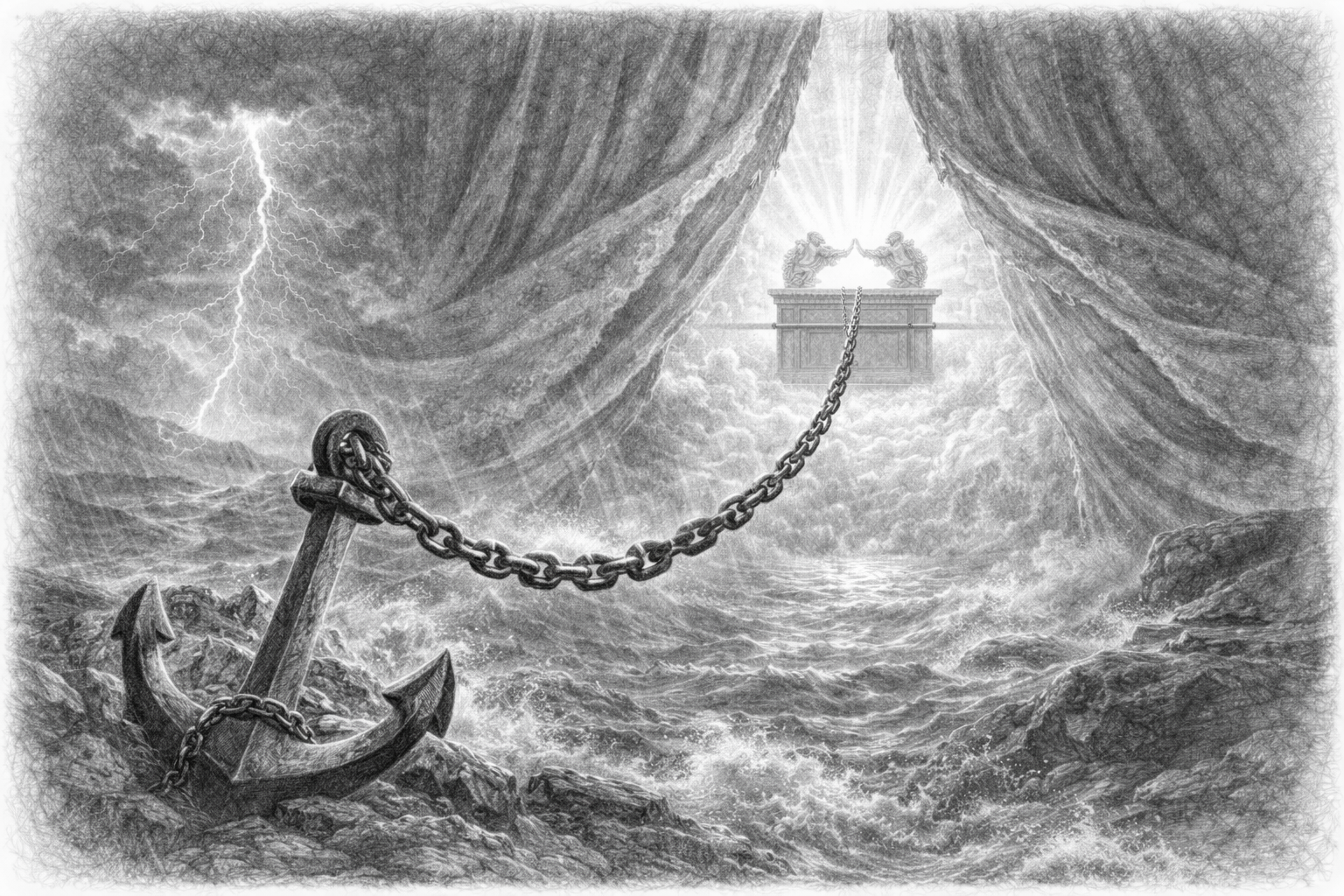
Hebrews 6:19 (a)
Which hope we have as an anchor of the soul, both sure and stedfast…
Hope is not presented here as a wish. It is not a crossed-fingers optimism. It is an anchor.
That means biblical hope is meant to hold.
When the sea is calm, an anchor does not seem all that impressive. It just sits there, unseen, doing nothing dramatic. But let the wind rise. Let the waves start pounding. Let the boat begin to strain and pull. That is when you find out whether the anchor is worth anything.
That is what hope does for the soul.
Life has a way of kicking up storms. Fear comes. Temptation comes. old habits call your name again. The pressure to go backward can get very real. For the Hebrews, the pull was back toward temple worship, toward what was familiar, visible, and established. For others, it may be the old life, the old compromise, the old escape routes. Different waves. Same sea.
But the writer says, in effect, “Do not drift. You have an anchor.”
And that anchor is sure and stedfast because it is tied to the Word of God and the promises He has made. Not to feelings. Not to circumstances. Not to the mood of the moment. God has spoken, and His promise does not slide across the ocean floor.
Here’s the thing: if your anchor is your own strength, you will drift. If your anchor is your own consistency, you will drift. If your anchor is people, systems, or routines, sooner or later you will drift.
But if your anchor is the unchangeable Word of God, then even when the boat creaks and groans, the soul can hold.
That is why the call is so plain. Do not go back. Do not drift into whatever you came out of. Stay anchored in the sure and steadfast promise of God.
Hebrews 6:19 (b)
…and which entereth into that within the veil.
Now the picture gets even stronger.
This hope is not only an anchor. It is an anchor that goes within the veil.
That would have hit the Hebrew mind with force.
The veil in the temple was not some light curtain blowing in the breeze. It was massive. Thick. Heavy. It stood as a barrier, declaring that sinful man could not just stroll into the presence of God. Priests could minister in the holy place, but behind the veil was another matter entirely. That was the place of the ark, the mercy seat, the shekinah glory. Only the high priest could go there, and only on the Day of Atonement.
So when Hebrews says our hope enters within the veil, it is saying something astonishing.
Our hope is not anchored in earth at all.
It is anchored in heaven.
Think about that.
An ordinary anchor drops down into the deep. This anchor goes up into the deepest reality of all, into the very presence of God. It holds because Jesus has gone there for us.
And that changes everything.
Because when Jesus cried, “It is finished,” the veil was torn from top to bottom. God Himself ripped open what man could never open. The message was unmistakable: the way into His presence had been made.
Open house.
Not for one high priest once a year, but for every believer who comes through Jesus Christ.
That would have sounded radical to the Hebrew ear. The whole old structure said, “Stay back.” Jesus says, “Come in.”
And that is why hope can anchor the soul. It is not anchored in a system, a ceremony, or a building made with hands. It is anchored in a living Savior who has already entered the presence of God on our behalf.
That is a strong anchor.
Like a rope tied not to driftwood but to bedrock, it holds because the point of attachment cannot move.
So when storms come, do not measure your safety by the size of the waves. Measure it by the strength of the One who holds you.
Be anchored there.