
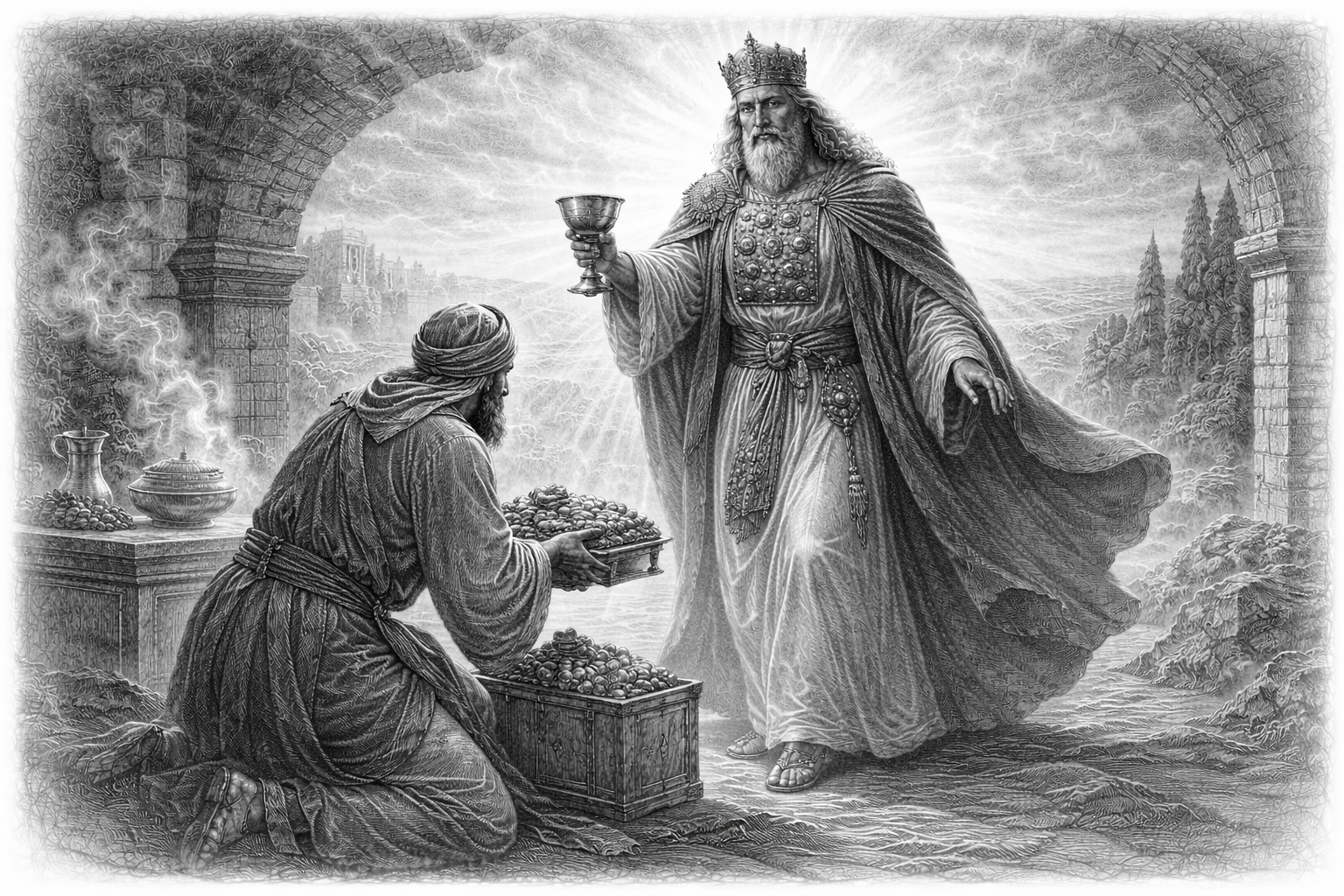
Hebrews 7:1–3
For this Melchisedek, king of Salem, priest of the most high God, who met Abraham returning from the slaughter of the kings, and blessed him;
To whom also Abraham gave a tenth part of all; first being by interpretation King of righteousness, and after that also King of Salem, which is, King of peace;
Without father, without mother, without descent, having neither beginning of days, nor end of life; but made like unto the Son of God; abideth a priest continually.
Melchizedek steps into the story suddenly. Abraham is returning from battle, and there this mysterious figure stands, meeting him, blessing him, and receiving a tenth from him. No long introduction. No family line. No record of where he came from or where he went. He appears in Scripture almost like a flash of light, and that is exactly why he has stirred so much thought through the years.
Some understand Hebrews to mean simply that no genealogy is recorded for Melchizedek. That is certainly one way to read it. But it is not hard to see why others have looked at this passage and said, “This sounds like more than an ordinary man.” The language is so unusual, so lofty, that it naturally lifts the mind toward Christ.
Because who else can truly be called the King of righteousness and the King of peace in the fullest sense?
There is only One. Jesus Christ.
And the order matters. He is first called the King of righteousness, and after that the King of peace. That is not accidental. Peace does not come first. Righteousness comes first.
Here’s the thing: people are always trying to reverse that order. They want peace without repentance. Peace without surrender. Peace without anything being made right. But it does not work.
It is like laying a fresh rug over a rotten floor. The room may look better for a little while, but the weakness underneath is still there. Before there can be lasting rest, something deeper has to be repaired. Before there can be peace, there has to be rightness.
That is true in the soul.
A person cannot bargain with sin and then wonder why peace never settles in. Compromise may create a moment of quiet, but it cannot produce real peace. Only when what is wrong is dealt with can peace begin to grow.
And that is why Jesus is so glorious. He does not merely soothe troubled people. He makes them right before God. He deals with sin. He brings righteousness first. And from that righteousness comes peace.
Don’t miss this. The gospel is not God pretending sin does not matter. The gospel is God dealing with sin completely through Jesus Christ, so that peace can be real and not artificial.
That is why Melchizedek is such an important figure. Whether one sees him as a Christophany or as a historical man uniquely designed to point to Christ, the direction is the same. He points beyond himself to Jesus.
The King of righteousness.
The King of peace.
And when Abraham bowed before him and gave him a tenth of all, that says something too. Abraham, the great patriarch, recognized greatness above himself. He honored one who stood over him.
That is where this text leads us. Not merely into curiosity about Melchizedek, but into worship of Christ.
If peace feels far away, the answer is not to chase peace directly. Come to the One who makes things right. Come to the King of righteousness. Because when He sets a life right, peace follows in His wake.