
Hebrews 9:8–10
The Holy Ghost this signifying, that the way into the holiest of all was not yet made manifest, while as the first tabernacle was yet standing:
Which was a figure for the time then present, in which were offered both gifts and sacrifices, that could not make him that did the service perfect, as pertaining to the conscience;
Which stood only in meats and drinks, and divers washings, and carnal ordinances, imposed on them until the time of reformation.
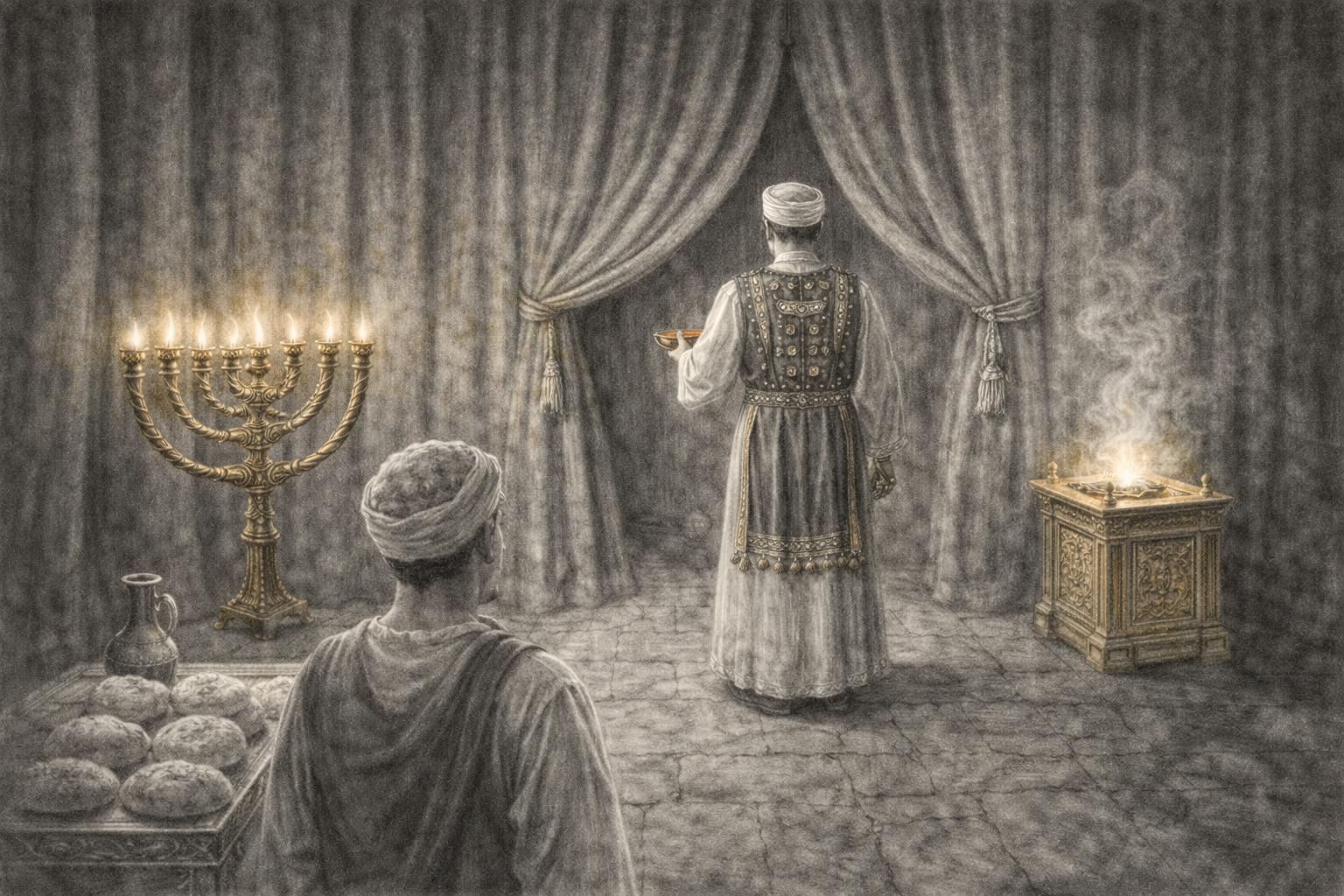
When the tabernacle stood in Israel, it was not only a place of worship—it was also a lesson.
The Holy Spirit was teaching something through the very structure of the building.
The veil separating the Holy Place from the Holy of Holies said something powerful without speaking a word. It said that the way into God’s presence was not yet open.
The high priest could enter—but only once a year.
And only with blood.
And only for a moment.
Everyone else stayed outside.
That limitation was not accidental. It was intentional. The Holy Spirit was using the tabernacle itself as a picture to show that something greater was still coming.
Notice what the writer says: the whole system was “a figure for the time then present.”
In other words, it was a symbol, a teaching model, a living illustration pointing forward to something better.
Here’s the thing.
All the sacrifices, all the rituals, all the ceremonies—they could deal with the external problem of sin, but they could not fully deal with the internal problem of conscience.
An animal could die on an altar. Blood could be sprinkled on the mercy seat. The priest could pronounce forgiveness. But when the worshiper walked away, something inside him still knew the truth.
The conscience was not fully cleansed.
The system could cover sin, but it could not completely erase the inner awareness of guilt. That is why the sacrifices had to be repeated again and again. Every year the same ceremony returned. Every year the same blood was offered.
Because the work was never finished.
Don’t miss this: the priesthood was limited in access and limited in effectiveness.
It was limited in access because only one man—the high priest—could enter the presence of God. And even he could do so only one day each year.
And it was limited in effectiveness because that high priest was himself a sinner.
Before he could offer sacrifices for the people, he had to offer sacrifices for himself.
So the entire system stood as a temporary arrangement. Verse 10 calls it “carnal ordinances… imposed on them until the time of reformation.”
That phrase “time of reformation” means a time when things would be set right—when the temporary structure would give way to the true solution.
Think of the old covenant like scaffolding around a building under construction. The scaffolding serves a purpose while the building is going up. But once the building is finished, the scaffolding is removed.
The tabernacle, the sacrifices, the priesthood—they were scaffolding.
They pointed forward to the day when the veil would be torn, the door would open, and access to God would no longer belong to one man on one day of the year.
It would belong to everyone who comes through Christ.
You need to understand this.
Many people still live spiritually as though the veil were standing. They assume that access to God is distant, restricted, reserved for the specially qualified. They imagine the presence of God as something rare and unreachable.
But the whole message of Hebrews is that the veil is gone.
The way into the Holy of Holies has been opened.
And the door that once stood closed now stands wide open.