
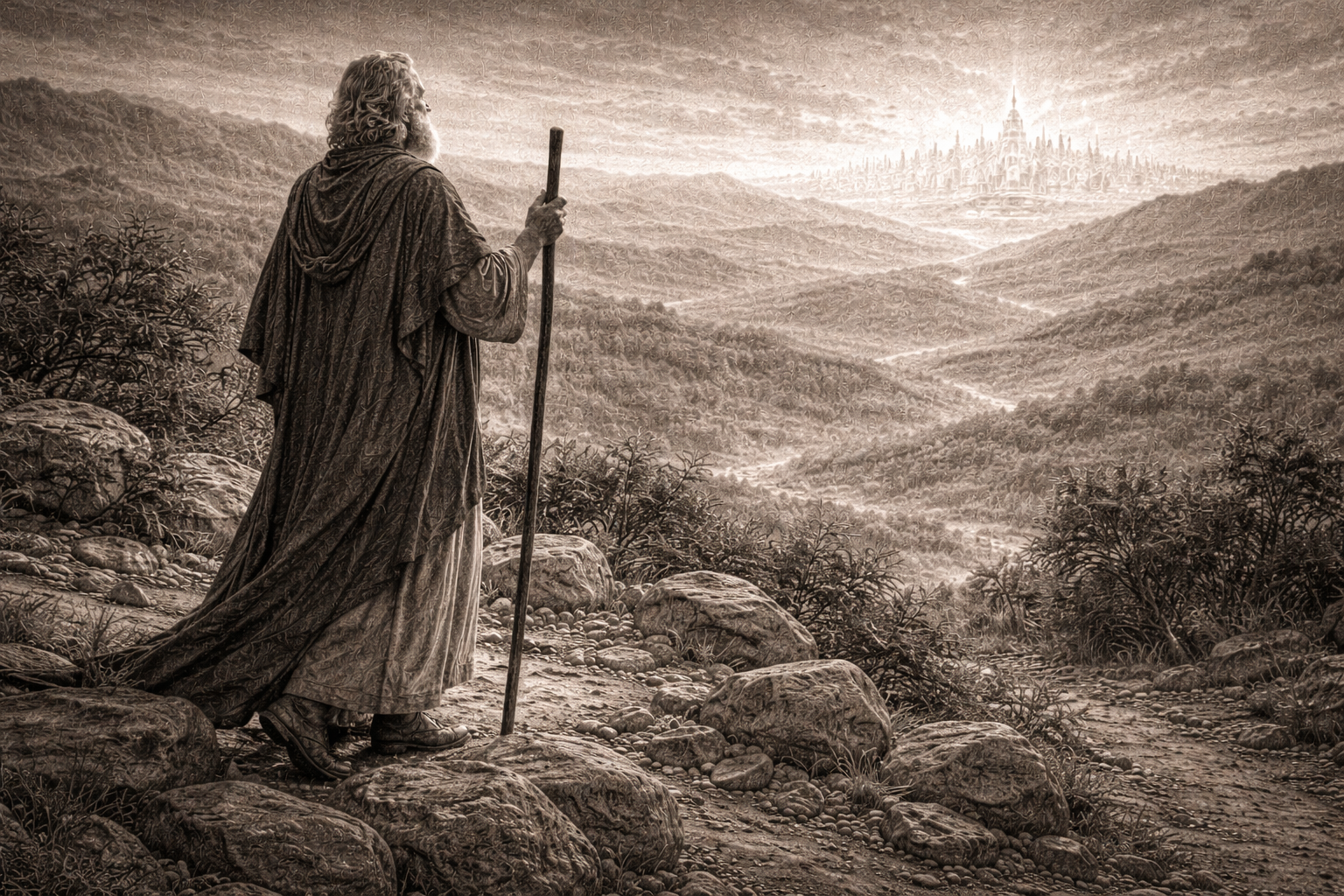
Hebrews 11:14–16
For they that say such things declare plainly that they seek a country. And truly, if they had been mindful of that country from whence they came out, they might have had opportunity to have returned. But now they desire a better country, that is, an heavenly: wherefore God is not ashamed to be called their God: for he hath prepared for them a city.
A man’s direction usually reveals his desire.
That is what these verses are saying. Abraham and the others spoke and lived in such a way that it became plain they were seeking another country. Not just a different patch of ground. Not merely a better neighborhood. Something deeper. Better. Heavenly.
And that mattered, because if Abraham had kept turning his thoughts back toward Ur, sooner or later his feet might have followed. If his heart had stayed tangled up in what he left behind, he would always have had an excuse to return. The road backward is usually built first in the mind before it is ever walked in the body.
Think about that. A man trying to drive forward while staring in the rearview mirror is going to drift all over the road. He will not make steady progress because his attention is fixed on what is behind him. In the same way, a believer who keeps romanticizing the old country will always be vulnerable to turning back. Not because the old country was truly better, but because memory has a way of airbrushing bondage and making it look familiar and warm.
But Abraham wanted something better.
That is the turning point. He was not just leaving one place. He was reaching for another. His life was not driven merely by dissatisfaction with Ur, but by desire for a better country. Heaven had begun to pull on him more strongly than the past. And when that happens, going back starts to lose its shine.
Here’s the thing. A lot of people struggle because they are trying not to return, but they have not yet learned to deeply desire what is ahead. They spend all their energy saying no to the past, while their hearts are still half in love with it. But Scripture shows a stronger way. The cure for longing after the old country is not simply gritting your teeth. It is seeing something better.
That is why these verses are so rich. They do not merely say the faithful refused the old country. They say they desired a better country, that is, an heavenly. Once heaven gets into a man’s bones, earth starts losing some of its power to seduce him. The old life still calls, old memories still whisper, old comforts still try to tug at him, but they no longer define him.
And then comes one of the most beautiful lines in the passage: “wherefore God is not ashamed to be called their God.”
I like that. Not ashamed. The God of heaven gladly identifies Himself with pilgrims who want Him more than the old country. He is not embarrassed by those who live looking ahead. He is not distant from those who ache for what He has promised. He is pleased to be called their God.
And why? For he hath prepared for them a city.
Not a mirage. Not a metaphor only. A city. Something real. Something prepared. Something waiting. They were not foolish for living like pilgrims. They were sane. They were responding to reality more deeply than the people who tried to make Ur into paradise.
So maybe that is the word here. Stop rehearsing Ur. Stop dressing up the past like it was life. Stop letting your imagination build a shrine to what God called you out of. Set your heart on the better country. Desire what is ahead. Let heaven pull harder than memory.
Because when a man longs for the better country, he does not have to be chained to the old one.