
Jude 7-10
Even as Sodom and Gomorrha, and the cities about them in like manner, giving themselves over to fornication, and going after strange flesh, are set forth for an example, suffering the vengeance of eternal fire. Likewise also these filthy dreamers defile the flesh, despise dominion, and speak evil of dignities. Yet Michael the archangel, when contending with the devil he disputed about the body of Moses, durst not bring against him a railing accusation, but said, The Lord rebuke thee. But these speak evil of those things which they know not: but what they know naturally, as brute beasts, in those things they corrupt themselves.
Jude now brings in a third example, and it is just as searching as the first two. Not only can people be delivered by God and still fail to keep themselves in His love, as Israel did. Not only can worshipers stand near holy things and still fall through pride, as the angels did. Jude now says that people can receive blessing from God and still turn away from Him, as happened in Sodom and Gomorrah.
That is a heavy word.
Because at one time, Sodom and Gomorrah were places of extraordinary blessing. In the world of that day, if you were a man with flocks, herds, and dreams of prosperity, that plain was the place to be. Genesis 13 says that when Abraham and Lot had to separate, Lot looked out and saw the plain of Jordan, well watered everywhere. It was fertile. Productive. Desirable. It looked like a place where a man could build, prosper, and do very well.
So Lot chose it.
That means Sodom and Gomorrah were not barren wastelands from the start. They were blessed places. Favored places. Fruitful places. And yet those very cities turned their backs on the Lord and sank into such corruption that they became a permanent warning.
That is Jude’s point.
A man can be delivered and still drift.
A man can worship and still rebel.
A man can be blessed and still collapse morally.
That is why this little letter is so sobering. It strips away every false confidence. Someone might say, “But I was brought out of Egypt.” Israel was too. Someone else might say, “But I stood among the worshipers.” So did angels who fell. Someone else might say, “But God has blessed my life.” Sodom and Gomorrah had blessing too. None of those things, by themselves, guarantee that a person is keeping himself in the love of God.
Do not miss that.
It is possible to experience deliverance by God, partake in worship to God, receive blessing from God, and still not remain in the place where His love is enjoyed.
Then Jude moves from the three examples to three explanations.
First, he says these men defile the flesh. That is the moral explanation. They do not merely stumble in weakness. They give themselves over to corruption. They treat the body as though it were made for indulgence instead of holiness. Like Sodom, they surrender themselves to impurity, and in so doing they step away from the life God intended for them.
Second, he says they despise dominion. That is the authority issue. They do not want rule over them. They do not want order, restraint, or submission. Their problem is not merely sensual. It is spiritual. At heart they are saying, “No one will tell me what to do.” That is always dangerous, because rebellion rarely begins in the body. It begins in the heart that refuses the Lord’s authority.
Third, he says they speak evil of dignities. That is the pride issue in speech. They are reckless with their mouths. They talk arrogantly about things beyond them. They sneer at what they do not understand. They have no reverence, no sobriety, no humility.
And Jude shows just how ugly that is by contrasting them with Michael the archangel. Here is Michael contending with the devil himself over the body of Moses, and even then he does not spit out some proud, railing accusation. He simply says, “The Lord rebuke thee.”
That is remarkable.
If Michael would not speak carelessly in the face of the devil, how much more should mere men guard their tongues?
But these false men do the opposite. They speak boldly about what they do not understand, and in the very things they do understand by instinct, like brute beasts, they corrupt themselves. In other words, they are loud where they should be humble, and they are enslaved where they boast of freedom.
That is still how sin works.
It makes a man proud in speech and base in appetite.
It makes him sound bold while he is actually rotting inside.
So Jude’s warning lands hard. Deliverance is not enough by itself. Worship experiences are not enough by themselves. Even seasons of blessing are not enough by themselves. The question is whether I am keeping myself in the love of God. Am I staying in the place of trust, humility, submission, and holiness? Or am I drifting into the same old pattern of flesh, rebellion, and proud speech?
Jude is not writing this to make the saints panic. He is writing to make them pay attention. These examples are flares in the night. They are meant to say, “Do not drift. Do not play with sin. Do not confuse blessing with safety. Stay near the Lord.”
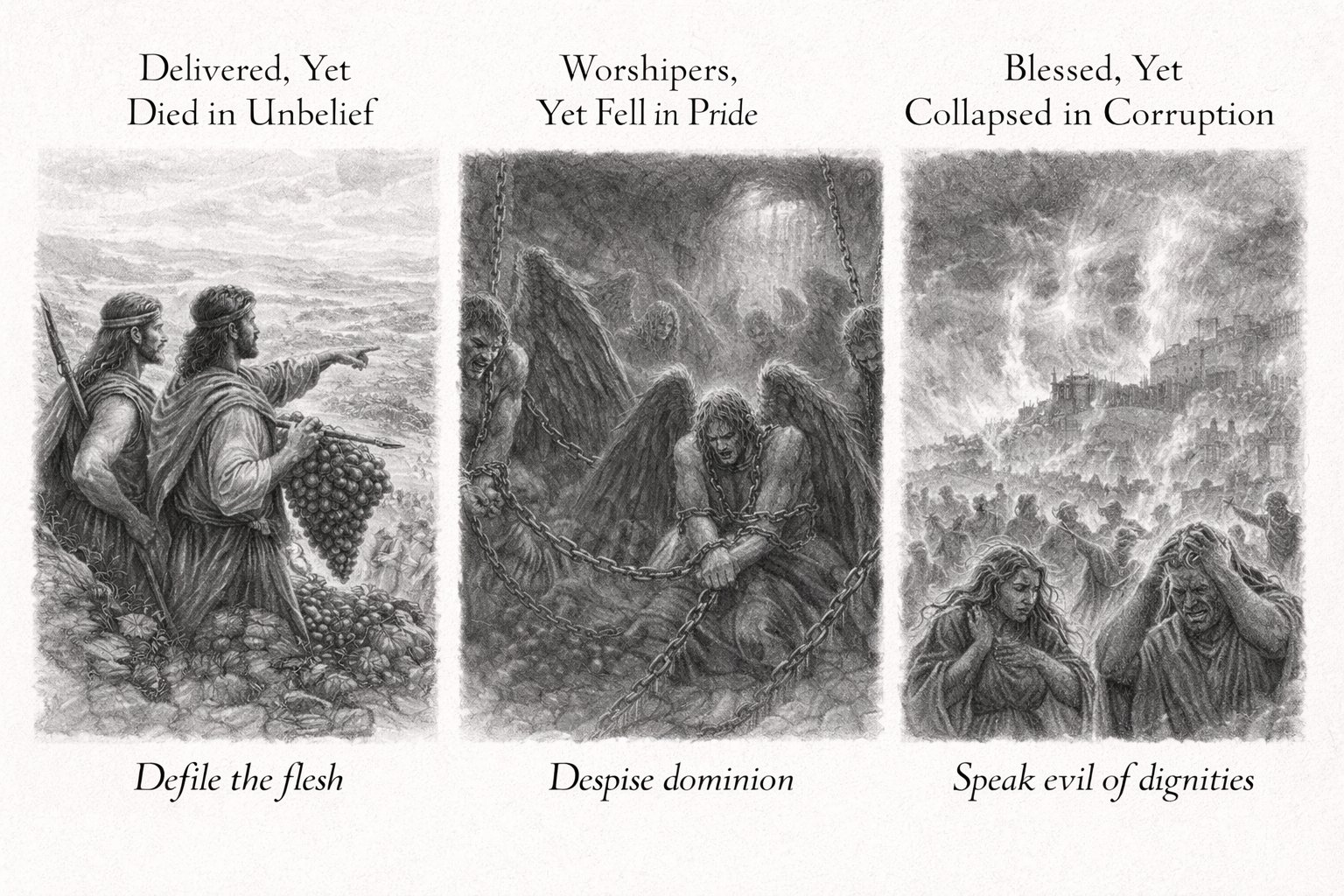
So here are Jude’s three examples together.
Israel was delivered, yet died in unbelief.
Angels were worshipers, yet fell in pride.
Sodom was blessed, yet collapsed in corruption.
And then here are Jude’s three explanations.
They defile the flesh.
They despise dominion.
They speak evil of dignities.
That is how people move away from the place where the blessings come out.
So keep yourself in the love of God. Stay low. Stay clean. Stay yielded. Stay careful with your mouth. The safest place in the world is still the surrendered place.