
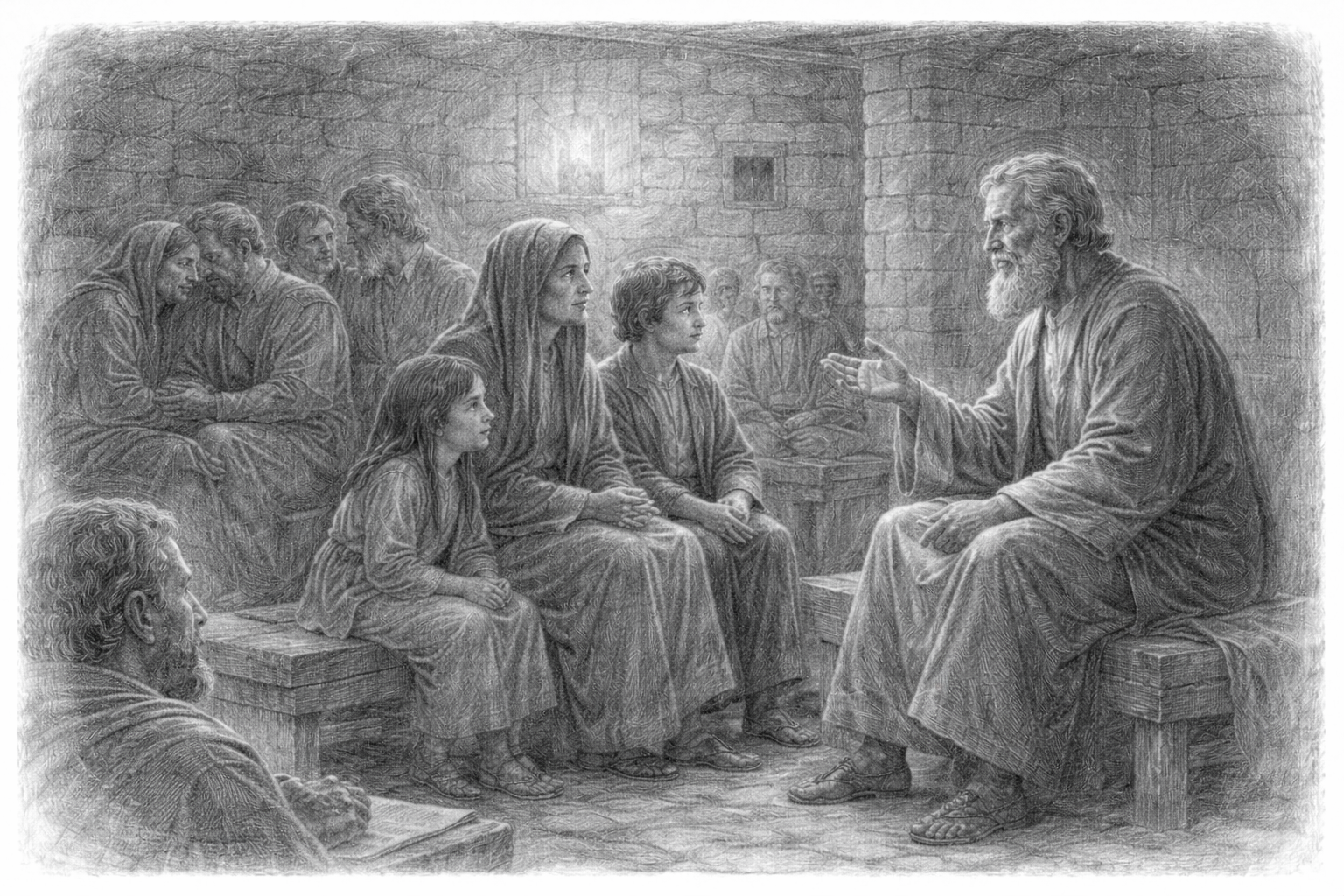
2 John 1:1-3
The elder unto the elect lady and her children, whom I love in the truth; and not I only, but also all they that have known the truth;
For the truth’s sake, which dwelleth in us, and shall be with us for ever.
Grace be with you, mercy, and peace, from God the Father, and from the Lord Jesus Christ, the Son of the Father, in truth and love.
John calls himself the elder. That fits beautifully. By this point he was likely near one hundred years old, the last surviving apostle, an old saint who had walked with Jesus for decade after decade. In the world, a man is considered old when his speed is gone. In the kingdom, a man that age may be just getting deeper.
That is one of the lovely things about ministry. There is no age when a believer becomes unusable to God. In fact, the longer a man walks with the Lord, the richer and steadier he can become. Gray hair is not a liability in the things of God. It can be a crown. Years with Jesus tend to deepen a soul, soften rough edges, and give weight to a life.
Then John writes unto the elect lady and her children. Some take that to mean a real woman and her family. Others believe the elect lady is a local church, chosen by God and loved as the bride of Christ. Either reading works well with the letter. If it was an actual woman, John may have left her unnamed to protect her in a season when believers faced persecution. If it was a church, the tenderness is still there. He is writing to people he loves and wants to guard.
And that really is the tone of the whole letter. John will commend them, command them, caution them, and comfort them. He is not merely being warm. He is shepherding.
What rises to the surface immediately is the way John joins truth and love. He is called the apostle of love, and rightly so. Few writers speak more warmly about love than John. But he also refuses to let love drift into sentimentality. He ties it firmly to truth. He loves them in the truth. Others love them too because they have known the truth. The truth dwells in them. Grace, mercy, and peace come in truth and love.
That is not a small detail.
Love without truth gets mushy. It smiles at things that are hurting people. It becomes afraid of honesty. It confuses niceness with faithfulness. But truth without love becomes hard and cutting. It may win the argument and still wound the person. John will allow neither. He keeps both together because both are essential.
That is a needed word in our time. We live in a culture where truth is treated like a private preference. What is true for one person may not be true for another. Pilate’s old question still echoes, “What is truth?” in John 18:38. But Jesus did not leave truth floating in the air. He said, “I am the way, the truth, and the life” in John 14:6. Truth is not a trend. Truth is not a feeling. Truth is found in Christ.
That is why love must not become soft in the wrong way. A parent who sees a child heading toward danger and says nothing is not loving. A pastor who watches a church drift into error and keeps quiet is not loving. A husband or wife who refuses honest words just to keep things calm is not loving either. Paul says in Ephesians 4:15 that we are to speak the truth in love. Both matter. Truth keeps love from lying. Love keeps truth from crushing.
John models that balance so well. He loves deeply, but never at the expense of truth. He speaks plainly, but never as though people do not matter. He does not use affection as an excuse to ignore danger, and he does not use doctrine as an excuse to grow cold.
That is where our homes must live too. Marriages cannot survive on warmth alone. Families cannot be built on sentiment alone. Churches cannot stand on feelings alone. Without truth, everything drifts. Without love, everything hardens. The Lord calls us to both.
John also says the truth dwelleth in us, and shall be with us for ever. That means truth is not merely correct information stored in the mind. It is living, abiding, present. Truth settles into a person and starts shaping the way he loves, speaks, warns, forgives, and stands.
So this opening greeting is far richer than it first appears. It tells us maturity is possible. It tells us age can be fruitful. It tells us love must stay anchored. It tells us truth must stay warm. And it reminds us that grace, mercy, and peace are found where truth and love are held together in Jesus Christ, the Son of the Father.
Beloved, may we never become so loving that we stop being honest. And may we never become so committed to truth that we stop sounding like Jesus. The elder still speaks wisely. Love in the truth. Stand in the truth. Speak the truth. But do it with a heart full of love.