
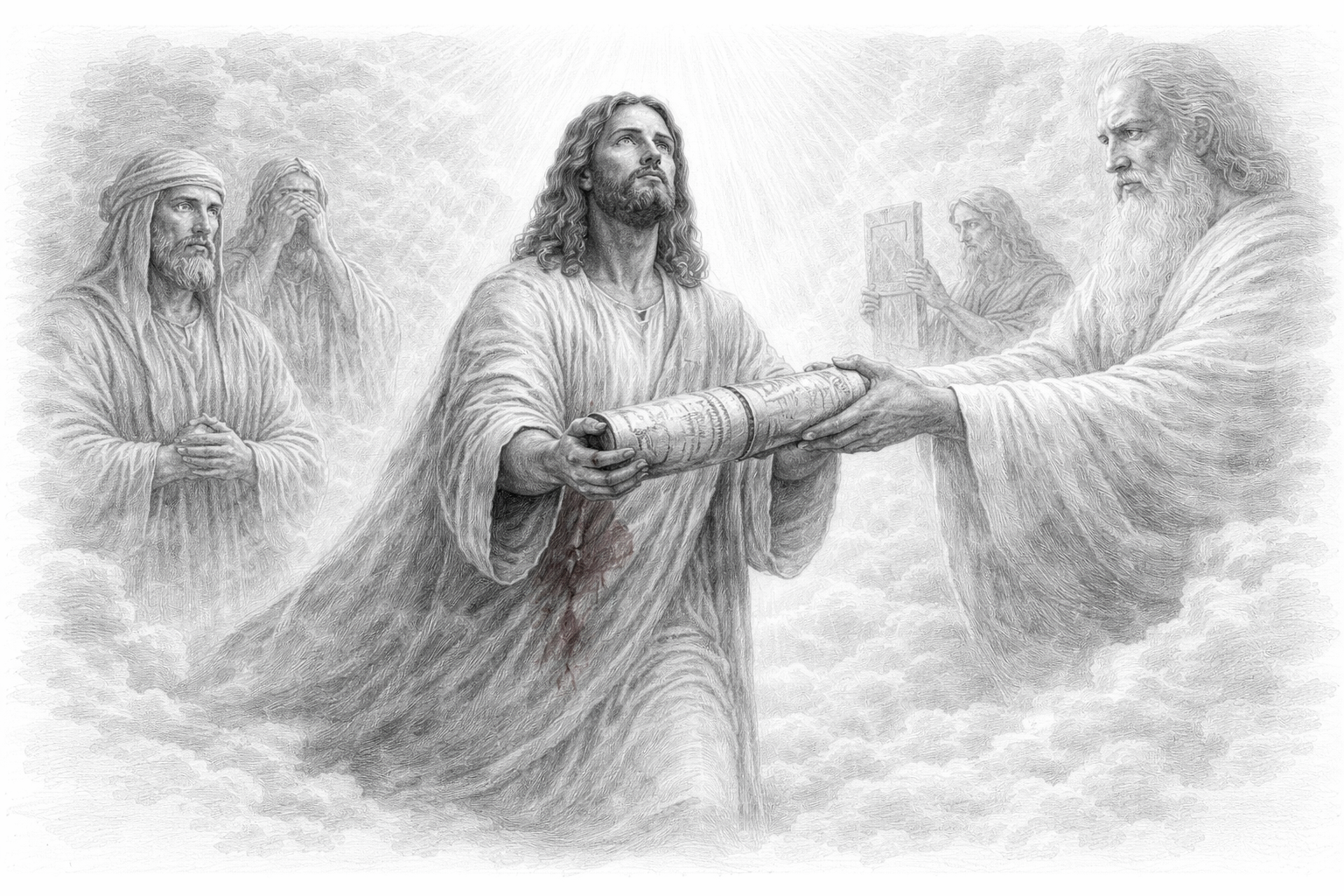
Revelation 5:7
“And he came and took the book out of the right hand of him that sat upon the throne.”
This is one of the great turning points in Scripture. Heaven has gone silent. John has wept. The question has been asked, and no one in heaven or earth has been found worthy. Then Jesus steps forward and takes the scroll from the right hand of Him who sits upon the throne.
That act says everything.
It tells us that the One who takes the scroll is the One who has the right to redeem what was lost. The earth had been forfeited. Man had gone bankrupt through sin. The inheritance was gone from Adam’s hand. And now the question is no longer whether the loss is real. The question is whether anyone can recover it.
That is where the Book of Ruth helps us so much.
In Ruth, a piece of property had to be redeemed, and there was a kinsman nearer than Boaz. He was first in line. He had the legal proximity. He was closer by claim. But when the matter was put before him, he could not do it. He would not take the cost upon himself. The right was near to him, but the power and willingness to redeem were not in him. So he had to step aside, and Boaz took his place as redeemer.
That is a beautiful picture of the law.
The law was near.
It stood close to man’s need. It addressed sin directly. It dealt with righteousness, justice, obligation, guilt, and consequence. It was not far off. It was right there, speaking clearly.
But it could not redeem.
It could expose sin, but it could not remove it.
It could demand righteousness, but it could not produce it.
It could show the debt, but it could not pay it.
It could tell you what was lost, but it could not bring it back.
That is why the law, though holy and just and good, could never be the savior. It was a mirror, not a redeemer. It could point to the bankruptcy of mankind, but it had no wealth of its own to cover the debt.
Think about that.
The law could say, “This is what you owe.”
The law could say, “This is what holiness requires.”
The law could say, “You have failed.”
The law could say, “The inheritance is gone.”
But the law could never say, “I will pay for it.”
That is where Jesus comes in.
He is our true Boaz.
He became our near Kinsman by taking on flesh. He did not redeem from a distance. He entered the human family. He was born under the law. He stood in our world. He came all the way into our poverty and loss.
And unlike the law, He was not only near. He was able.
He had no debt of His own.
He had no sin of His own.
He was not bankrupt.
He had the means to pay in full.
And unlike the nearer kinsman in Ruth, He was willing. He did not draw back from the cost. He did not protect Himself at our expense. He took the full obligation upon Himself and went to the cross to secure redemption.
That is why Revelation 5 is so powerful. Jesus does not merely admire the scroll. He takes it. He does not merely sympathize with the loss. He claims the right to recover it. He steps forward as the Redeemer the law could never be.
I love that.
Because every one of us knows what it is to stand condemned by the law. The law tells the truth. It tells us we have fallen short. It tells us we are guilty. It tells us we cannot make ourselves righteous. And if all we had was the law, we would weep with John and have no answer.
But the law was never meant to be the final voice.
It was meant to lead us to Christ.
It was meant to bring us to the place where we stop looking to ourselves and start looking to the Redeemer.
Jesus does what the law could never do. He fulfills its demands. He satisfies its justice. He pays the debt it exposed. He recovers what Adam lost. He redeems the inheritance. He takes a bride to Himself.
Boaz redeemed the field and received Ruth.
Jesus redeems the lost inheritance of earth and takes unto Himself His bride, the church.
That is not a side note. That is the story.
So when Revelation 5:7 says, “And he came and took the book,” it is heaven’s declaration that the true Kinsman Redeemer has stepped forward. The nearer kinsman could not do it. The law could not do it. No angel could do it. No man could do it.
But Jesus could.
He was near enough.
He was willing enough.
He was able enough.
And because He took the scroll, the story of this world will not end in forfeiture. It will end in redemption.