
Revelation 8:8
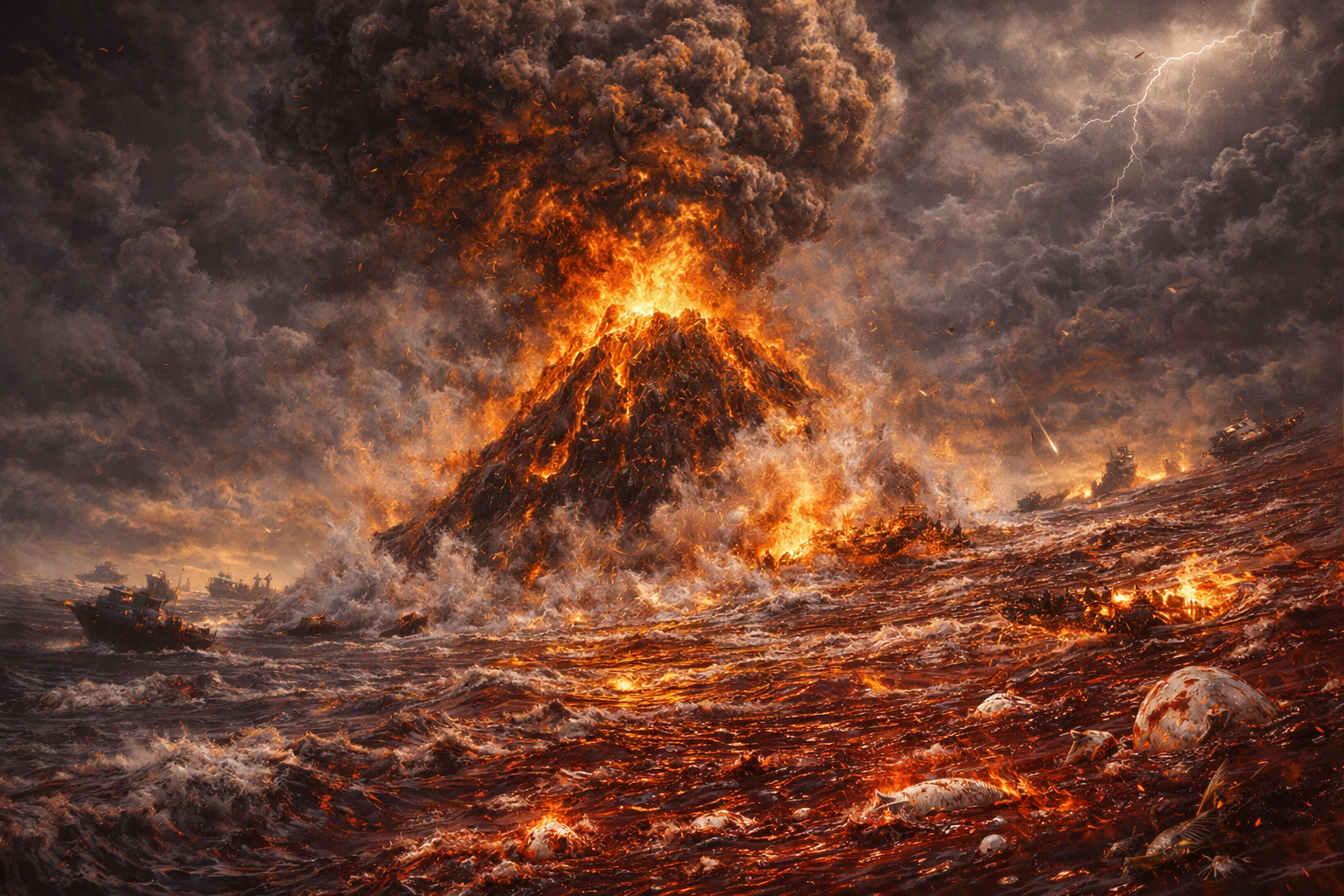
And the second angel sounded, and as it were a great mountain burning with fire was cast into the sea: and the third part of the sea became blood;
And the third part of the creatures which were in the sea, and had life, died; and the third part of the ships were destroyed.
John is careful with his words. He does not say a mountain was thrown into the sea. He says, as it were a great mountain burning with fire was cast into the sea. In other words, what he saw looked like a mountain, but it was something else. That matters. John is reaching for language to describe a sight so immense and so terrifying that the nearest comparison he can find is a blazing mountain crashing into the waters.
That is sobering, because it reminds us that Revelation is not giving us cartoon images. John is trying to put heavenly vision into human words. He sees something massive, fiery, catastrophic, and he says, in effect, “It looked like a mountain on fire.”
Now some have suggested this could point to the kind of devastation we would associate with modern warfare, even something like a nuclear blast with its towering cloud, its fire, and its ecological ruin. I would not say the text must mean that. We should be careful not to force every detail into our own generation. But I also would not dismiss the thought too quickly, because the language is meant to show us destruction on a scale that is hard to imagine. And in our day, for the first time in human history, mankind has the tools to produce exactly that kind of devastation.
Think about what follows. The sea becomes blood. Sea life dies. Ships are destroyed. This is not a private judgment hidden in a corner. It is global in its reach and economic in its consequences. It touches creation, commerce, and human life all at once. The sea, which men have always looked to for trade, food, travel, and wealth, becomes a place of death.
And that is where the passage starts pressing on us. Men boast in their ships. Nations trust in their power. Economies rise on the strength of trade and military might. Yet with one trumpet blast, the Lord can touch the sea, and all that swagger starts sinking. The things men call secure are not secure at all.
Do not miss that. John is writing to believers who were being crushed by Rome, and Rome looked untouchable. Rome had ships. Rome had armies. Rome had commerce. Rome had reach. Rome looked like a mountain itself. But John is shown a greater mountain, one burning with fire, cast into the sea by the hand of heaven. It is the Lord’s way of saying that no empire, no weapon, no fleet, no proud machinery of man stands outside His authority.
Some people read scenes like this and immediately say it must all be symbolic, just figures, just allegory. But the plagues in Egypt were not imaginary. The river truly turned to blood. The hail truly fell. The land truly suffered. Pharaoh did not experience poetry. He experienced judgment. And that ought to make us read Revelation with holy seriousness.
At the same time, this passage is not given merely to make us guess at weapons or headlines. It is given to humble us. It tells us that creation itself can become an instrument of judgment when God speaks. The sea that carries our ships can swallow them. The world we organize so confidently can be shaken in a moment.
Saints, that is why our confidence cannot be in the systems of men. Not in governments. Not in military strength. Not in economies. Not in the illusion of stability. Our refuge is in the Lord alone. When the sea itself turns against man, only the One who made the sea can save.
So Revelation 8 is not just about future terror. It is about present clarity. It reminds us how fragile human greatness really is. It pulls the mask off worldly confidence and says, “Do not trust what can burn. Do not trust what can sink. Do not trust what God can overturn in a single moment.”
And for the believer, there is a strange comfort even here. The same chapter that shows us the trumpet judgments also shows us the prayers of the saints rising before God. Before the earth shakes, heaven listens. Before the sea is struck, the throne is still occupied. Before judgment falls, prayer has already risen.
That steadies me. The world may become more dangerous. Men may build things they were never wise enough to handle. Nations may rage. But none of it moves outside the reach of the throne. John wants persecuted believers to know that. And we need to know it too.
Beloved, if what John saw looked like a burning mountain, then the judgment he describes is no small thing. But neither is the God who rules above it. Therefore do not set your hope in what floats on the sea of this age. Set your hope in the King who rules the sea itself.