
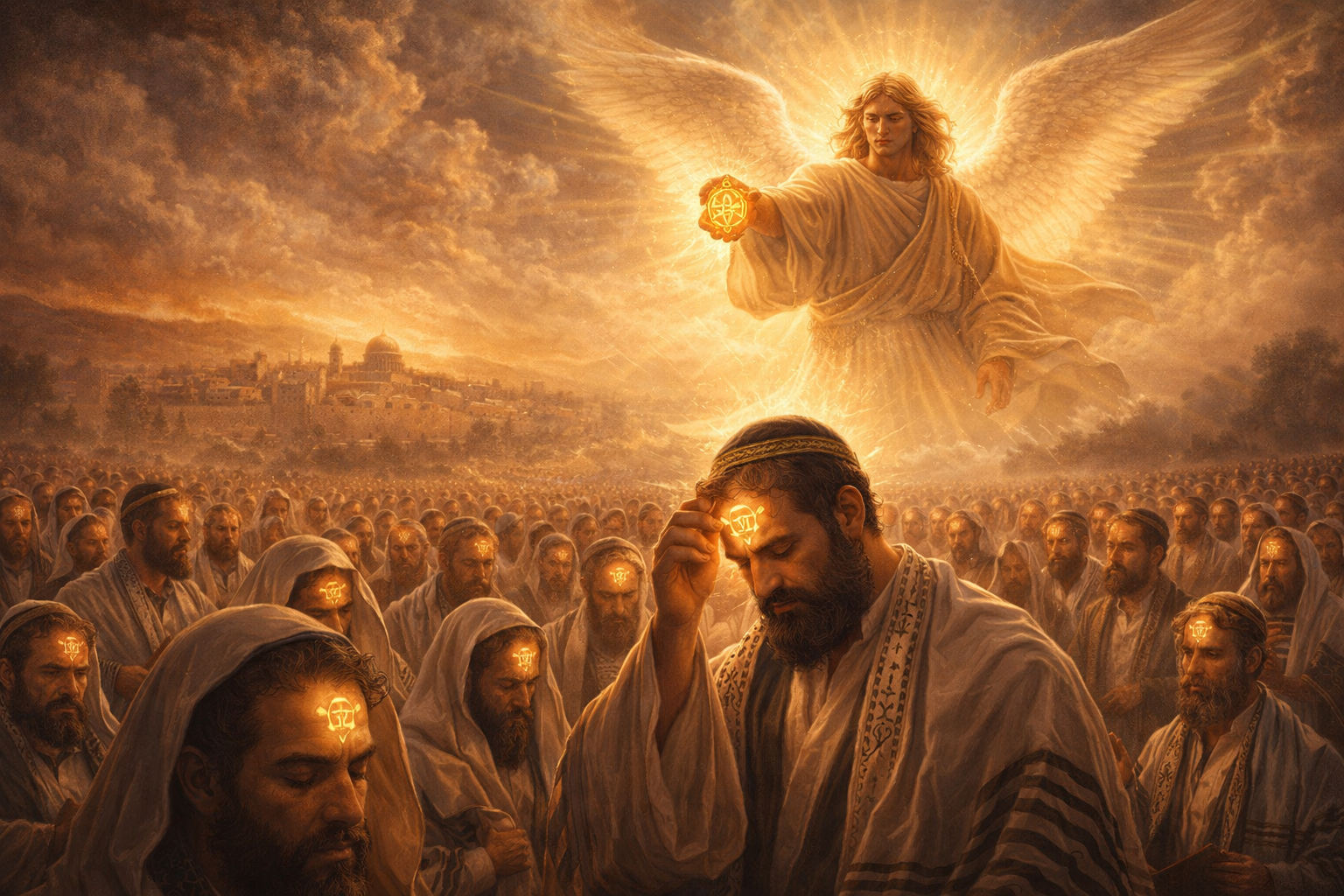
Revelation 7:2-4
And I saw another angel ascending from the east, having the seal of the living God: and he cried with a loud voice to the four angels, to whom it was given to hurt the earth and the sea,
Saying, Hurt not the earth, neither the sea, nor the trees, till we have sealed the servants of our God in their foreheads.
And I heard the number of them which were sealed: and there were sealed an hundred and forty and four thousand of all the tribes of the children of Israel.
What a comfort this scene is.
Judgment is ready to move forward, but before the earth is touched again, heaven pauses. The Lord will not let the winds blow until His servants are marked. Before anything else happens, He seals His own. That tells me once more that even in the Tribulation, nothing is random. God is still ruling. God is still ordering events. God is still watching over those who belong to Him.
The idea of a seal is a beautiful one. In those days, a builder selecting lumber would place his mark in wax on the timber he had chosen before it was shipped across the sea. Then when the shipment arrived, he would take away the wood that bore his seal. I like that picture because it reminds us that Jesus, the Master Carpenter, has chosen what belongs to Him. He has marked His own. He knows exactly what is His, and He will not lose a single piece.
That speaks to us too. Ephesians 4:30 says we are sealed by the Holy Spirit unto the day of redemption. So when we come to Revelation 7 and see these servants being sealed, we are reminded of something precious about the heart of God. He marks what belongs to Him. He claims it as His own. And what He seals, He keeps.
Then John hears the number of those sealed: one hundred forty four thousand from all the tribes of the children of Israel. The text is plain. These are Jews. They are not a vague symbolic company. They are not the church under another name. They are not some later religious movement trying to insert itself into prophecy. They are of the tribes of Israel.
That matters because for a long time people have tried to write Israel out of the prophetic story.
A number of groups have claimed to be the one hundred forty four thousand. Why would they want that identity, especially when the Tribulation is such a terrible time? Because if they can assign that number to themselves, they can push Israel off the page. And that has been the tendency of a lot of teaching through the centuries. The idea keeps coming around in different clothes, but it says the same thing in the end: that God is finished with the Jew, and that all the promises once given to Israel now belong only to the church.
But that simply is not true.
After Constantine came to power and Christianity became the religion of the empire, a shift began to take place. Men who had been saying the kingdoms of this world would fall suddenly found themselves living under a ruler who called himself Christian. So instead of rethinking their politics, they reinterpreted prophecy. Origen began popularizing the idea that the promises to Israel were really allegories. Augustine gave great force to that same approach. And from there, much of the church drifted into reading the Old Testament in a way that took its plain promises away from the Jewish people.
That weakening of the literal sense had a cost. Once you begin saying God did not really mean what He plainly said to Israel, the edge of confidence in Scripture begins to dull. The church loses some of its strength when it stops trusting the simple meaning of God’s promises.
And history only grew darker on that point. Even Martin Luther, used so powerfully in recovering the truth of justification by faith, was terribly wrong in the way he spoke of the Jews. The church has often failed badly here. But the failure of the church does not cancel the faithfulness of God.
God is not through with Israel.
His promises to the Jewish people are rooted in the covenants He made with them. In the Abrahamic Covenant, He promised blessing to Abraham. In the land promise, He gave territory to Israel far beyond what they have ever fully possessed. In the Mosaic Covenant, there was a conditional element tied to obedience under the Law. In the Davidic Covenant, God promised an everlasting King from David’s line, fulfilled in Jesus Christ. In the New Covenant, He promised a new heart and inward renewal.
The point is simple. God made promises to Israel that were grounded in His own purpose and faithfulness. Therefore they cannot be erased simply because Israel stumbled.
And that gets very close to home.
People say, “But Israel failed.”
So have I.
They say, “But Israel was inconsistent.”
So am I.
They say, “But Israel faltered.”
So do we.
That is why Romans 9 through 11 is so important. The Lord says, in effect, “Look at Israel. I have not turned My back on them.” And that becomes a comfort to every believer. Because the God who keeps His ancient promises is the God who will keep us too.
Think about that.
If God could cast off His people permanently because of failure, what hope would any of us have? If His faithfulness lasted only as long as our consistency, none of us would stand. But Revelation 7 reminds us that the Lord still knows His people, still marks His servants, still remembers His covenants, and still carries out His purposes exactly as He said He would.
So this is not just a passage about a number. It is a passage about the character of God.
He seals His own.
He remembers His promises.
He does not abandon His people.
He finishes what He starts.
And in the middle of Tribulation, that truth shines even brighter.
Beloved, the Carpenter has not forgotten His timber. The Lord who marks what is His will gather what is His. He is not through with Israel. And He is not going to stop being faithful now.