
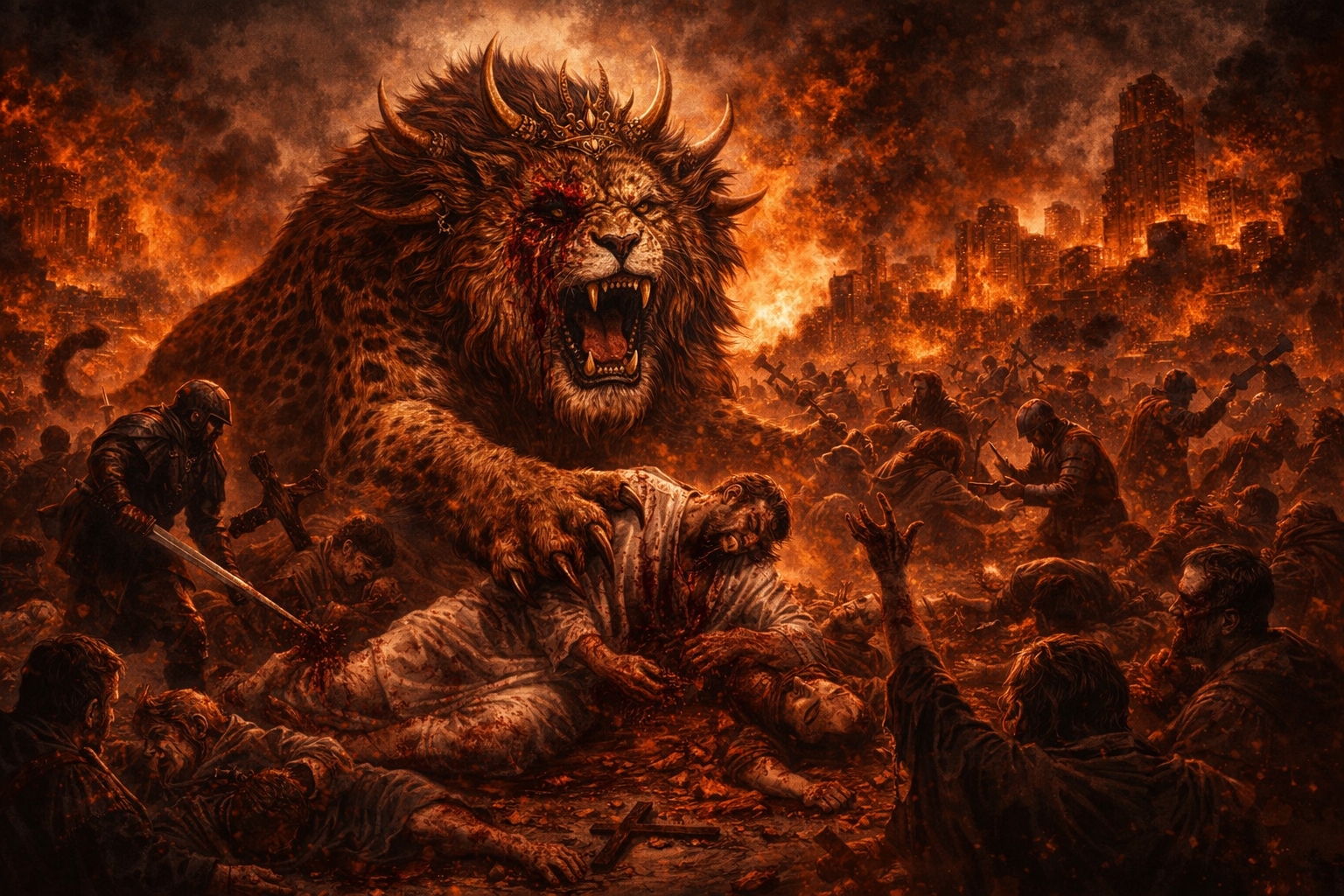
Revelation 13:6-7
And he opened his mouth in blasphemy against God, to blaspheme his name, and his tabernacle, and them that dwell in heaven.
And it was given unto him to make war with the saints, and to overcome them: and power was given him over all kindreds, and tongues, and nations.
The beast is not content just to rule. He must also rage.
He opens his mouth against God, against His name, against His tabernacle, and even against those who dwell in heaven. That is what evil always does when it reaches its full expression. It does not merely ignore God. It spits at Him. It cannot climb to heaven, so it blasphemes heaven instead.
Then John says he makes war with the saints.
This is where some get confused. They read that phrase and conclude the church must still be on earth during the Tribulation. But Scripture uses the word saints more broadly than that. It simply means separated ones. In the Old Testament, saints can refer to God’s people Israel. In the New Testament, the word is used for the church. And here in the Tribulation, it speaks of those who come to faith after the church has been caught up.
That matters, because Jesus already said in Matthew 16:18,
And I say also unto thee, That thou art Peter, and upon this rock I will build my church and the gates of hell shall not prevail against it.
The church is not the company described here as being overcome by the beast. This is not the church losing a war on earth. This is the beast turning his hatred against those who come to the Lord during the Tribulation.
And he overcomes them.
That is a painful phrase, but it needs to be understood correctly. It does not mean he defeats their faith. It does not mean he steals their salvation. It does not mean he wins in the deepest sense. It means he is allowed to overcome them physically. He is allowed to persecute, imprison, and kill. He can touch their bodies, but he cannot touch their standing before God.
Think about that.
The beast may conquer them outwardly, but he cannot conquer them inwardly.
He may silence their voices on earth, but he cannot erase their names in heaven.
He may take their lives for a moment, but he cannot take their Christ.
That is the difference between appearance and reality.
From earth’s point of view, the beast looks unbeatable.
From heaven’s point of view, his victories are paper thin.
This is one reason Revelation keeps pulling back the curtain for us. On the surface, evil looks strong. The beast blasphemes freely. He wages war openly. He overcomes visibly. But the Lord wants His people to know that none of this changes who truly belongs to Him. The saints in the Tribulation will suffer terribly, but they will not be abandoned.
There is a hard comfort in that.
God does not promise they will escape the beast’s rage.
He does promise the beast cannot reach beyond what is permitted.
He does promise that heaven still knows exactly who His people are.
So this is not a verse about Satan finally defeating the people of God. It is a verse about severe persecution in the darkest stretch of human history. The beast will be allowed to go very far, but not far enough to undo redemption. Not far enough to unseat the Lamb. Not far enough to turn saints into lost souls.
He can make war.
He can overcome physically.
But he cannot finally win.
And that is where the strength of this passage lies. The saints of the Tribulation will pay dearly for belonging to Jesus, but belonging to Jesus will still be worth everything.