
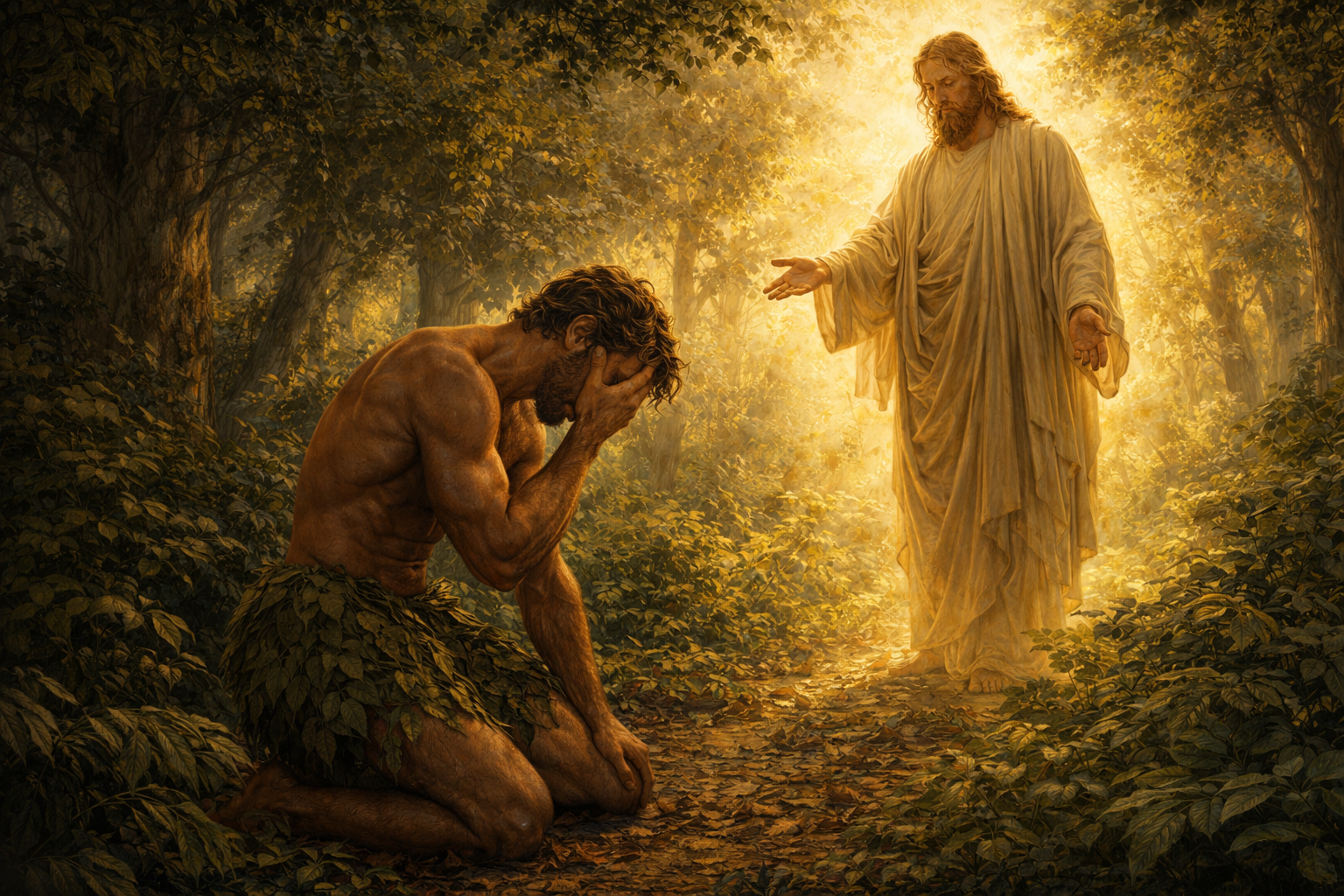
Genesis 3:10-11
“And he said, I heard thy voice in the garden, and I was afraid, because I was naked; and I hid myself. And he said, Who told thee that thou wast naked? Hast thou eaten of the tree, whereof I commanded thee that thou shouldest not eat?”
Now Adam speaks.
And the first thing we hear in his voice is fear.
“I was afraid.” That is what sin does. It turns fellowship into fright. It makes a man who once walked with God now shrink back from Him. Adam hears the same voice, in the same garden, yet everything feels different because sin has entered the story. The problem is not with the Lord’s voice. The problem is with Adam’s heart.
Then Adam says, “I was naked; and I hid myself.” Sin had not only made him guilty. It had made him self conscious. Suddenly he is aware of his shame, aware of his exposure, aware that something is terribly wrong. And that is still the way of sin. It uncovers us, then drives us into the shadows.
But notice how the Lord answers him.
He does not crush Adam with a thunderbolt. He asks questions. “Who told thee that thou wast naked? Hast thou eaten of the tree…?” The Lord already knows precisely what Adam has done. He is not gathering facts. He is drawing out confession.
That is an important difference.
God does not ask because He is uninformed. He asks because Adam needs to come clean. The Lord is leading him to the place where he stops hiding behind leaves, stops speaking around the issue, and admits what has happened. Not for God’s benefit, but for Adam’s freedom.
That is still true for us.
Confession is not God dragging us into embarrassment. Confession is God breaking the power of secrecy. Sin grows best in the dark. It feeds on concealment. It tightens its grip while we excuse it, rename it, soften it, or bury it under religious language. But when we confess it plainly before the Lord, something happens. The grip begins to loosen.
Not because confession purchases forgiveness.
Forgiveness was secured at Calvary. Jesus did not wait for us to clean ourselves up before He went to the Cross. The price was paid there, fully and finally. But confession is the way the heart steps out of hiding and back into the light of what Christ has already accomplished.
A splinter buried in the hand keeps throbbing as long as it stays hidden. The wound may be small, but it keeps hurting until it is exposed and pulled out. Confession is like that. It does not create the cure. It is the means by which the pain is brought into the open so healing can begin to be felt.
And I think that is why these verses are so tender.
The Lord is not humiliating Adam. He is helping him. He is pressing past the surface words to reach the real issue. Adam says, “I was afraid.” The Lord says, in effect, “Let us go deeper than fear. Let us get to the root. What happened? Bring it into the open.”
Saints, the Lord still deals with us that way.
He knows the sin already.
He knows the compromise already.
He knows the conversation, the attitude, the bitterness, the secret, the pride.
Yet He still asks, not to shame us, but to free us.
That is why confession matters so much. It is not a payment made to God. It is a doorway back into fellowship. It is the end of hiding. It is the moment the soul stops clutching fig leaves and starts standing in the mercy of God.