
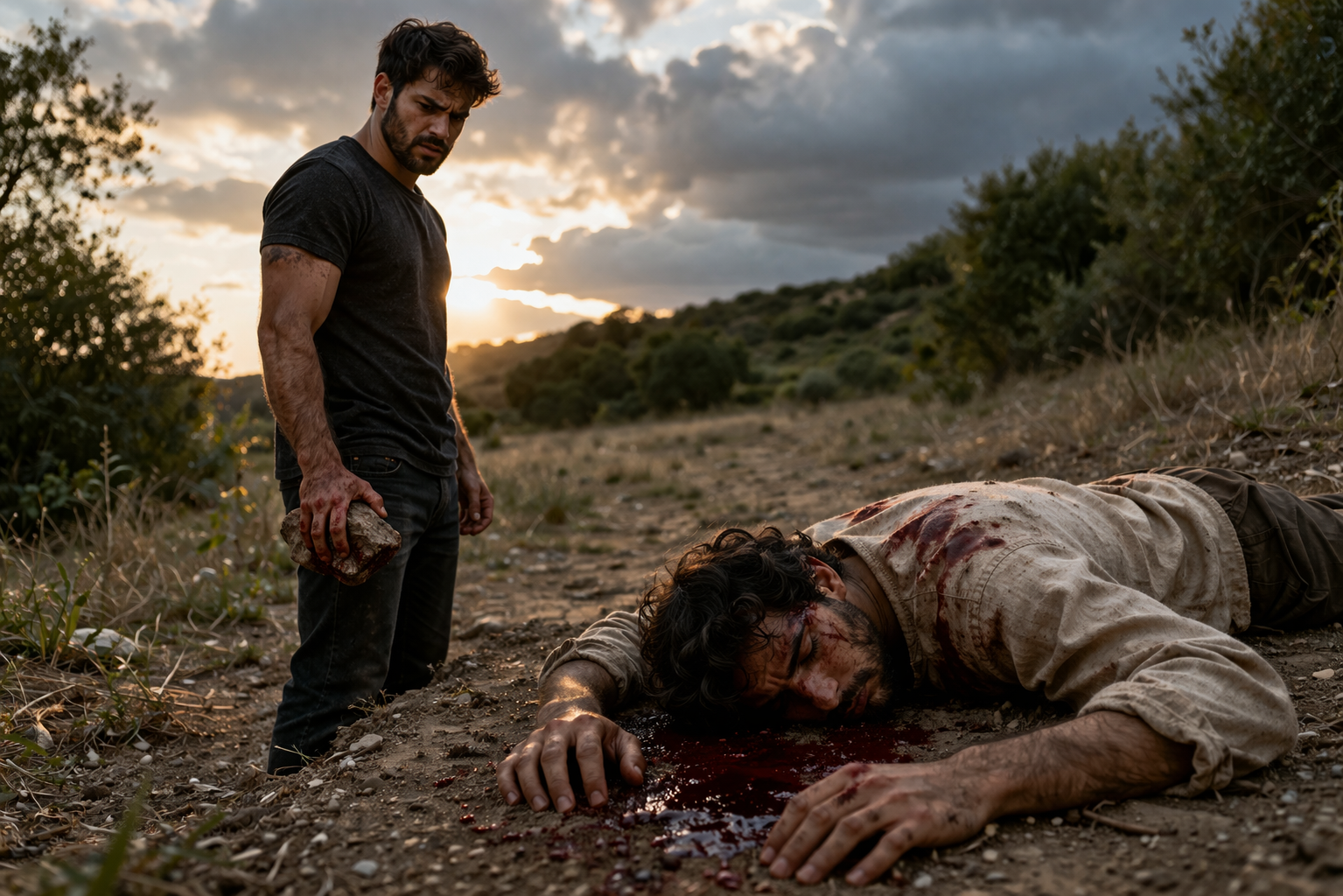
Genesis 4:8-9
And Cain talked with Abel his brother: and it came to pass, when they were in the field, that Cain rose up against Abel his brother, and slew him. And the Lord said unto Cain, Where is Abel thy brother? And he said, I know not: Am I my brother’s keeper?
This is where sin takes bitterness when it is left alone.
It begins in the heart. It smolders in resentment. It feeds on injury. It rehearses the offense again and again until at last the soul grows cold enough to do what once would have seemed unthinkable. Cain did not suddenly become a murderer in the field. The murder in the field was only the final act of what had already been growing in his heart.
That is why his words after the murder are so chilling.
“Am I my brother’s keeper?”
That is not merely a denial. It is the language of a heart that no longer cares. Sin had worked on Cain until he could look at his brother’s absence and answer God with a shrug. In essence, he says, “Why should I care? He is not my concern.”
That is what sin does.
It hardens a man.
It narrows his world.
It teaches him to justify what should have broken him.
And that spirit is still with us. We may never lift a hand as Cain did, but the same poison shows up whenever we say in our hearts, “I do not care about him. He hurt me. I do not care about her. She offended me. I do not care about them. They wronged me.” The way of Cain is not only violence of the hand. It begins with hostility of the soul.
That is why Jude 11 is so sobering. There is a way of Cain. A path. A pattern. A road a man can walk down when bitterness is allowed to stay alive. And if a man keeps feeding that bitterness, it will alter the course of his life just as surely as it altered Cain’s.
That is worth hearing.
When there is someone in my life I would just as soon avoid forever, erase from thought, or see removed from my story, I need to stop and take that seriously before the Lord. Because that is not a small thing. That is not harmless frustration. That is a warning light on the dashboard of the soul.
Cain did not wake up one morning and fall into ruin by accident. He walked there. Step by step. Pride. Anger. Refusal. Brooding. Bitterness. Hatred. Then bloodshed. The field only revealed what the heart had already become.
And the Lord’s question is piercing.
“Where is Abel thy brother?”
God already knew where Abel was. As in Eden, the question was not for information. It was for exposure. It was another chance for Cain to come into the light. Another chance to confess. Another chance to break. But sin had carried him too far for that. Instead of confession, Cain gives defiance. Instead of grief, he gives indifference.
That is the terror of unchecked bitterness. It can make a man lose all tenderness.
Beloved, if there is someone toward whom your spirit has turned hard, do not play with that. Do not baptize it as discernment. Do not excuse it as personality. Do not call it strength. Bring it to the Lord while your heart can still feel His question.
Because the way of Cain always takes more than a man thinks it will.
It steals tenderness.
It steals peace.
It bends the whole direction of a life.
But the opposite is also true. When bitterness is brought into the light, when resentment is confessed, when the soul yields to God, a different path opens. Grace begins to soften what sin was trying to harden. And that is where life starts to turn again.
Saints, Cain’s tragedy is not only that he killed his brother. It is that sin so warped his heart that he no longer seemed to care. That is the warning in this passage. If there is someone you would rather see disappear than be blessed, take heed. That road has a name in Scripture. It is called the way of Cain.