
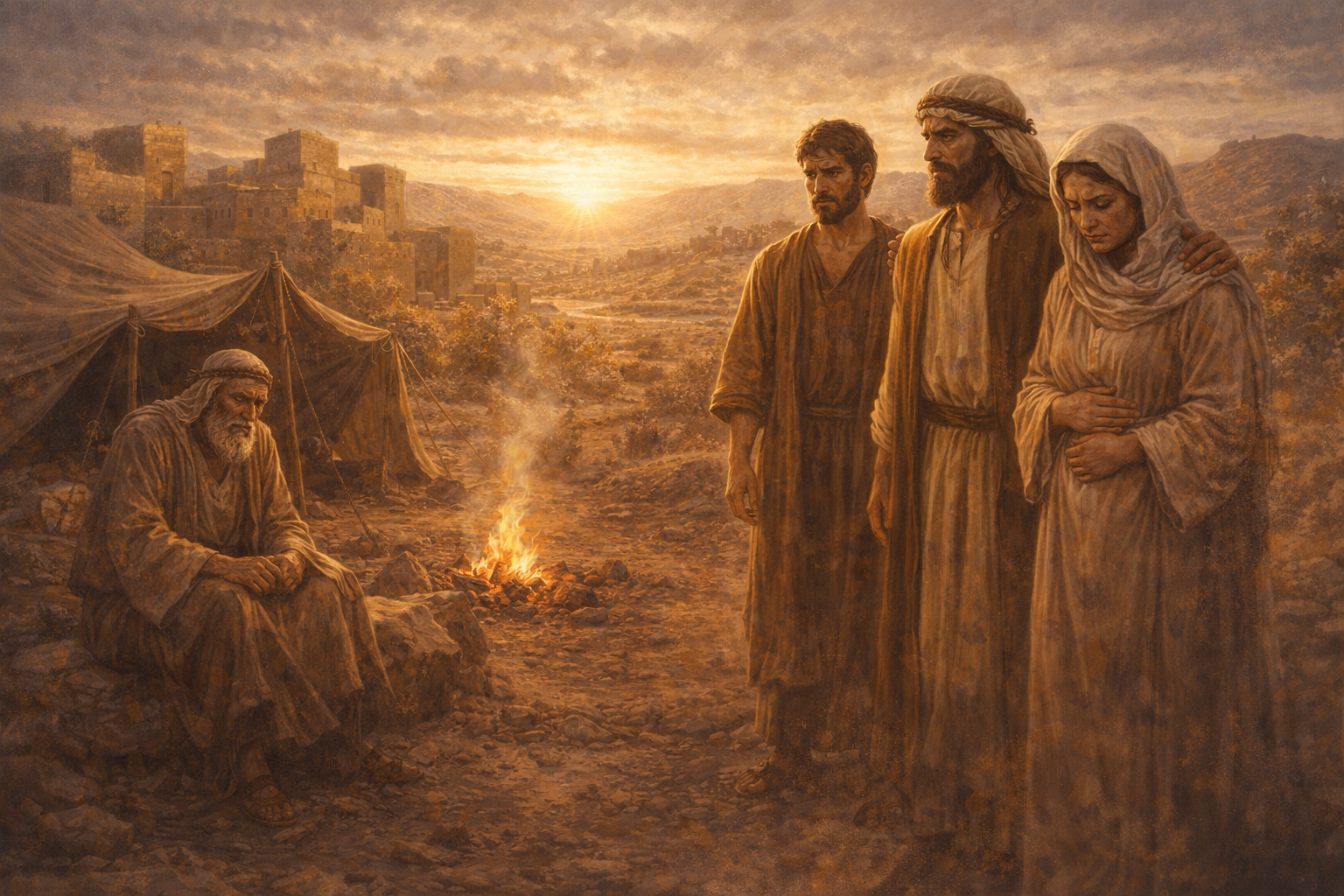
Genesis 11:31-32
And Terah took Abram his son, and Lot the son of Haran his son’s son, and Sarai his daughter in law, his son Abram’s wife; and they went forth with them from Ur of the Chaldees, to go into the land of Canaan;
… and they came unto Haran, and dwelt there. And the days of Terah were two hundred and five years: and Terah died in Haran.
This is one of those passages that says more than it seems to say at first.
They were headed toward Canaan. That was the destination. That was where the story was supposed to go. But they stopped in Haran and settled there. They got partway to the place of promise, but partway is not the same as obedience.
That lands pretty close to home.
Because it is possible to leave Ur and still not reach Canaan. It is possible to make a move in the right direction, yet stop short of what God actually said. Outwardly, it can look respectable. After all, they did leave. They did travel. They did get closer. But the call of God is not fulfilled by getting adjacent to the place of promise. It is fulfilled by going where He said to go.
And here the surprising detail is that Terah took Abram.
As chapter 12 unfolds, it becomes clear that Abram was the one God was calling onward. But here his father is out in front, leading the movement. And that is often how delay enters a life. Not always through open rebellion. Sometimes through misplaced attachments. Sometimes through family ties that become stronger than spiritual obedience. Sometimes through letting someone else set the pace when God has already spoken.
So they came to Haran and dwelt there.
That is the danger word.
Dwelt there.
They did not camp there for a night. They did not pause there briefly. They settled there. Haran became a halfway house between where they came from and where they were called. It was not Ur, but it was not Canaan either. It was in between. And in between can be a very dangerous place when God has already made His direction clear.
There is a lesson there for me.
I may leave behind obvious sin and still stop short of full surrender. I may start moving toward what God has for me and then settle into a safer, more manageable version of obedience. Not back in Ur. Not yet in Canaan. Just somewhere comfortable in between. But delayed obedience is still disobedience, even when it wears the clothes of gradual progress.
And then the text adds that Terah died in Haran.
Only then does Abram move again.
That does not mean Abram did not love his father. Of course he did. Nor does it mean family responsibilities are unimportant. Scripture never teaches that. But it does show that family ties can become weights when they hold us in a place God never meant us to remain. Jesus touched that very nerve when He said, in essence, that following Him must take priority even over the most sacred earthly obligations. That is a hard word, but it is a freeing one too. Because anything that keeps me from wholehearted obedience, even something tender and understandable, becomes a delay.
And that makes this passage feel very current.
How many people are no longer in Ur, but still not in Canaan? They have left the old life in some measure. They have made some changes. They have taken some steps. But they have settled in Haran. Close to promise. Close to calling. Close to where they ought to be. But not there.
That is not where the Lord wants us to live.
He does not call us merely out. He calls us on.
So this little paragraph is more than travel information. It is a warning not to settle halfway. It is a reminder that partial obedience can still cost years. It is a call to let nothing, not even good and natural ties, keep us from following the Lord fully.
Ur was behind them.
Canaan was before them.
Haran was the place of delay.
And for Abram, the story really starts moving again only when the delay is over.