
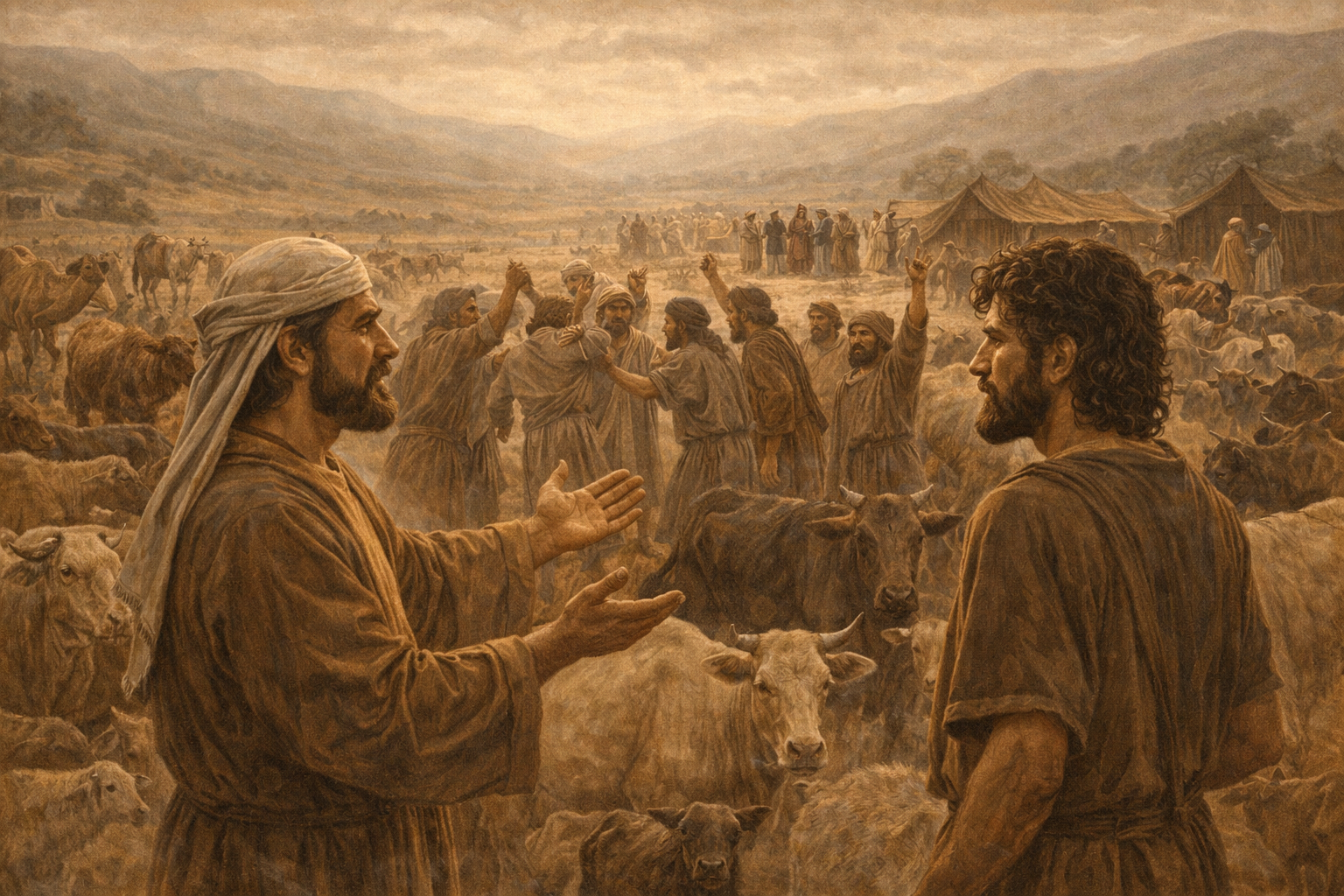
Genesis 13:7-8
And there was a strife between the herdmen of Abram’s cattle and the herdmen of Lot’s cattle: and the Canaanite and the Perizzite dwelled then in the land. And Abram said unto Lot…
… Let there be no strife, I pray thee, between me and thee, and between my herdmen and thy herdmen…
… for we be brethren.
Abram came out of Egypt a wiser man. You can see it here. Before, he was evasive. Before, he was fearful. Before, he was trying to manage things sideways. But now, when strife breaks out, he does not duck it. He goes straight to Lot and deals with it directly.
I like that.
There is strife between the herdmen, and Abram does not pretend it is not there. He does not let it smolder. He does not wait for it to get worse. He addresses it. That takes maturity. That takes humility. That takes wisdom. He understands that a problem left alone rarely gets smaller.
And he also understands something else. The Canaanite and the Perizzite were dwelling then in the land. In other words, the heathen were watching. The people around them could see the conflict. That mattered to Abram. It ought to matter to us too. Christians fight and bicker while the world watches and wonders. It ought not be.
That is still painfully true.
When believers go after each other, when churches split over foolish things, when Christians get petty and proud and sharp with one another, the world sees it. And they do not say, Look at the beauty of Christ. They say, They are no different from anybody else. Abram saw that danger, and he wanted no part of it.
Then notice his deference.
He does not come to Lot with accusations. He does not say, Your herdmen started this. He does not say, This whole thing is your fault. He says, “Let there be no strife, I pray thee, between me and thee, and between my herdmen and thy herdmen.” That is beautiful. He puts himself right into the middle of the responsibility. He does not stand above the problem. He shoulders it.
That is what spiritual people do.
They may be in the right, but they are not obsessed with proving it. They care more about peace than about vindication. Abram assumes the secondary place when it comes to choosing the land, but he assumes the primary place when it comes to carrying responsibility. That is wisdom. That is leadership. That is grace.
And then there is the line that ties it all together.
“For we be brethren.”
Do not miss that.
Abram is saying, Yes, there are complications with the cattle. Yes, the herdmen are at odds. Yes, the situation is real. But there is something deeper here than this present irritation. We are brethren. There is more uniting us than dividing us.
That is discernment.
A carnal man sees only the irritation of the moment. A spiritual man sees the larger relationship. Abram refuses to let a practical conflict erase a deeper bond. And how badly we need that in the church. Because if we all embrace the Person and Work of our Lord Jesus Christ, then there is more that unites us than could ever divide us.
That does not mean differences are not real. It means they are not supreme.
It means Christ is bigger.
It means the Cross is bigger.
It means the family bond is bigger.
So Abram shows us something here. If there is strife, deal with it directly. Do not let it spread. Do not let it simmer. And when you deal with it, do it with deference. Do it without blame dripping from your words. Do it remembering that if this is truly your brother, there is more at stake than winning an argument.
Abram learned something in Egypt. He came back straighter. Softer. Wiser. And one of the clearest signs of that wisdom is right here. He became a man who would rather pursue peace than preserve position.