
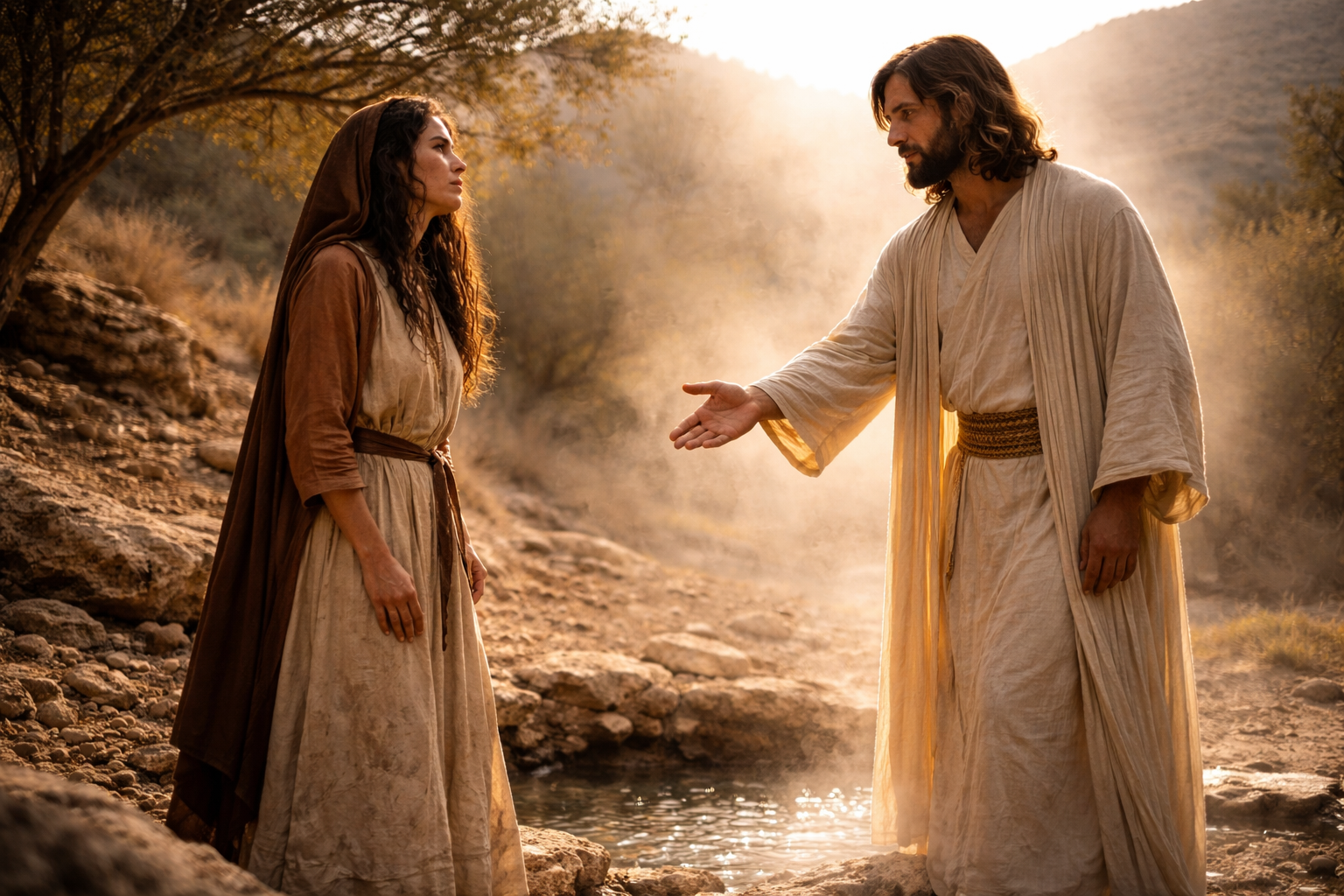
Genesis 16:8-12
And he said, Hagar, Sarai’s maid, whence camest thou? and whither wilt thou go? And she said, I flee from the face of my mistress Sarai. And the angel of the LORD said unto her, Return to thy mistress, and submit thyself under her hands. And the angel of the LORD said unto her, I will multiply thy seed exceedingly, that it shall not be numbered for multitude. And the angel of the LORD said unto her, Behold, thou art with child, and shalt bear a son, and shalt call his name Ishmael; because the LORD hath heard thy affliction. And he will be a wild man; his hand will be against every man, and every man’s hand against him; and he shall dwell in the presence of all his brethren.
The Lord meets Hagar in the wilderness, but He does not merely soothe her feelings. He speaks truth to her. He asks where she came from and where she is going. Hagar knows what she is running from, but she has no real answer about where she is headed. That is often the way it is when people run in pain. They know what they want to escape, but they have no clear idea where their running will take them.
Then the Lord tells her something hard.
He tells her to return.
That matters because the Lord does not heal us by pretending hard realities do not exist. Sarai’s plan may have seemed expedient, but it was not obedient. It may have made sense culturally. It may even have seemed logical. But Abram and Sarai moved ahead without seeking the Lord, and the result was sorrow, tension, and conflict.
That one decision did not stay inside one tent.
It reached much farther than they ever imagined.
And yet even here, mercy shines through. The Lord tells Hagar that she will bear a son, and that his name will be Ishmael, because the Lord had heard her affliction. That is beautiful to me because it means that even in the middle of a mess caused by unbelief, God still hears the cry of the wounded.
And right here, by this well, you can almost feel a shadow stretching forward.
Because one day there would be another woman at another well in John 4. She too would be carrying shame. She too would have a tangled story. She too would meet the Lord in a very personal way. And just like Hagar, she would discover that the Lord sees more than people see, knows more than people know, and still comes near in mercy.
This well in the wilderness becomes an early whisper of that later well in Samaria.
In both places, the Lord comes to a wounded woman.
In both places, He speaks truth, not flattery.
In both places, He shows that He is not repelled by brokenness.
He moves toward it.
That is the heart of our Lord.
He is not helped by our schemes, and He does not excuse our sin. But He is full of mercy toward people caught in the wreckage of it. He meets Hagar in the desert. He meets the Samaritan woman in Samaria. And He still meets hurting people today, not only to comfort them, but to tell them the truth that can save them.