
Genesis 22:1-2
And it came to pass after these things, that God did tempt Abraham, and said unto him, Abraham: and he said, Behold, here I am. And he said, Take now thy son, thine only son Isaac, whom thou lovest, and get thee into the land of Moriah…
… and offer him there for a burnt offering upon one of the mountains which I will tell thee of.
This is one of those passages where the Lord is already painting Calvary on the canvas long before Jesus was born in Bethlehem. The wording is too deliberate to miss. “Take now thy son, thine only son Isaac, whom thou lovest…” Ishmael is not mentioned at all. Why? Because God speaks here in terms of covenant and promise. Hebrews 10:17 says the Lord remembers our sins and iniquities no more. Ishmael was the fruit of Abraham trying to get ahead of God. But when God speaks of the son of promise, He speaks of Isaac alone.
And immediately the parallels begin to unfold.
Isaac is a picture of Christ. Isaac’s birth was miraculous, born to Sarah when her womb was long past the time of hope. Jesus’ birth was even more miraculous, born of a virgin. Isaac’s coming was promised years before he arrived. Jesus’ coming was promised all the way back in Genesis 3:15, thousands of years before Bethlehem. Abraham and Sarah were told what to name their son. Mary and Joseph were told what to name their Son. Isaac would be yielded by his father. Jesus would be given by His Father.
Then there is Moriah. The very name carries the idea of being foreseen by Jehovah. That is powerful, because this was not some random mountain picked off a map. It is as though the Lord is saying, “Abraham, I am going to show you something ahead of time. I am going to give you a preview.” On this same mountain region, the Father would one day give His only begotten Son.
And the parallels do not stop there.
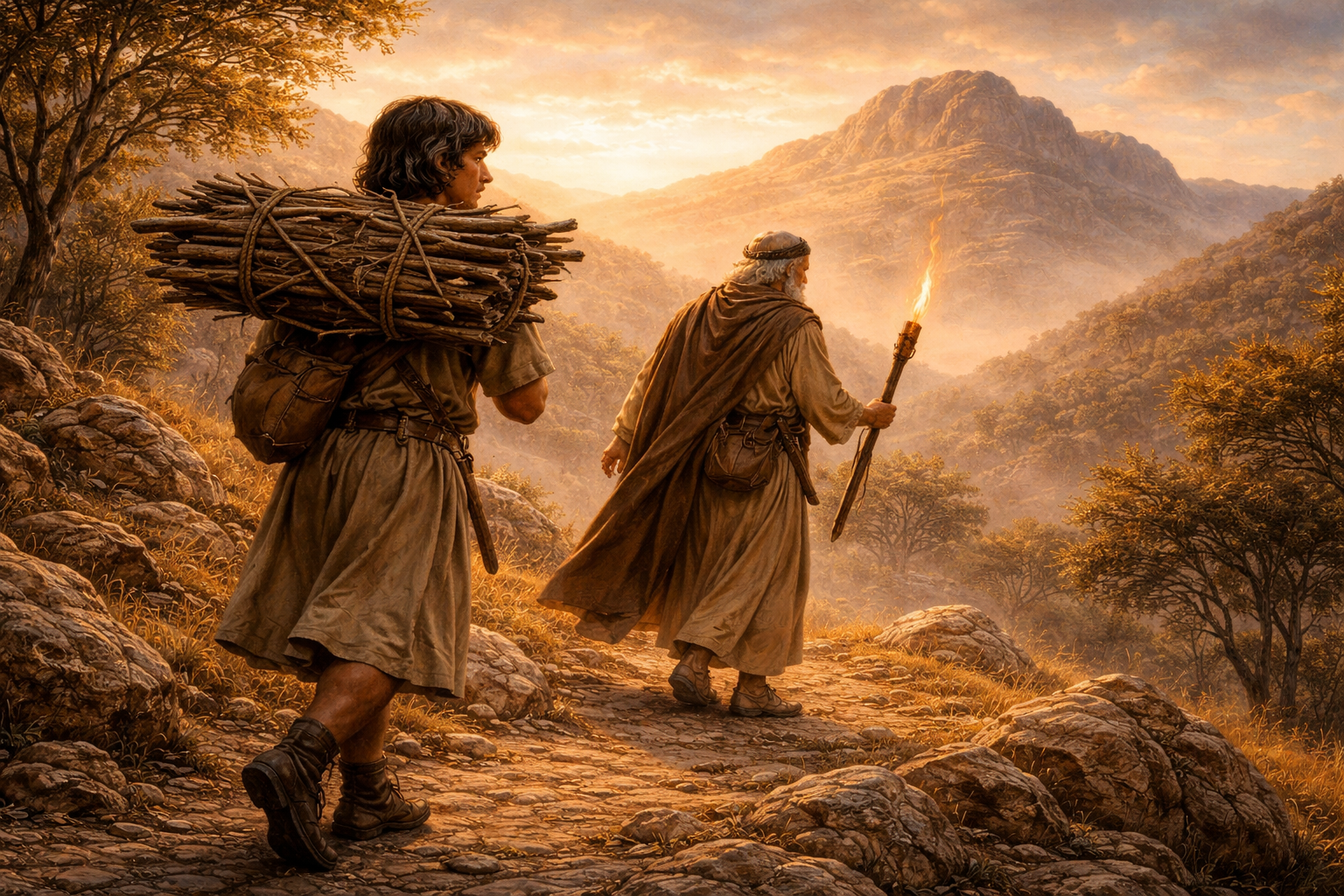
In Genesis 22:6, Isaac will carry the wood up the mountain. That detail is huge. The son of Abraham bears on his back the very wood on which he is to be offered. In the same way, Jesus carried His cross in John 19:17. Isaac is the shadow. Jesus is the fulfillment. Isaac walks up Moriah with the wood of sacrifice laid upon him. Jesus walks toward Calvary carrying the wooden cross on which He would be lifted up.
That makes the picture even richer, because Isaac was not a helpless little boy. He was old enough, and strong enough, to carry the wood. That means he could have resisted. He could have fought his father. But he did not. There is a willing submission here that points straight to Christ. Jesus said in John 10:18, “No man taketh it from me, but I lay it down of myself.” He was not forced to the cross. He went willingly.
Even the word “offer” is full of meaning. It carries the idea of lifting up. Abraham was told to lift up Isaac on Moriah. And in John 12:32-33, Jesus said, “And I, if I be lifted up from the earth, will draw all men unto me.” John tells us plainly He was speaking of His death. So even in the language, the cross is already in view.
What I love here is that Genesis 22 is not only about Abraham’s faith. It is about the Father’s heart. It is about the Son’s willingness. It is about a God who was already preaching the gospel in picture form long before the nails were driven and the tomb was sealed.
So when I read this passage, I do not just see Abraham and Isaac walking toward Moriah. I see the Father and the Son moving toward redemption. I see love. I see surrender. I see sacrifice. I see grace. And I am reminded that the God who foresaw Calvary has never once lost sight of anything in my life either.