
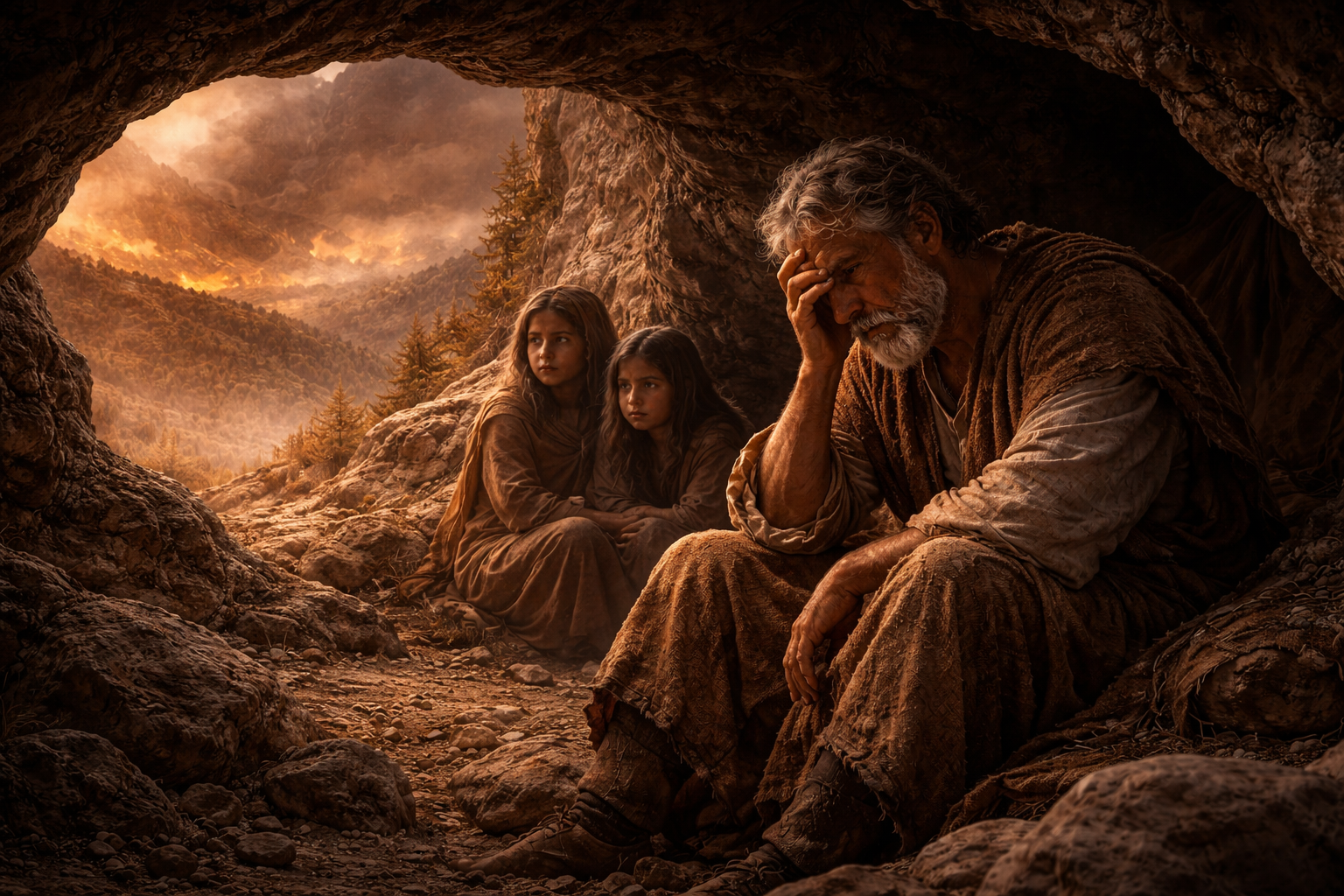
Genesis 19:27-30
And Abraham gat up early in the morning to the place where he stood before the Lord: And he looked toward Sodom and Gomorrah, and toward all the land of the plain, and beheld, and, lo, the smoke of the country went up as the smoke of a furnace. And it came to pass, when God destroyed the cities of the plain, that God remembered Abraham, and sent Lot out of the midst of the overthrow, when he overthrew the cities in the which Lot dwelt. And Lot went up out of Zoar, and dwelt in the mountain, and his two daughters with him; for he feared to dwell in Zoar… and he dwelt in a cave, he and his two daughters.
Abraham rises early and looks out across the plain. Where there had once been life and movement and prosperity, now there is smoke rising like a furnace. The whole thing is gone.
And right there in the middle of that devastation, the text gives us one of the sweetest lines in the chapter. God remembered Abraham, and sent Lot out.
I love that.
Lot was rescued by mercy, yes. But tied to that mercy were the prayers of Abraham. Lot had a praying uncle standing in the gap for him. And when judgment fell, God did not forget those prayers.
That is a comfort to every person carrying somebody on his heart today.
God remembers.
He remembers the tears.
He remembers the pleading.
He remembers the early morning prayers.
He remembers the names whispered before Him again and again.
And then comes the irony.
Lot finally goes to the mountain.
That is where God told him to go in the first place. That is where safety was. That is where he should have gone from the beginning. But now, after all the bargaining, after all the fear, after all the delay, he ends up there anyway.
Only now he is not on the mountain in victory.
He is on the mountain in a cave.
That hits hard.
It is possible to arrive at the right place in the wrong condition. It is possible to end up where God told you to go, but only after so much compromise, fear, loss, and sorrow that instead of standing in freedom, you are hiding in darkness.
That is Lot.
He had seen fire fall. He had watched judgment consume the plain. He had tried Zoar. He had tested his little compromise. And now he realizes the little city is not enough after all. So up to the mountain he goes.
But he goes wounded.
He goes fearful.
He goes diminished.
And he ends up in a cave.
That makes me think of Elijah in 1 Kings 19. After fire from heaven, after a great display of God’s power, Elijah ends up in a cave. The Lord comes to him there and says, “What doest thou here, Elijah?” Elijah is sitting in the dark, convinced he is alone, convinced the story is over, convinced there is nothing left.
The Lord basically says, “You are not seeing clearly. There is still more going on than you know. There is still work to do.”
Lot is in that same kind of place here. He is on the mountain, yes, but not in the joy of obedience. He is there in the shadow of regret. He is there in the cave of fear, of exhaustion, of collapse.
That is what compromise does.
It does not always keep you from eventually getting where God wanted you. But it can make the journey far more painful than it ever had to be. It can leave you sitting in a cave when you could have been standing in the sunlight.
And yet even here, the mercy of God is still in the story.
Lot is alive.
Lot is out.
Lot is on the mountain at last.
That does not erase the wreckage, but it does remind me that even when a man gets there late, even when he gets there broken, the Lord is still not done writing the story.
Still, there is a warning in this passage I do not want to miss.
If God says mountain, go to the mountain.
Do not wait for fire to convince you.
Do not keep bargaining for Zoar.
Do not make the path longer, darker, and sadder than it needs to be.
Because delayed obedience has a way of landing a man in a cave.