
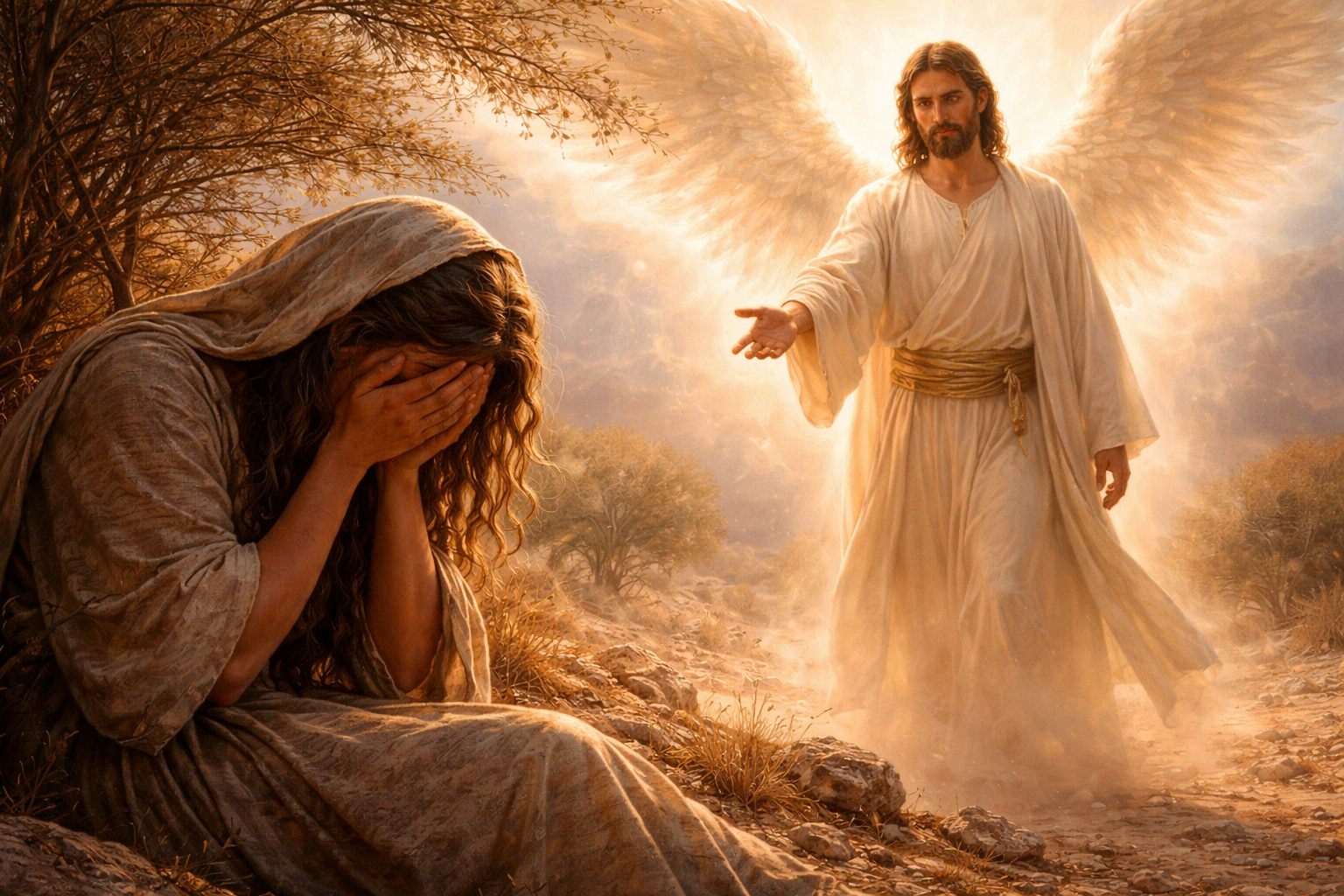
Genesis 21:16, 17
And she went, and sat her down over against him a good way off, as it were a bowshot: for she said, Let me not see the death of the child. And she sat over against him, and lift up her voice, and wept. And God heard the voice of the lad; and the angel of God called to Hagar out of heaven, and said unto her, What aileth thee, Hagar? fear not; for God hath heard the voice of the lad where he is.
This is such a tender scene. Hagar is at the end of herself. She cannot bear to watch Ishmael die, so she moves away a bowshot and weeps. She is overwhelmed, exhausted, and certain the story is over.
But it is not over.
The angel of God calls to her out of heaven. I believe this is Jesus, just as we see the angel of the Lord appearing in other places in the Old Testament. And what He says is so striking: “What aileth thee, Hagar? fear not.” In other words, “Why are you unraveling? Why are you giving way to despair? Have you forgotten what I already said?”
That is the issue, is it not? Hagar is looking at the bottle instead of the promise. She is looking at the shrub instead of the Word. She is looking at the heat, the dust, and the weakness of her son, and in that moment all she can see is death. But the Lord had already spoken concerning Ishmael. He had already said the boy would be blessed. Which means the wilderness could not cancel what God had promised.
That reminds me of the disciples in the storm. Jesus said, “Let us go over unto the other side” in Mark 4:35. He did not say, “Let us go under in the middle.” He had already given them the word that they would arrive. The storm was real, but the promise was more real. Their fear came from forgetting what He had said.
And that is exactly what happens to us.
The Lord gives us His Word, and then the wilderness comes.
The Lord gives us His promise, and then the bottle runs dry.
The Lord speaks peace, and then the storm rises.
And suddenly, what He said feels very far away because what we feel is pressing in so hard.
So the question comes to Hagar, and it comes to us too: “What aileth thee?”
Why are you fearful when He has spoken?
Why are you collapsing when He has promised?
Why are you acting as though the wilderness is greater than His Word?
That is not a harsh rebuke. It is a loving one. It is the kind of question a good Father asks when His child is panicking unnecessarily. He is not mocking her pain. He is calling her back to what is true.
And the same is true for us. What has the Lord already said?
He has said all things work together for good to them that love God, to them who are the called according to his purpose in Romans 8:28.
He has said, “I am with you alway, even unto the end of the world” in Matthew 28:20.
He has said, “I will never leave thee, nor forsake thee” in Hebrews 13:5.
He has said, “If we confess our sins, he is faithful and just to forgive us our sins” in 1 John 1:9.
He has said, “Yea, I have loved thee with an everlasting love” in Jeremiah 31:3.
He has said that we are “more than conquerors through him that loved us” in Romans 8:37.
So what aileth us?
Why do we sit a bowshot away, weeping as though the promise died in the dust?
Why do we let the empty bottle preach louder than the living God?
Why do we stare at the problem until it grows bigger than the One who spoke?
I am not saying pain is fake. Hagar’s pain was real. I am saying panic is not the same thing as faith. And often the Lord, in mercy, comes to us right in the middle of our breaking and says, “Fear not. I have heard. I know where he is. I know where you are. I have not lost track of this.”
I love that last phrase: “where he is.” God had heard the voice of the lad where he was. Not where Hagar wished he was. Not where Abraham left him. Not where he might be tomorrow. Where he was.
That means the Lord meets us in the actual place of need. Right there in the dust. Right there in the fear. Right there in the heat of the wilderness. He does not wait for us to get cleaned up, straightened out, or emotionally composed. He comes to us where we are.
And that is good news.
Because sometimes we are Hagar, sitting down a bowshot away, unable to bear one more look at the situation.
And when that happens, Jesus still speaks.
He still says, “Fear not.”
He still reminds us of what He already promised.
He still meets us where we are.