
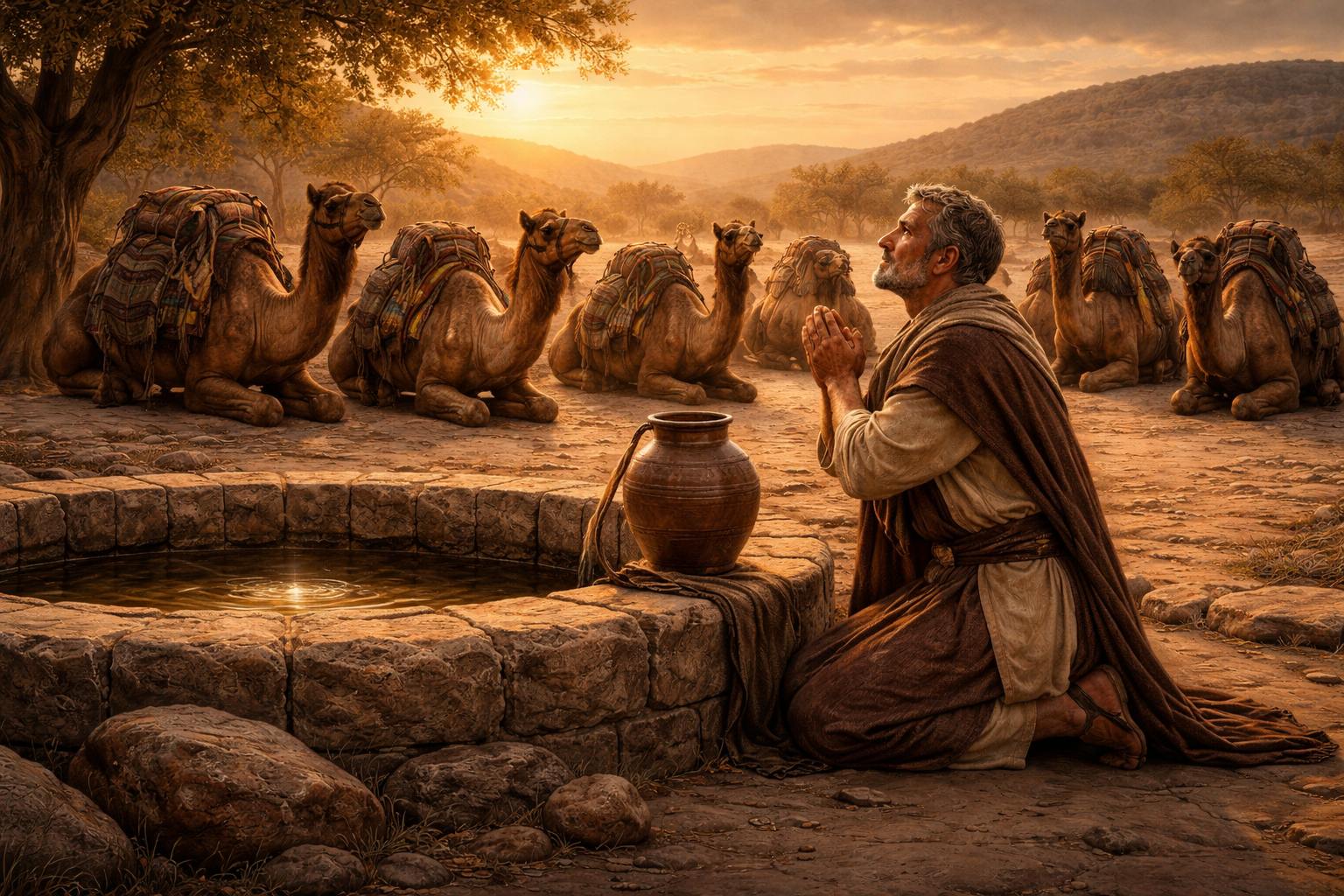
Genesis 24:10-14
And the servant took ten camels of the camels of his master, and departed… for all the goods of his master were in his hand: and he arose, and went to Mesopotamia, unto the city of Nahor. And he made his camels to kneel down without the city by a well of water at the time of the evening, even the time that women go out to draw water. And he said, O Lord God of my master Abraham, I pray thee, send me good speed this day, and shew kindness unto my master Abraham. Behold, I stand here by the well of water; and the daughters of the men of the city come out to draw water: And let it come to pass, that the damsel to whom I shall say, Let down thy pitcher, I pray thee, that I may drink; and she shall say, Drink, and I will give thy camels drink also: let the same be she that thou hast appointed for thy servant Isaac; and thereby shall I know that thou hast shewed kindness unto my master.
Now the story really starts to open up.
The servant sets out with ten camels, and those camels are not just passing details in the background. They matter. They are part of the picture. Quietly, but very clearly, they help show how a person is brought out of a distant place and into the embrace of the bridegroom, into the embrace of grace.
That is what is happening here.
The servant comes carrying the wealth of his master. He arrives in a far country. He brings the camels to the well. He stops at evening, at the very time when the women of the city would come out to draw water. And there, in that ordinary setting, the next great movement in the story begins.
I love the way the Lord does that.
He so often works in common places. A well. An evening hour. A daily chore. A woman coming out with a pitcher in her hand. And yet heaven is at work in all of it. The servant has come for the bride, even though the bride does not yet know it.
That is just like grace.
Before we knew what the Lord was doing, He was already moving toward us. Before we had any clear understanding of the Son, heaven had already set the plan in motion. Before we ever thought we were looking for Him, He was already seeking us.
And before anything else happens, the servant prays.
That stands out to me.
He has the camels. He has the goods of his master. He has the commission from Abraham. He has the authority of the mission. But he still knows none of that is enough by itself. If this is going to happen rightly, the Lord must do it. So he prays. He asks for help. He asks for success. He asks for kindness. He asks the God of Abraham to make the right woman plain.
That is the way the work of God always has to be done.
Not merely with movement.
Not merely with planning.
Not merely with resources.
But with prayer.
And then look at the sign he asks for. He does not ask for something easy. He does not say, “Lord, let the right woman simply smile,” or “let her be friendly,” or “let her say a polite word.” No, the test he lays out is one that will require real labor.
She is not only to offer him a drink.
She is to volunteer to water ten camels.
That is enormous.
This is not some little act of courtesy. This would take a long time. This would mean lowering the pitcher again and again and again. This would mean effort, strength, patience, and a servant’s heart.
And that tells me something very important. The servant is not merely looking for outward charm. He is looking for character. He is looking for kindness. He is looking for a woman whose heart is marked by willingness.
That is beautiful.
Because the Lord always sees deeper than we do. Man looks on the outward appearance, but God looks on the heart. And here the one appointed for Isaac will be revealed, not by a dramatic speech, not by appearance alone, but by humble, costly service.
That preaches.
A lot of people can do what is easy.
A lot of people can do what is visible.
A lot of people can do what gains attention.
But it takes something different to quietly take on hard work with no thought of reward. It takes something deeper to serve that way.
And that is exactly where Rebekah begins to come into view.
There is another part of the picture here that I do not want to miss. The camels kneel down at the well. That strikes me because before the bride is brought to the son, there is first this place of thirst, this place of need, this place where supply must come from somewhere else.
That is how the Lord works in people too.
Before grace becomes sweet, need has to become real.
Before Christ becomes precious, emptiness has to be felt.
Before salvation is understood, there has to be some awareness that what I have in myself is not enough.
That is why the picture matters so much. The servant has come. The camels are kneeling. The well is there. The goods of the master are in his hand. The son is waiting, though unseen. And the appointed bride is about to be brought into the story.
What a picture of grace.
Grace goes into the far country.
Grace meets people in the ordinary.
Grace works before it is recognized.
Grace is directed by heaven.
Grace is moving toward the son.
Beloved, that is our story too. We were far off. We were going about the ordinary business of life. We did not know how much heaven was already at work around us. But the Spirit had come. The call was already moving. The kindness of God was already being set in motion. And in time, grace found us and began bringing us to the Bridegroom.