
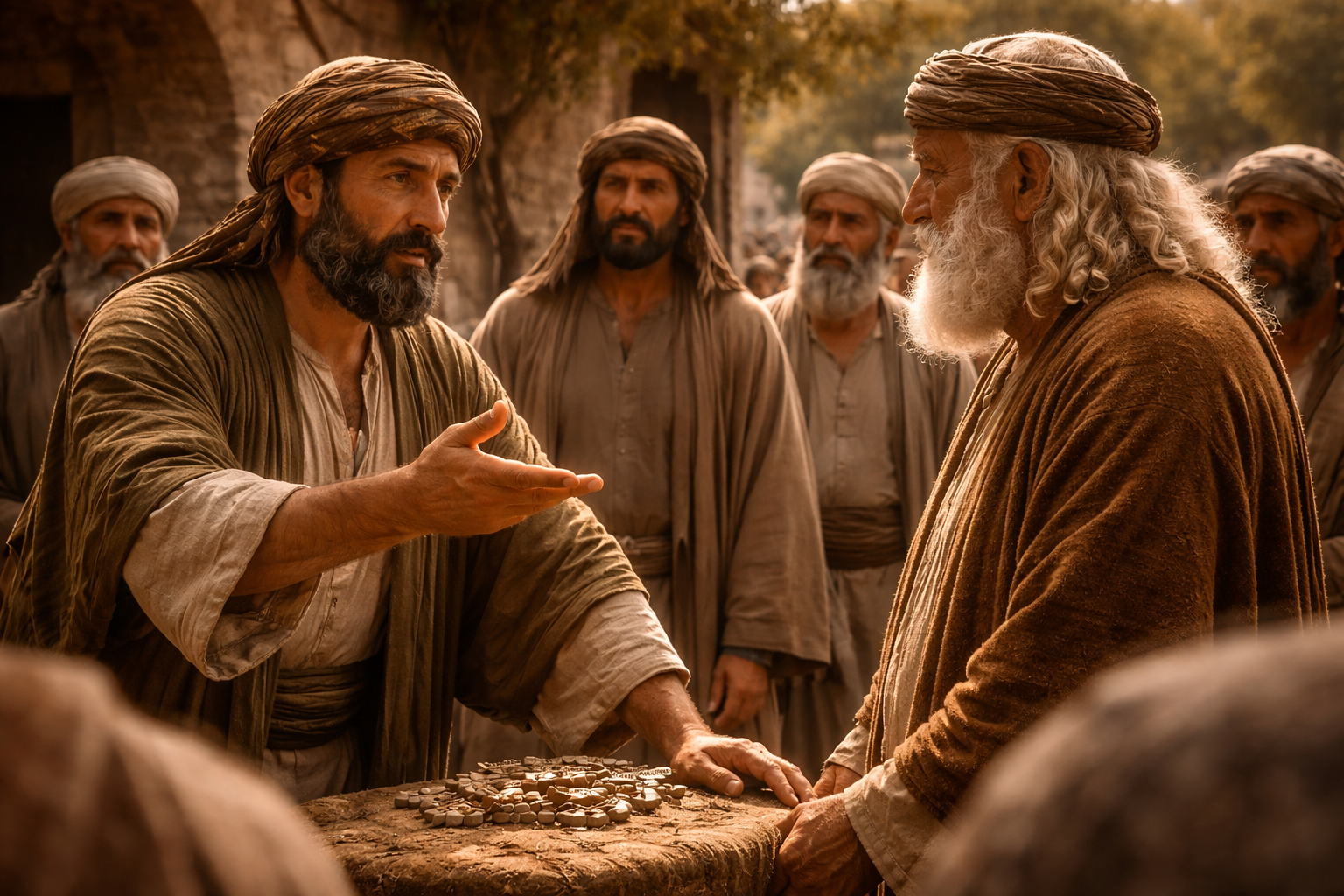
Genesis 23:12-15
And Abraham bowed down himself before the people of the land.
And he spake unto Ephron in the audience of the people of the land, saying, But if thou wilt give it, I pray thee, hear me: I will give thee money for the field; take it of me, and I will bury my dead there.
And Ephron answered Abraham, saying unto him, My lord, hearken unto me: the land is worth four hundred shekels of silver; what is that betwixt me and thee? bury therefore thy dead.
Now the real number comes out.
Ephron has already said, “I give it to thee,” but now we see what that meant. It meant the bargaining had begun. And when he names four hundred shekels of silver, he is not necessarily naming the final fair price. He is naming a high figure to start the negotiation.
That is how this worked.
The words sound smooth, almost generous: “What is that betwixt me and thee?” In other words, “This is such a small matter between friends.” But of course it was not a small matter. This was part of the bargaining process. Historians tell us four hundred shekels was likely not the actual value of the land, but an inflated opening figure. Ephron may have been hoping to settle somewhere much lower.
That fascinates me because it shows how the world often operates. There is a lot of politeness. There is a lot of ceremony. There are a lot of gracious sounding words. But behind the smooth language, everybody knows the real game being played.
Abraham knows it too.
And yet once again, he handles himself with such dignity.
He bows before the people. He speaks respectfully. He does not become rude. He does not get pulled into fleshly wrangling. He does not lose his testimony in the middle of a negotiation. He stays composed, honorable, and clear.
I love that.
Because it reminds me that godliness does not mean naïveté. Abraham is a pilgrim, but he is no fool. He understands what Ephron is doing. He understands the custom. He understands the inflated number. But he refuses to play games in return. He just keeps moving toward what is right.
That says a lot to me.
A lesser man might have started haggling aggressively. Another man might have tried to manipulate the situation. But Abraham is not merely trying to get the best deal possible. He is trying to secure a possession cleanly, honorably, openly. He wants no future dispute. He wants no shadow over Sarah’s grave. He wants the matter settled in a way that no one can question later.
And that is worth remembering. Sometimes paying the full price is about more than money. Sometimes it is about clarity. Sometimes it is about integrity. Sometimes it is about leaving no loose ends behind.
Abraham understood that.
There is also a spiritual lesson here. The world smiles, flatters, gestures broadly, and talks as though everything is easy and free. But in the end, there is always a price tag somewhere. That is the way of men. Their promises are often padded. Their generosity is often mixed with self interest.
But Abraham, the man of faith, moves through that world without becoming like it.
He stays gracious without being gullible.
He stays discerning without becoming cynical.
He stays honorable without becoming weak.
That is a beautiful balance.
Beloved, the people of God ought to have that same kind of steadiness. We should not be ignorant of how the world works, but neither should we adopt its spirit. We can be wise without being hard. We can be clear without being carnal. We can conduct ourselves with integrity even when others are playing angles.
And Abraham does exactly that here. Ephron names the price. The theater of the negotiation is now out in the open. And Abraham, still grieving, still a pilgrim, still a man of God, keeps his footing.