
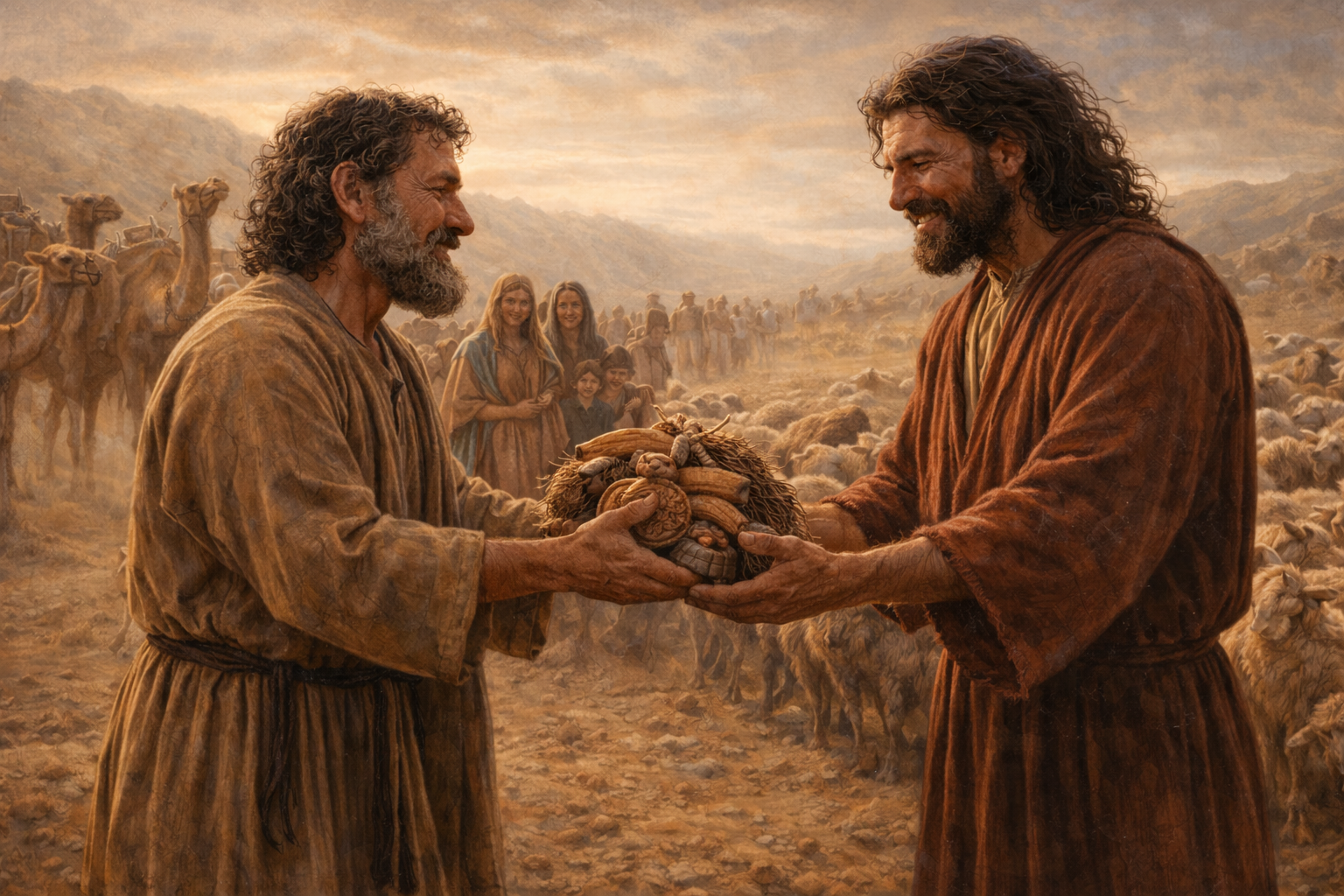
Genesis 33:10-12
And Jacob said, Nay, I pray thee, if now I have found grace in thy sight, then receive my present at my hand: for therefore I have seen thy face, as though I had seen the face of God, and thou wast pleased with me.
Take, I pray thee, my blessing that is brought to thee; because God hath dealt graciously with me, and because I have enough. And he urged him, and he took it.
And he said, Let us take our journey, and let us go, and I will go before thee.
Something shifts here.
At first, Jacob sent gifts ahead to find grace.
Now he gives because grace has already been shown.
That is a completely different posture.
He says, in essence, “Please take this—not so you will accept me, but because you already have.” And then he says something remarkable: “I have seen thy face, as though I had seen the face of God.”
That is not exaggeration. That is recognition.
Jacob had just wrestled with God the night before. And now, standing in front of Esau—the one he feared, the one he wronged—he sees mercy instead of judgment, welcome instead of wrath.
And he says, “This… this feels like God.”
Because it is.
Whenever grace shows up where judgment could have, you are seeing something of the heart of God.
Then Jacob adds, “Because God hath dealt graciously with me, and because I have enough.”
That is new language for Jacob.
This is the man who always needed more. More security. More control. More advantage. More blessing on his terms. But now, after being touched and broken and met by grace, he says, “I have enough.”
Grace does that.
It settles the restless part of you that keeps reaching, grasping, calculating. It quiets the need to keep proving, keep earning, keep accumulating.
“I have enough.”
Not because everything is perfect.
Not because life is easy.
But because God has been gracious.
And when that takes hold, giving changes too.
You no longer give to get.
You give because you already have.
You no longer serve to earn favor.
You serve because favor has been freely given.
You no longer try to secure acceptance.
You live from acceptance.
That is the difference between religion and relationship. One is driven by pressure. The other flows from peace.
Esau, for his part, does not need the gift. But he receives it. And then he says, “Let’s go together. I will go before thee.”
It is an invitation.
Walk with me.
Travel with me.
Let’s move forward side by side.
And that is what grace does. It not only reconciles what was broken, it opens a new path forward.
Not at a distance.
Not in suspicion.
But together.
And maybe that is where this lands.
When you finally understand that God has dealt graciously with you, something settles inside. You stop striving. You start resting. And out of that place, your life begins to move differently.
Not trying to get grace.
Responding to it.