
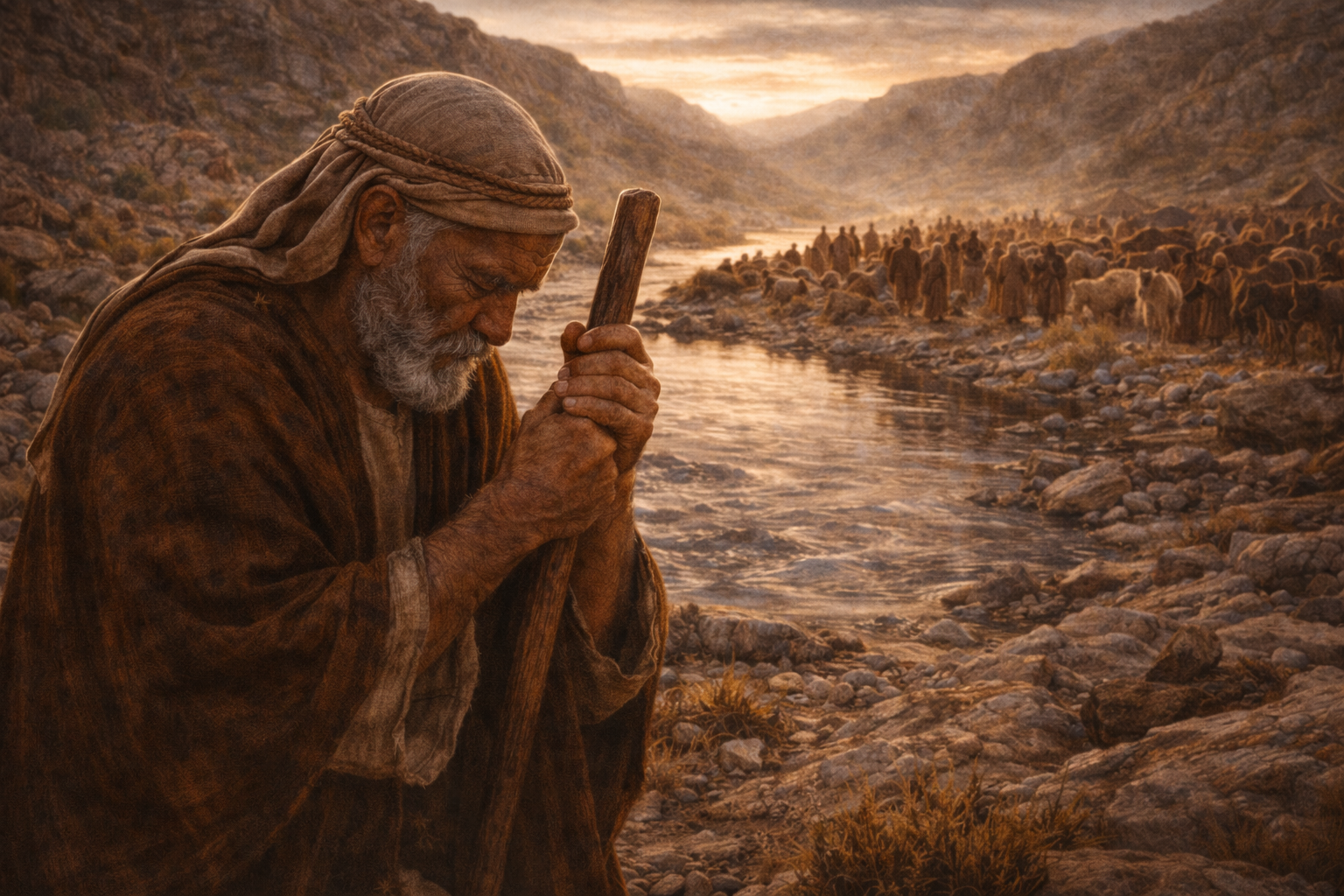
Genesis 32:9-10
And Jacob said, O God of my father Abraham, and God of my father Isaac, the LORD which saidst unto me, Return unto thy country, and to thy kindred, and I will deal well with thee: I am not worthy of the least of all the mercies, and of all the truth, which thou hast shewed unto thy servant; for with my staff I passed over this Jordan; and now I am become two bands.
This is a beautiful turn in the story.
Jacob has already tried diplomacy. He has already reacted in fear. He has already started making plans for survival. And now, at last, he prays.
That is often the order for us too. We try to smooth things out. We panic when the report comes back. We start arranging, calculating, and preparing for the worst. Then finally we do what we should have done first. We pray.
But I am glad this prayer is here, because it shows that even when prayer comes after fear, it still matters. The Lord still receives it.
Jacob begins by reminding himself who God is. He is the God of Abraham. The God of Isaac. The Lord who told Jacob to return and promised to deal well with him. That is important, because real prayer does not begin with our feelings. It begins with God’s character and God’s word.
Jacob is, in effect, saying, “Lord, this road was Your idea. This promise came from You. I am standing on what You said.”
Then his tone changes, and it gets very tender. “I am not worthy of the least of all the mercies.”
Now you are hearing a different Jacob than the one from earlier chapters. This is not the man angling for advantage. This is a man brought low enough to realize that everything he has is mercy.
He looks back and says, “When I crossed this Jordan the first time, all I had was my staff.” That is all. No wealth. No great company. No flocks. No servants. Just a man with a stick, walking into the unknown.
And now look what God has done.
Two bands. Great increase. Full provision. A whole household. A whole story of sustaining grace.
Jacob is finally doing something very healthy here. He is measuring his present fear against God’s past faithfulness.
That helps.
Because when fear takes over, it makes you forget what the Lord has already done. It narrows your vision until all you can see is the problem in front of you. But gratitude opens the window again. It says, “Wait a minute. The God who brought me this far has not failed me yet.”
Jacob is still afraid. Esau is still coming. The tension has not vanished. But now fear is being answered by prayer, and prayer is being shaped by memory.
That is a strong place to be.
Not because Jacob suddenly feels brave, but because he is finally getting honest. Honest about his weakness. Honest about God’s goodness. Honest about the fact that every step of the journey has been mercy.
And that is where prayer gets powerful.
Not when we come in boasting.
Not when we come in pretending.
But when we come saying, “Lord, I am not worthy, but You have been so good to me.”