
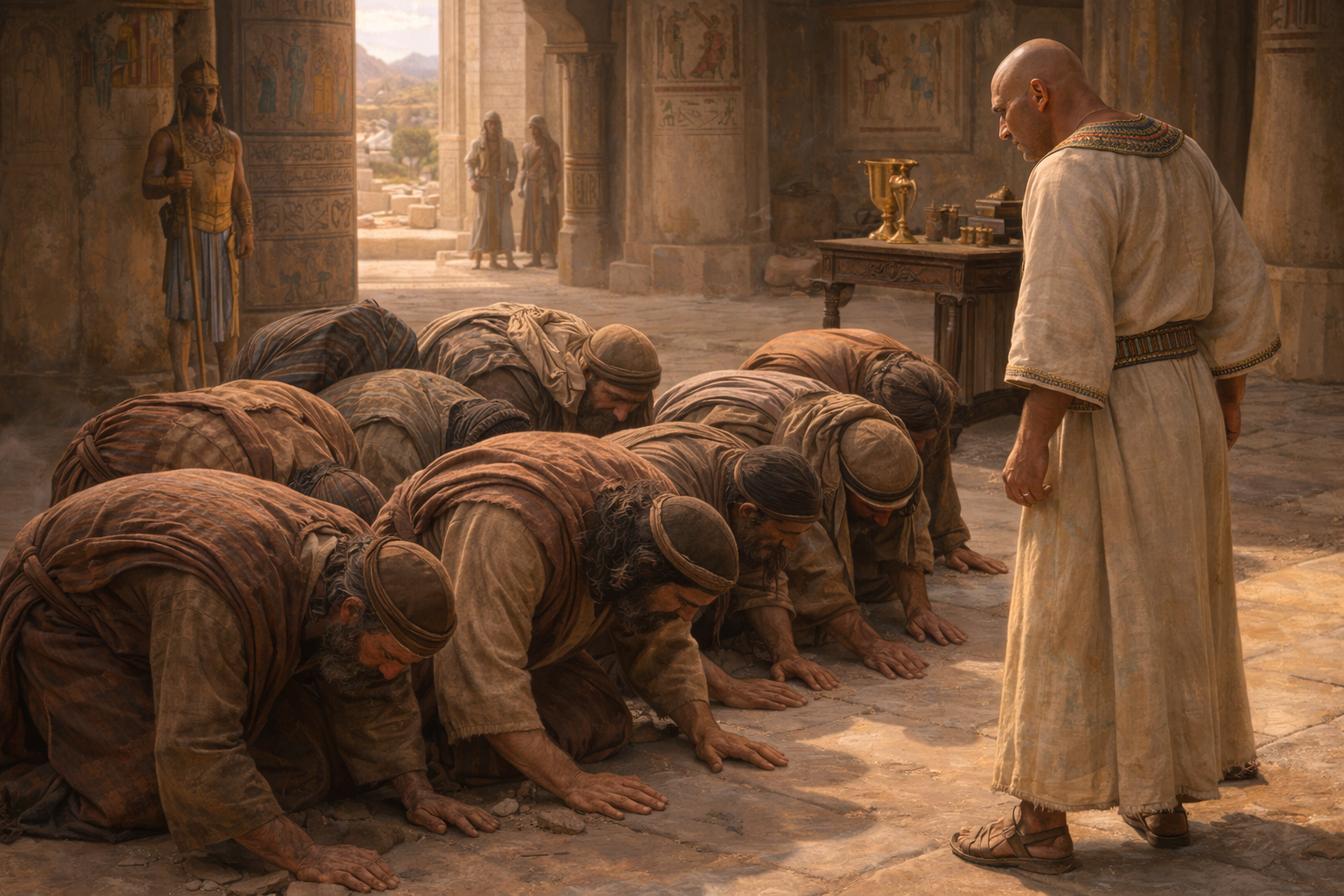
Genesis 44:13-16
Then they rent their clothes, and laded every man his ass, and returned to the city.
And Judah and his brethren came to Joseph’s house; for he was yet there: and they fell before him on the ground.
And Joseph said unto them, What deed is this that ye have done? wot ye not that such a man as I can certainly divine?
And Judah said, What shall we say unto my lord? what shall we speak? or how shall we clear ourselves? God hath found out the iniquity of thy servants: behold, we are my lord’s servants, both we, and he also with whom the cup is found.
This is where you begin to see that something has changed in these men.
Earlier in the story, they could throw one brother away and go on with life. Years before, that is exactly what they did to Joseph. But now, when Benjamin is the one marked out, they do not leave him behind. They tear their clothes. They load their animals. They turn around together. They go back together.
That matters.
At Joseph’s table they were tested for envy. Here they are tested for loyalty. Will they save themselves and sacrifice Benjamin? Will they protect their own freedom and let the younger brother bear the loss alone? That would have been the old story all over again. But this time, they do not walk away.
There is something beautiful about that. Real repentance is not just feeling bad about yesterday. It is acting differently today. It is one thing to say, “We were wrong.” It is another thing entirely to stand with the one who now stands in trouble and say, “If he stays, we stay too.”
Then Judah speaks, and his words are weighty:
“What shall we say unto my lord? what shall we speak? or how shall we clear ourselves? God hath found out the iniquity of thy servants…”
Genesis 44:16
Notice what he does not say. He does not say, “Benjamin is guilty, but the rest of us are innocent.” He does not say, “This is unfair.” He does not say, “There must be some mistake.” He says, in essence, “We have no defense. God has brought our sin into the light.”
That is a remarkable confession, because the issue is no longer merely the cup. Deep down, Judah knows this is bigger than the silver vessel in Benjamin’s sack. God is dealing with old iniquity. God is uncovering buried guilt. God is bringing these brothers face to face with what they did years ago.
That is how the Lord works. He may use one event in the present to reach something buried in the past. He may touch one circumstance on the surface while speaking to a much deeper issue underneath. A man thinks he is only dealing with a problem. God knows He is dealing with a heart.
And then Joseph says something striking. Only the man with the cup will remain. The rest may go in peace.
That was the doorway out. That was the easy road. That was the moment where they could have said, “Well, Benjamin, we are sorry, but there is nothing more we can do.”
But Judah does not take that road.
He draws near.
I love that phrase. He draws near and begins to plead. That is the language of intercession. That is the language of a man stepping into the gap. That is the language of somebody who is no longer thinking only about himself.
And right there the story starts pointing beyond Joseph and beyond Judah and beyond Benjamin to Jesus Christ.
Joseph had said, “Except your youngest brother come down with you, ye shall see my face no more.” In a far greater way, unless there was One who would come down for us, unless there was One who would stand in our place, unless there was One who would bear our guilt, we could never see the face of the King.
That One is Jesus.
We were the guilty ones. We were the ones who should have been left to answer for our own sin. But Jesus did not leave us. He came near. He stood with the guilty. More than that, He stood for the guilty. He took our place so that we could go free.
That is why this passage lands so deeply. Judah’s loyalty is moving. Judah’s confession is beautiful. Judah’s willingness to stand with Benjamin is powerful. But all of it is only a shadow of a greater Brother, a truer Substitute, a better Savior.
Saints, this is what grace does. It changes men who once abandoned a brother into men who will not leave one behind. And that is what Jesus does in an even deeper way. He does not merely improve us. He rescues us. He does not merely sympathize from a distance. He comes near and takes our case as His own.
So when you read this scene, do not miss the wonder of it. The brothers return. Judah confesses. Benjamin is not abandoned. And through it all, the Spirit whispers the greater story.
Someone came near for us.