
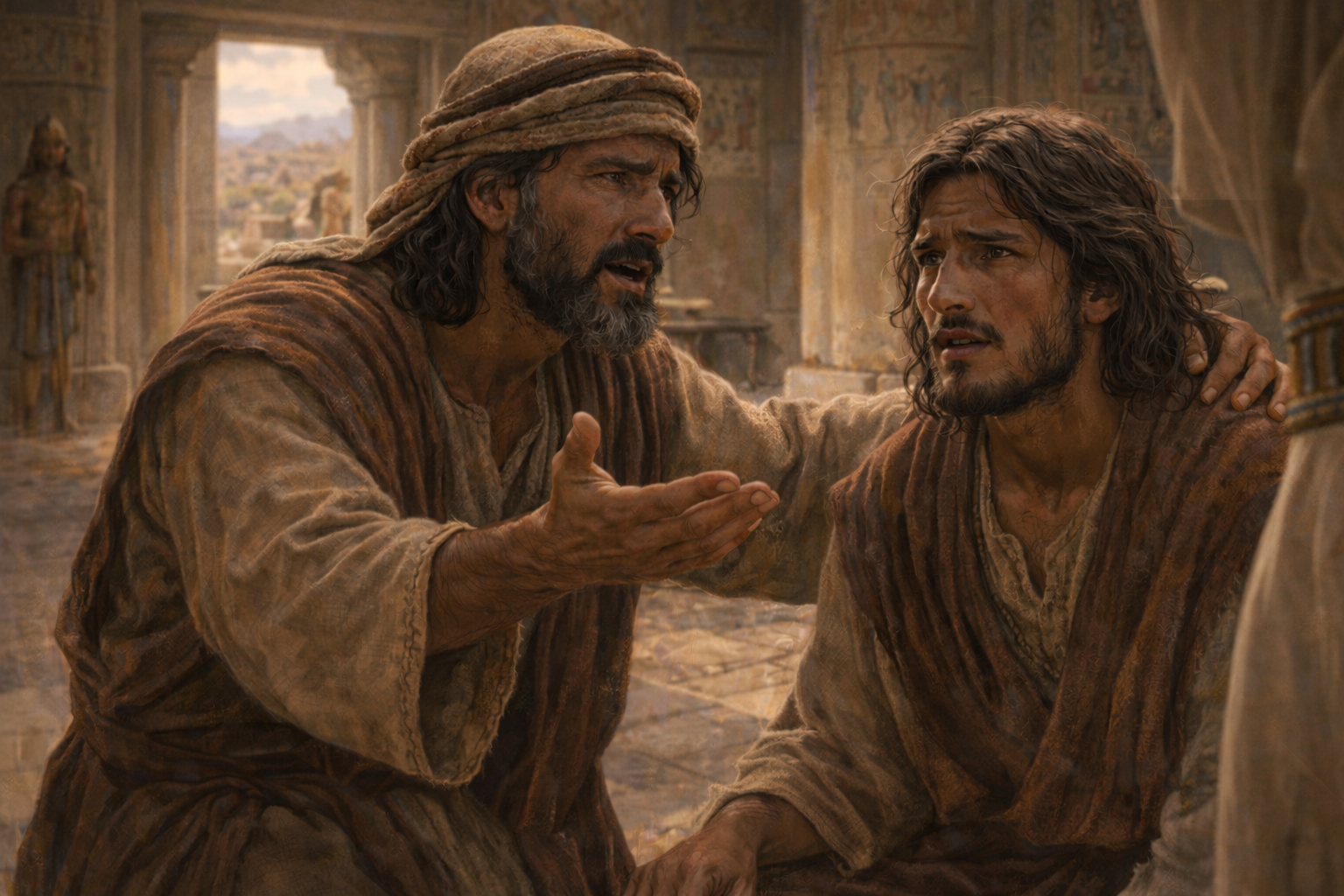
Genesis 44:32-34
For thy servant became surety for the lad unto my father, saying, If I bring him not unto thee, then I shall bear the blame to my father for ever.
Now therefore, I pray thee, let thy servant abide instead of the lad a bondman to my lord; and let the lad go up with his brethren.
For how shall I go up to my father, and the lad be not with me? lest peradventure I see the evil that shall come on my father.
This is one of the most beautiful moments in the life of Judah.
The man who once stood with brothers who sold Joseph is now offering himself in Benjamin’s place. The man who once had no problem letting his father grieve is now saying, in effect, “I cannot let my father go through that again.” Something has changed. Deeply changed.
Judah says, “I became surety for the lad.” That means he had bound himself to Benjamin’s safety. He had put his own name on the line. He had made himself responsible. And now, when the moment of testing comes, he does not back away from his word. He does not look for an escape hatch. He does not try to explain why the promise should be adjusted. He steps right into the cost of it.
That is real love. Love that does not merely feel. Love that stands. Love that stays. Love that says, “If someone must remain, let it be me.”
And do you see how simple and powerful Judah’s burden is? It really comes down to two cries of the heart.
“I cannot bear to wound my father again.”
“I will not leave Benjamin here.”
That is intercession. That is what pleading love sounds like. He is not making a clever legal argument. He is not negotiating from self interest. He is carrying the pain of another man and offering himself for another brother.
What a picture that is.
Because when you read Judah here, it is hard not to think of Jesus. Judah says, “Let thy servant abide instead of the lad.” And that phrase instead of is where the beauty shines. That is substitution. That is one standing in the place of another. That is one taking the chain so another can walk free.
And that is exactly what Jesus did for us.
Isaiah 53:5 says:
“But he was wounded for our transgressions, he was bruised for our iniquities: the chastisement of our peace was upon him; and with his stripes we are healed.”
And 2 Corinthians 5:21 says:
“For he hath made him to be sin for us, who knew no sin; that we might be made the righteousness of God in him.”
Judah offered himself for Benjamin.
Jesus offered Himself for the world.
Judah was willing to become a bondman so Benjamin could go free.
Jesus took the form of a servant, and went all the way to the cross, so that sinners like us could go free.
Judah says, “How shall I go up to my father, and the lad be not with me?” In other words, “I cannot face my father without the one entrusted to me.” And I think of John 6:39, where Jesus says:
“And this is the Father’s will which hath sent me, that of all which he hath given me I should lose nothing, but should raise it up again at the last day.”
I love that. Our greater Judah is not indifferent about those given to Him. He is not careless with souls. He does not shrug at the thought of losing one. He saves to the uttermost. He keeps. He brings home.
So here in Genesis 44, before Joseph even reveals himself, grace is already filling the room. The brothers are different men now. Judah is different now. The selfishness is giving way to sacrifice. The coldness is giving way to compassion. The one who once took part in crushing his father is now willing to be crushed rather than let his father hurt again.
That is not natural human improvement. That is the kind of thing God does when He has been working on a heart for a long time.
Beloved, thank God for Judah’s intercession here. But thank God even more for the greater Intercessor it points to. Jesus did not merely offer to stay behind. He actually did. He took our place fully, willingly, lovingly. He bore the blame. He entered the sorrow. He broke the power of slavery.
And because He did, the guilty can go free.