
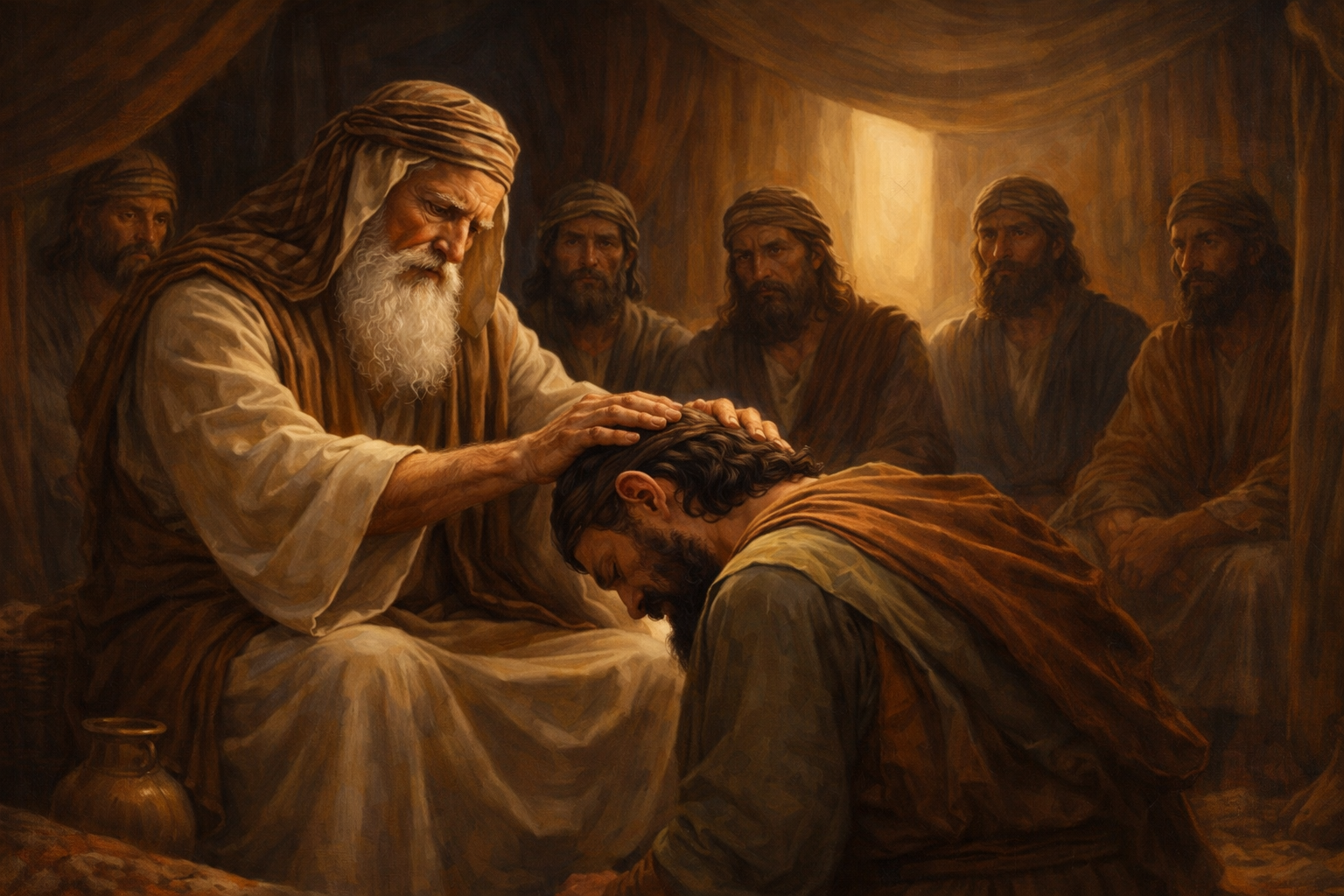
Genesis 49:5–7
Simeon and Levi are brethren; instruments of cruelty are in their habitations. O my soul, come not thou into their secret; unto their assembly, mine honour, be not thou united: for in their anger they slew a man, and in their selfwill they digged down a wall. Cursed be their anger, for it was fierce; and their wrath, for it was cruel: I will divide them in Jacob, and scatter them in Israel.
Jacob now turns to Simeon and Levi, and what he says is heavy. These are not the warm words of a father simply recalling better days. He reaches back to that terrible scene in Shechem and brings it into the light. When Dinah was defiled, Simeon and Levi answered not with brokenness before God, but with violent revenge. They made a plan. They carried it out. And Jacob says, in essence, I want no part of that spirit.
That is an important word. He does not merely condemn what they did. He condemns the anger that drove it. “Cursed be their anger, for it was fierce; and their wrath, for it was cruel.” The issue was deeper than one sinful act. It was the kind of heart that takes matters into its own hands and feels justified doing so.
That kind of anger always promises strength. But it never leaves strength behind. It leaves division. It leaves damage. It leaves scattering.
And that is exactly what Jacob says would happen. “I will divide them in Jacob, and scatter them in Israel.” They thought they were seizing control back in Shechem. Instead, their own wrath helped write the story of their future.
There is something larger here too. Simeon and Levi become a picture of what would later happen in the history of Israel. Just as they leaned on their own scheme, the nation would later lean on her own wisdom, her own alliances, her own maneuvering among the nations. Instead of resting in the Lord, she looked for security in politics, strategy, and human arrangement.
The result was the same kind of sorrow on a national scale.
The Assyrians came in 722 B.C. and carried away the northern kingdom. Then the Babylonians came in 586 B.C. and took Judah captive. The people were dispersed. Scattered. Moved out of the land.
That is what happens when men trust their own arm. It may look strong for a moment. It may even seem clever. But it does not hold.
There is a warning here for all of us. Anger can feel righteous when we have been wounded. Self will can feel reasonable when we think somebody has crossed a line. But once I decide I can handle things better than the Lord can, I am already moving into dangerous territory. The flesh always thinks it can produce something clean. It never does.
And yet the Lord, in His mercy, does not abandon His people even when they are scattered. He disciplines, yes. He deals truthfully, yes. But He is never finished with His people. He would preserve Israel through dispersion, and in His own time He would regather them. Even judgment would not cancel His covenant.
That is the hope running underneath this passage. Man’s anger scatters. God’s faithfulness preserves.
So Jacob’s words are not just history. They are warning. They are a call to step back from the secret counsel of the flesh, from the heat of self will, from the kind of response that feels powerful but leaves ruin behind. Better to be still before the Lord. Better to trust Him with the wrong done to you. Better to wait for His justice than to reach for your own.
Because when anger takes the wheel, scattering is never far behind.