
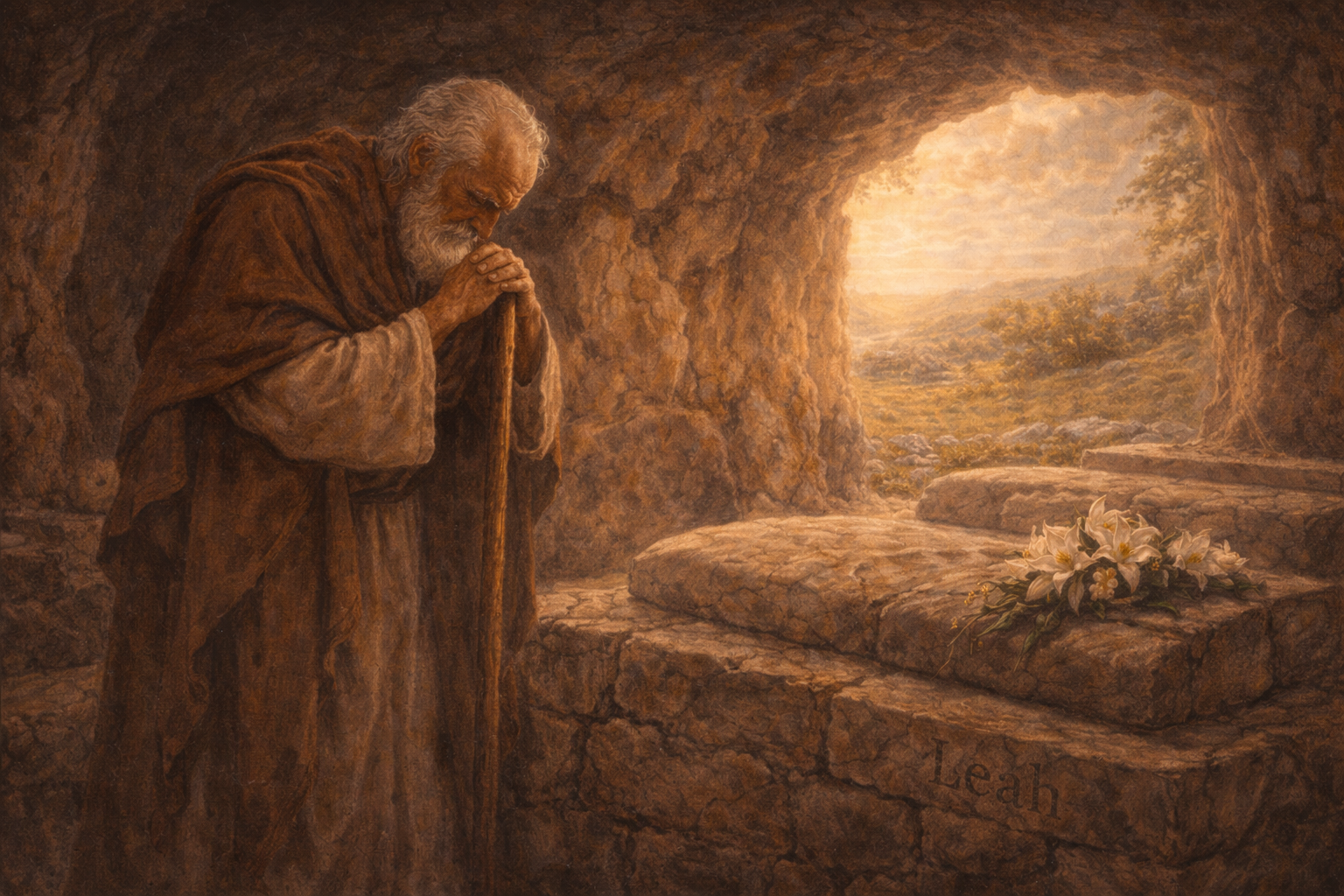
Genesis 49:28-32
All these are the twelve tribes of Israel: and this is it that their father spake unto them, and blessed them; every one according to his blessing he blessed them. And he charged them, and said unto them, I am to be gathered unto my people: bury me with my fathers in the cave that is in the field of Ephron the Hittite, In the cave that is in the field of Machpelah, which is before Mamre, in the land of Canaan, which Abraham bought with the field of Ephron the Hittite for a possession of a buryingplace. There they buried Abraham and Sarah
his wife; there they buried Isaac and Rebekah his wife; and there I buried Leah. The purchase of the field and of the cave that is therein was from the children of Heth.
This is the first time in the Bible the phrase “the twelve tribes of Israel” appears. So already you can feel the scope of this chapter. Jacob is not merely speaking to twelve sons. He is speaking over the heads of tribes. He is speaking words that reach into the future. He is laying out things that touch the history and destiny of Israel.
Then after all of that, after the blessings, after the prophecy, after the words over each son, Jacob gives one final charge.
“Bury me in Machpelah.”
Not in Egypt.
Not in splendor.
Not in the land that had fed him well for seventeen years.
Take me back.
That is a message all by itself. Jacob had been living in the best part of Egypt. He was father to the prime minister of the land. Had he wanted some grand monument, some nobleman’s tomb, some elaborate Egyptian memorial, it could have been done in a heartbeat. But at the end of his life, none of that impressed him.
He wanted to go back to the cave Abraham bought.
He wanted to go back to the field of promise.
He wanted to go back to the land God had sworn to give.
Egypt had been comfortable, but Egypt was not home.
That is a needed word. This world may feed us for a while. It may even treat us kindly in certain seasons. But for the child of God, this world is never home. Jacob knew that. So in death, he is still testifying. He is still saying, “My future is tied to the promise of God, not to the comforts of Egypt.”
But then you come to that line, and it stops you.
“There I buried Leah.”
How about that twist.
For most of Jacob’s story, Rachel seems to be the great love of his life. Rachel is the one he worked for. Rachel is the one he longed for. Rachel is the one that seemed to hold his heart in those early days. But when everything is said and done, when the race is almost over, when he speaks of where he wants to be laid, he says in essence, “Take me back to Leah.”
That is not a small detail.
That is a turn in the whole story.
Leah was the one he did not choose first. Leah was the one who knew what it was to be overlooked. Leah was the one who lived in the shadow of another woman’s beauty and another woman’s place in Jacob’s affections. And yet Leah was the one who stayed in the long, hard, ordinary years. Leah was the one bound up in the actual building of the family. Leah was the one buried there in Machpelah. And now Jacob says, “That is where I want to be.”
There is something quiet and powerful in that.
A man can live long enough to see things differently at the end than he saw them at the beginning.
What dazzled him early may not be what matters most later.
What he once chased may not be what he clings to when all the dust settles.
And I cannot prove it, but I do wonder if Jacob may have begun to sense something even deeper in all of this. Leah was the mother of Judah. And Judah was the tribe Jacob had just spoken over in such remarkable terms. The sceptre. Shiloh. The royal line. The promise reaching forward to Messiah. I wonder if, by the end of his life, Jacob had some sense that Leah’s place in the story was far greater than he understood when he was a younger man.
That would not be surprising.
Because that is so often how God works.
Man looks one way.
God is working another way.
Jacob set his heart on Rachel, but God tied the kingly line to Leah.
Jacob may have been drawn to one story, while heaven was quietly writing another.
And that is worth sitting with.
The overlooked place becomes the chosen place.
The less desired place becomes the fruitful place.
The woman who seemed pushed to the side becomes the mother of the tribe through whom Messiah would come.
That is just like the Lord. He does not always work through what man would have picked first. He often works through what was unnoticed, unwanted, or underestimated. And by the end, that is what stands there shining with a different kind of glory.
So Jacob’s request is not merely sentimental. It is full of meaning. Yes, it is faith in the promise. Yes, it is a refusal to let Egypt define his future. But it is also this surprising and tender turn back toward Leah.
Back to covenant.
Back to family.
Back to promise.
Back to the woman whose place in the story had become more weighty than perhaps anyone realized at the start.
I think that is beautiful. At the end, Jacob is not asking for Egypt’s applause. He is asking to be carried back to the cave of promise, and to be laid beside Leah.
That says something about faith.
And it says something about grace.