
Hebrews 9:6
Now when these things were thus ordained, the priests went always into the first tabernacle, accomplishing the service of God.
After the tabernacle was set in order and everything placed where it belonged, the priests began their daily ministry. Their service was not occasional. It was constant.
Every day they entered the Holy Place.
You can imagine a young Levite growing up in that environment. As a boy he would stand in the courtyard watching his father serve. He would see the sacrifices placed upon the altar, the smoke rising toward heaven, the rhythm of worship happening day after day.
At some point the day would come when he himself was finally allowed to minister.
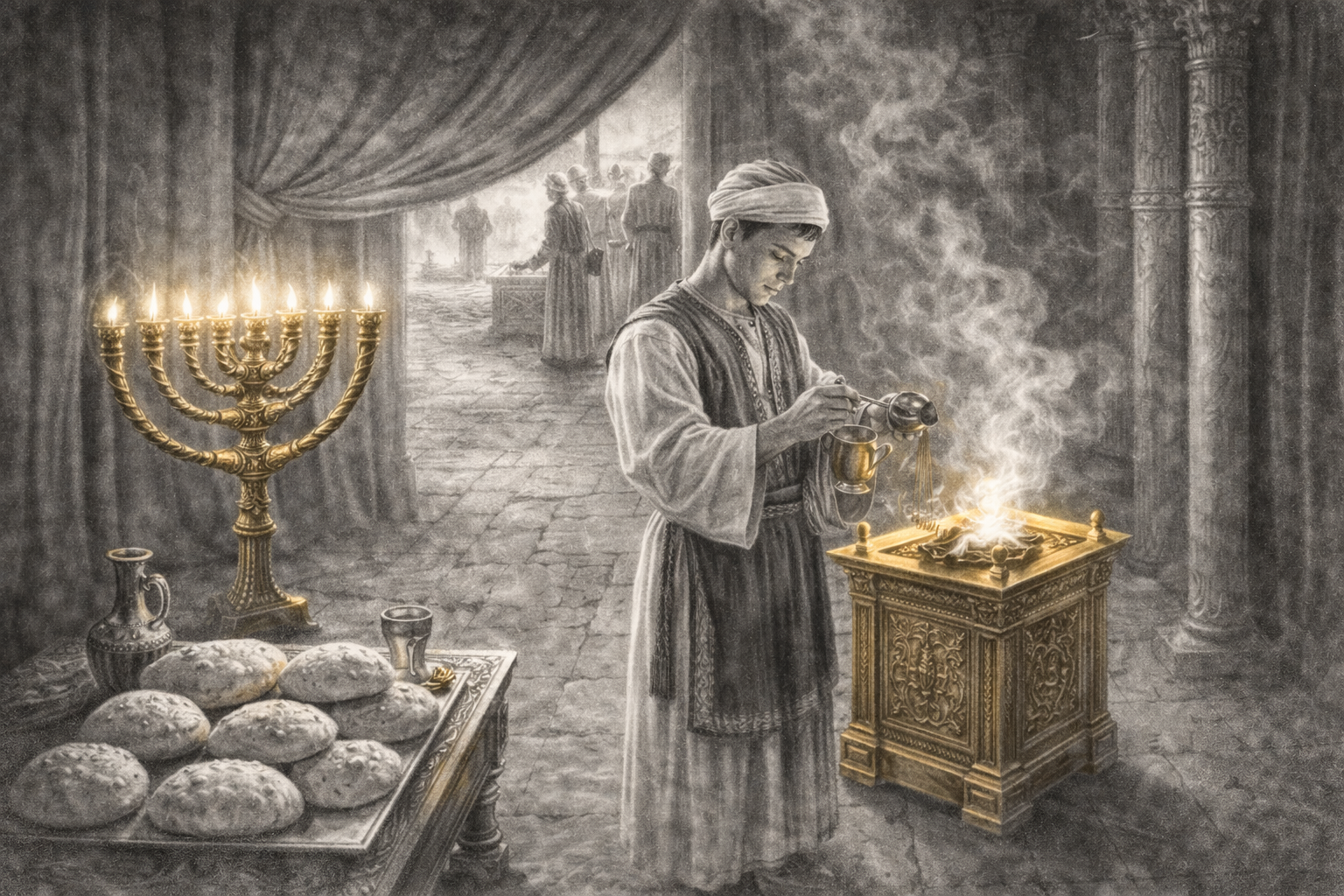
Think about that moment. After years of watching, he would step beyond the courtyard and into the tabernacle. Into the Holy Place. The room lit by the golden lampstand. The room filled with the scent of incense. The room where the quiet work of worship happened.
His duties were simple but sacred.
Every morning and every evening he would trim the wicks of the lamps and refill them with oil so the light would never go out. The lampstand was the only source of light in that room, so it had to be tended carefully. A priest’s quiet faithfulness kept the sanctuary illuminated.
Then he would move to the altar of incense, placing fresh incense upon the coals so the fragrance would rise upward. The smoke symbolized prayer ascending to God, a continual reminder that worship was always meant to be rising toward heaven.
And once a week he would replace the twelve loaves of showbread on the table. Those loaves represented the twelve tribes of Israel. Week after week they were set before the Lord, a reminder that the people were continually in His presence.
None of these tasks looked dramatic.
There were no crowds in the Holy Place. No applause. No spectacle. Just quiet, faithful service carried out day after day.
But that was the work God appointed.
Here’s the thing: the ministry of the priest was not built on occasional excitement. It was built on daily faithfulness. The lamps had to be tended every day. The incense had to be refreshed continually. The bread had to be replaced week after week.
It was steady, repetitive, ordinary work.
And yet that steady rhythm is exactly what kept the sanctuary functioning.
There is something deeply instructive in that. Most of the life of faith is not lived in dramatic moments. It is lived in quiet, repeated acts of devotion. The small decisions to pray. The steady returning to the Word. The simple acts of worship that may seem routine but keep the heart turned toward God.
Think about that.
A sanctuary stays bright because someone trims the lamps.
Prayer continues because someone keeps adding incense.
The people remain before the Lord because someone keeps placing bread on the table.
Faithfulness in small things sustains the whole system.
And in a beautiful way, this daily ministry also pointed forward to something greater. The priests had to keep repeating their work because the old covenant was never finished. The lamps needed trimming again tomorrow. The incense had to be offered again tonight. The bread had to be replaced again next week.
The work was never complete.
But Hebrews is slowly leading us to the One whose ministry would not need to be repeated endlessly. The daily work of the priests pointed forward to a greater Priest who would accomplish what they never could.
For now, though, the young Levite simply stepped into the Holy Place and began doing what his father had done before him—quietly accomplishing the service of God.