
Hebrews 9:3–5
And after the second veil, the tabernacle which is called the Holiest of all;
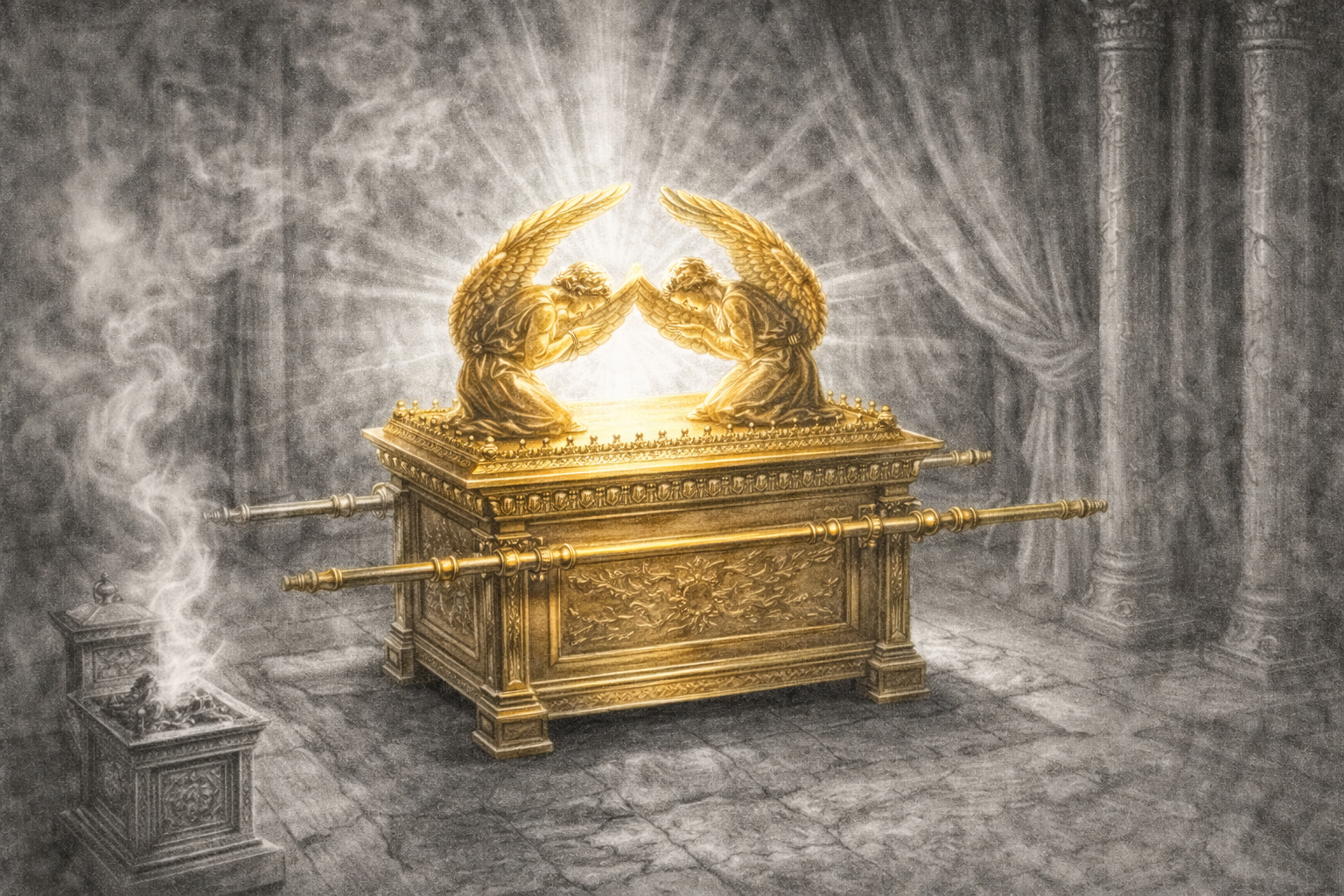
Which had the golden censer, and the ark of the covenant overlaid round about with gold, wherein was the golden pot that had manna, and Aaron’s rod that budded, and the tables of the covenant;
And over it the cherubims of glory shadowing the mercyseat; of which we cannot now speak particularly.
Behind the second veil was the most sacred place in the entire tabernacle—the Holiest of All.
Inside that room stood the ark of the covenant, a small chest overlaid with gold. It was not large—roughly three feet by two feet—but what it represented was immense. Inside the ark were three items that told the story of Israel’s relationship with God.
There were the tables of the covenant, the Ten Commandments themselves—the standard of God’s holiness. There was Aaron’s rod that budded, a reminder of God’s chosen priesthood. And there was a golden pot of manna, a testimony to God’s daily provision for His people in the wilderness.
Each item spoke of something important. The law revealed God’s righteousness. The rod spoke of authority and priesthood. The manna spoke of provision. Together they told the story of God’s dealings with His people.
But the most important part of the ark was not inside it. It was on top of it.
The lid of the ark was called the mercy seat. Above it stood two golden cherubim, their wings stretched toward each other, their faces turned downward, gazing at the mercy seat below.
Think about that for a moment.
Inside the ark was the law—the very commandments Israel repeatedly broke. The evidence of human failure sat right there beneath the lid. But covering the law was something greater: mercy.
Don’t miss this: God placed mercy above the law.
Once a year, on the Day of Atonement, the high priest would enter that room and sprinkle blood upon the mercy seat. The blood symbolized atonement. And when God looked down from above the cherubim, He did not see the broken law first. He saw the blood upon the mercy seat.
That is the picture of grace.
Now in verse 4 the author mentions the golden censer, or altar of incense. According to Exodus, that altar originally stood just outside the veil, not inside the Most Holy Place. Yet here Hebrews associates it with the inner sanctuary.
Is that a contradiction? Not at all.
It seems that somewhere along the line the altar of incense was moved closer to the ark. Whether by design or by circumstance, something had shifted from the original arrangement. The furniture was not exactly where it had once been.
And yet, remarkably, God still worked.
That is strangely comforting.
Because if you look honestly at human history—including church history—you will find that things often get rearranged. Systems change. Traditions shift. Methods vary. One church does things one way, another church does things entirely differently.
Some congregations are formal and structured. Others are relaxed and simple. Some pastors wear robes. Others preach in sweaters. Some churches are full of programs. Others are quiet gatherings of believers. From the outside it sometimes looks like the furniture has been moved all over the room.
And yet the Lord keeps working.
Here’s the thing: the power of God does not depend on our ability to keep every piece of furniture perfectly aligned. If it did, none of us would have any hope. In our homes, in our churches, and in our own hearts, things are often out of place. We misjudge. We misunderstand. We make adjustments that may not always be ideal.
But the mercy of God is greater than our imperfect arrangements.
The real center of the room was never the furniture anyway. It was the presence of God above the mercy seat. That is where forgiveness was declared. That is where grace was revealed.
And that same truth still holds today. We may not always arrange things perfectly, but when Christ is lifted up, when mercy is proclaimed, when people come seeking the Lord, God breaks through our imperfections and draws people to Himself.
That is amazing.
Because it means the story of redemption does not rest on flawless systems. It rests on a merciful God who meets people above the mercy seat.