
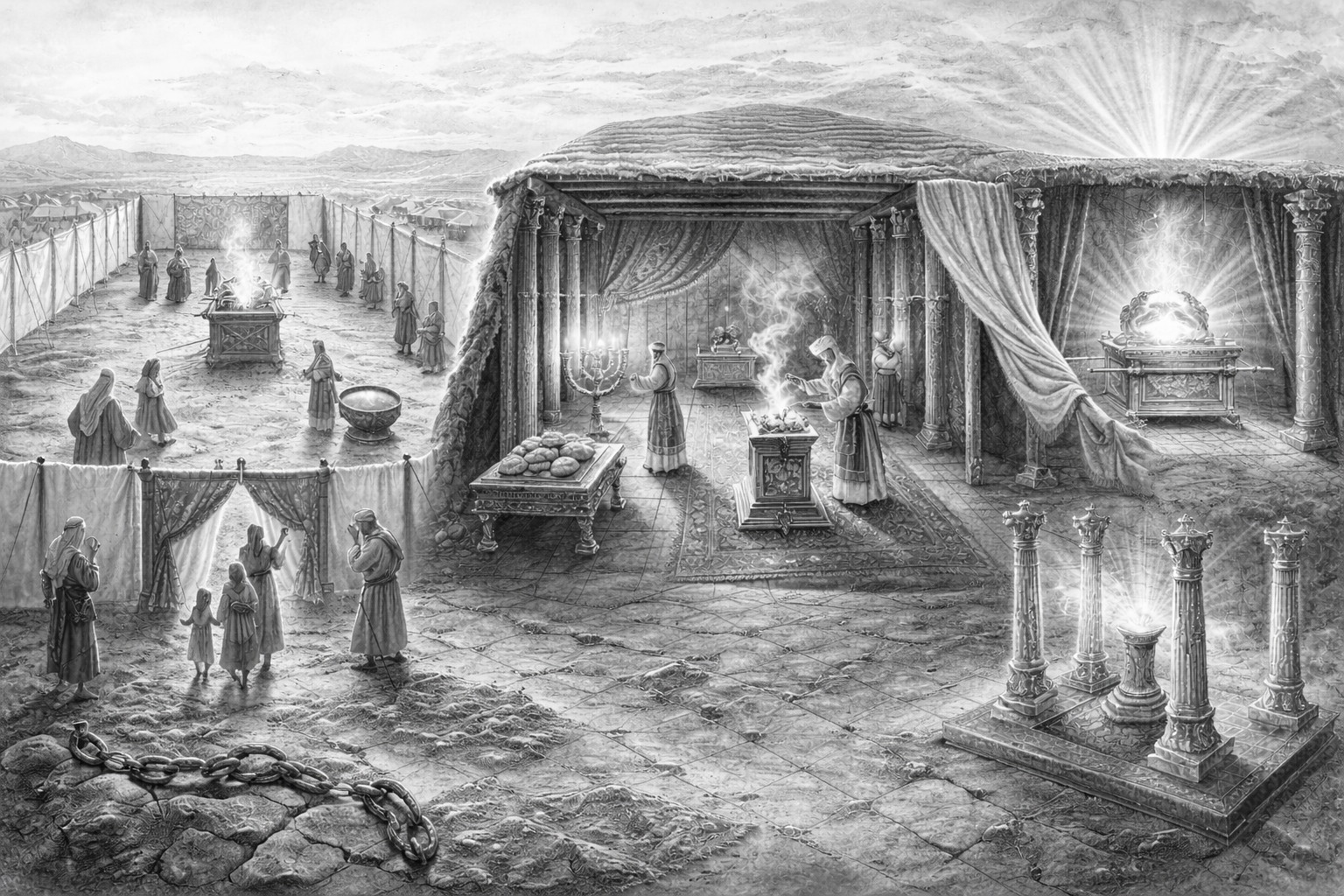
Hebrews 9:1–2
Then verily the first covenant had also ordinances of divine service, and a worldly sanctuary.
For there was a tabernacle made; the first, wherein was the candlestick, and the table, and the shewbread; which is called the sanctuary.
When God instructed Moses to build the tabernacle, He was establishing something remarkable: a meeting place between Himself and His people.
The courtyard alone was about one hundred fifty feet long and seventy-five feet wide, surrounded by white linen curtains. When you picture that in your mind, something almost surprising emerges. There were roughly three million Israelites wandering in the wilderness at the time. Three million people, and the place of meeting with God was relatively small.
You can almost imagine Moses hearing the measurements and thinking, Wait a minute… that’s not nearly big enough.
But here’s the thing. God knew exactly what He was doing.
It is almost as if the Lord was quietly saying, “This will be enough space… because at any given time there will not be that many who truly want to meet with Me.”
That is a sobering thought.
The invitation was open to the entire nation. God had brought them out of Egypt, protected them through the wilderness, fed them with manna, and guided them with the pillar of cloud and fire. Yet even with all of that, only a portion of the people would actually draw near.
That has always been the pattern.
Many are glad for what God provides. Fewer are eager for God Himself.
Think about that. The courtyard was not mainly about ritual. It was about relationship. It was the place where people could come, approach, worship, and encounter the Lord. The size of the space quietly reflected a truth that still holds today: the Lord opens the door wide, but only some step through.
Then beyond the courtyard stood the tabernacle itself. Interestingly, it looked very much like the tents the Israelites lived in as they traveled through the wilderness. God did not place a marble palace in the middle of the camp. He met His people in a structure that resembled their own dwellings.
That says something beautiful about the heart of God.
He does not stand far removed from us in unreachable splendor. He comes near. He meets people where they live. The God of heaven was willing to dwell in a tent among wandering people.
Inside that tabernacle was the Holy Place, a room about thirty feet long. Three main pieces of furniture stood there, each one quietly pointing to deeper realities.
On the right was the table of showbread, holding twelve loaves representing the twelve tribes of Israel. It was a reminder that the people were continually before the Lord. He had not forgotten them. They were present in His sight.
On the left stood the golden lampstand, its seven lamps burning oil and casting light throughout the room. In a tent covered with dark skins, that lampstand was the only light. It spoke of illumination, of God providing the light necessary for those who serve Him.
Straight ahead was the altar of incense, where fragrant incense rose upward. The rising smoke symbolized prayers ascending to God, a picture of communion and worship.
And then, beyond that altar, hung a massive veil supported by four golden pillars set in silver sockets. The veil separated the Holy Place from the Most Holy Place.
Even the materials preached a message. Gold speaks of divine glory. But the pillars stood in silver sockets, and silver in Scripture is the metal of redemption. It quietly reminds us that access to God rests on redemption.
Notice something here. Every detail in the tabernacle was intentional. Every measurement, every piece of furniture, every material whispered something about God’s plan to bring people near.
But here is the irony: the place of meeting existed, yet many still stayed away.
And that raises a question for us today.
The door to God is open wider now than it was then. Through Christ, the veil has been torn, the way has been made, and the invitation has gone out to everyone. The question is not whether God wants to meet with us. He has already made that clear.
The question is simply this: do we want to meet with Him?
Because the greatest tragedy is not that the place is too small. It is that too few people choose to enter.