
1 Peter 2:21-25
For even hereunto were ye called: because Christ also suffered for us, leaving us an example, that ye should follow his steps: Who did no sin, neither was guile found in his mouth: Who, when he was reviled, reviled not again; when he suffered, he threatened not; but committed himself to him that judgeth righteously: Who his own self bare our sins in his own body on the tree, that we, being dead to sins, should live unto righteousness: by whose stripes ye were healed. For ye were as sheep going astray; but are now returned unto the Shepherd and Bishop of your souls.
Peter says we are called to follow the Lamb.
That is a beautiful thought until you see where the path goes.
It goes through suffering.
It goes through misunderstanding.
It goes through being mistreated without striking back.
Jesus did not merely tell us to endure hardship. He walked through it first. When He was reviled, He did not revile in return. When He suffered, He did not threaten. He entrusted Himself to the Father who judges righteously.
And that is where the struggle comes in for us.
Because everything in the flesh wants to answer back. Everything in us wants to defend, explain, push, and make sure our side is heard. We want the last word. We want to make the other person feel what they made us feel. We want to swing back.
But Jesus did not.
He suffered without sinning.
He was wounded without becoming cruel.
He was wronged without becoming wrong.
Think about that.
Peter is not handing us a cold command here. He is pointing us to a Person. Christ is our example, yes. But thank God, He is more than an example. If He were only an example, we would all be crushed by the distance between His steps and ours.
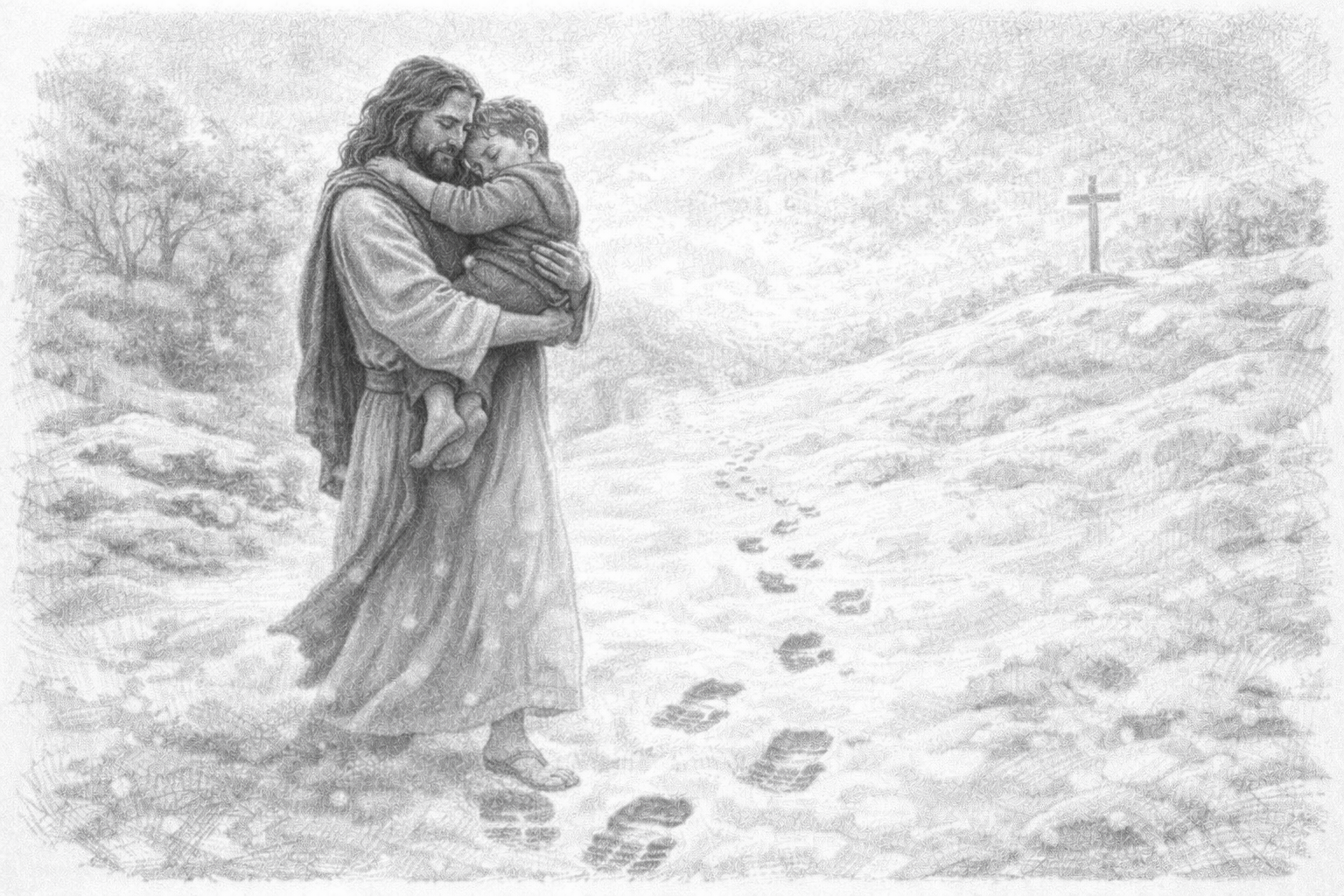
It is like a father walking in deep snow with a small child behind him. The child is told, “Follow my steps.” But the stride is too wide. The footprints are too far apart. The little legs cannot make it on their own.
That is us.
The steps of Jesus are too pure for our flesh.
Too steady for our pride.
Too meek for our self-protection.
But here is the mercy of it: the One who gives us the path also gives us the strength. He does not only say, “Walk like Me.” He lifts us, steadies us, and enables us to put our feet where His feet have already gone.
That changes everything.
Because now the Christian life is not me gritting my teeth and trying to imitate Jesus from a distance. It is Jesus, the risen Shepherd, carrying, helping, strengthening, and teaching me to walk where I never could walk alone.
Don’t miss this: Peter ties the example of Christ to the cross of Christ. The One whose steps we follow is the One who “bare our sins in his own body on the tree.” Before He ever asked us to walk in righteousness, He died for our sin. Before He ever called us to follow, He rescued us when we were wandering.
That means our hope is not in our performance.
It is in His sacrifice.
By His stripes we were healed. We were sheep going astray, lost and stubborn and exposed. But now we have returned to the Shepherd and Bishop of our souls. He is not merely ahead of us on the path. He is watching over us on it. He is not only the Lamb who suffered. He is the Shepherd who keeps.
Here’s the thing.
When I am hurt, I need more than a lecture.
When I am wrongly treated, I need more than an ideal.
When I am tempted to answer in anger, I need Someone stronger than me living within me.
And that is exactly who Jesus is.
So Peter’s word is not crushing. It is comforting. Yes, follow His steps. But do it knowing the Shepherd is helping you. The same One who died for you is the One who now keeps you. The same One who suffered without sin is the One who gives grace when you are pressed.
So when the road gets hard, look to the Lamb.
And when your strength runs thin, lean on the Shepherd.
He will lift you into His footsteps.