
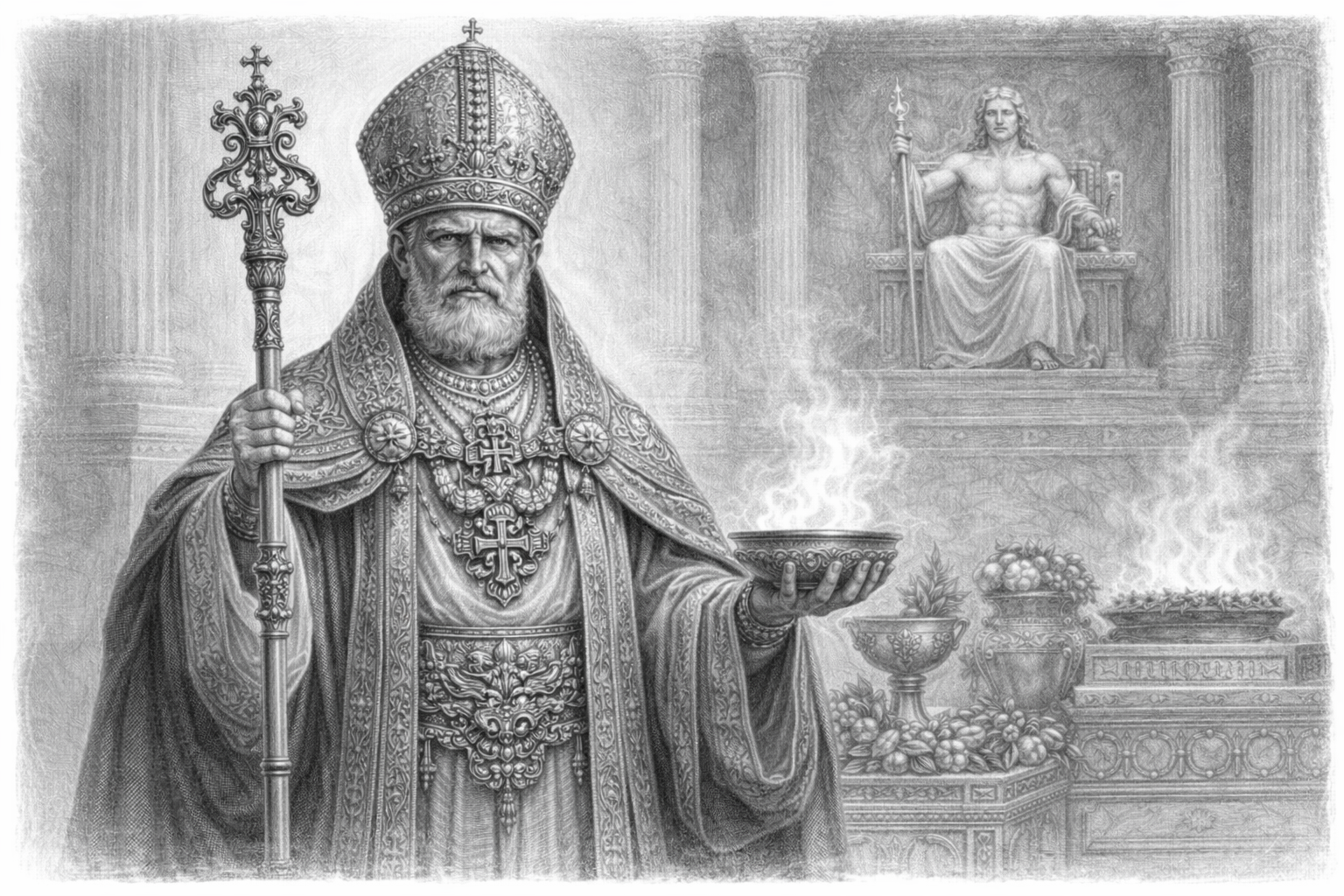
Revelation 2:12
And to the angel of the church in Pergamos write…
Pergamos speaks of a dangerous union.
The idea behind the name points to an objectionable marriage, and that fits this period well. If Smyrna speaks of a crushed church, Pergamos points to a compromised church. The pressure from outside began to ease, but a new danger moved in. And sometimes that danger is harder to detect.
Persecution had failed to wipe the church out.
So the enemy changed tactics.
Instead of attacking the church from the outside, he began to invite her to the table. Instead of chains, he offered influence. Instead of fire, he offered favor. That is often how compromise begins. It does not always come wearing a cruel face. Sometimes it comes smiling.
The turning point came in A.D. 313, when Constantine and Licinius issued the Edict of Milan. That decree granted toleration to Christianity, gave Christians legal standing, and restored property that had been confiscated during the persecutions. It changed everything about the church’s place in the empire.
Now the church was no longer merely surviving under Rome.
She was being welcomed by Rome.
And that is where the danger began.
From about A.D. 313 to A.D. 600, church and state became increasingly intertwined, and the church began paying a spiritual price for political favor. It sounded like victory at first. The persecution stopped. Christians gained standing. The church had a seat at the table. But with that acceptance came mixture. Pagan customs were not fully left behind. Political expediency started shaping spiritual life. The church that once stood apart began learning how to blend in.
That is never a small thing.
A church can survive persecution far better than it can survive compromise.
When the world cannot crush the church, it often tries to court her. It says, “Let’s work together. Let’s soften the sharp edges. Let’s find common ground. Let’s meet halfway.” And before long, what began as cooperation turns into corruption.
That seems to be the tragedy wrapped up in Pergamos. The church became linked with earthly power in a way that looked strong on the surface, but inwardly it weakened her. She gained public standing and lost spiritual simplicity. She became impressive in the eyes of men, but less pure in the eyes of God.
It is a little like salt losing its savor. It is still present, still visible, still called salt, but it no longer carries its sharp preserving quality. Once the church begins borrowing the world’s methods, chasing the world’s approval, and making peace with the world’s idols, she may look larger, richer, and more secure, but something vital has gone missing.
And that warning is not just for history books.
Pergamos is still with us whenever the church tries to gain influence by trimming truth.
Pergamos is still with us whenever believers think political advantage is the same thing as spiritual power.
Pergamos is still with us whenever Christianity becomes a label people wear without new birth, repentance, or real devotion to Christ.
The church was never called to marry the spirit of the age.
She was called to belong to Jesus.
That is why this letter matters so much. It reminds us that open persecution is not the only danger. Comfort can be dangerous. Acceptance can be dangerous. Success can be dangerous. Anything that causes the church to trade purity for popularity is a losing trade.
Beloved, the church is strongest when she is closest to Christ, not when she is most applauded by the culture around her. The answer is not to chase power. The answer is to stay pure, stay faithful, and stay near the One who called us out of the world in the first place.