
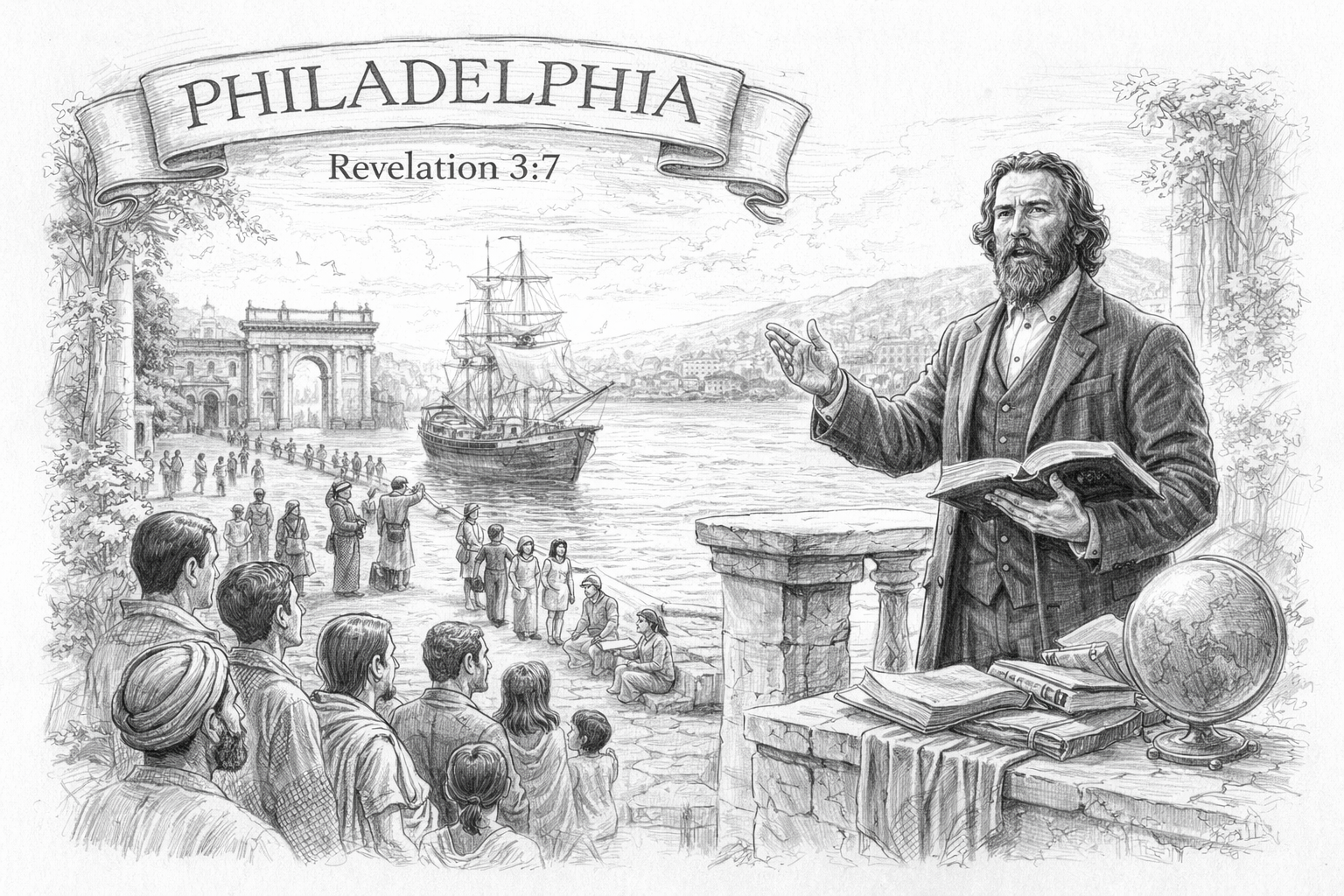
Revelation 3:7
And to the angel of the church in Philadelphia write…
When we come to Philadelphia in the panorama of church history, we come to a beautiful stirring. After the dead denominationalism of Sardis, after the drifting from the simplicity of the gospel, there came a fresh awakening.
Picture a young cobbler in London. In his shop sat two books: a worn Bible and Captain Cook’s journal. As the days passed, he found himself caring less about the soles of shoes and more about the souls of people in distant lands. Something was happening in his heart. A burden was growing. A fire was being lit.
So on May 31, 1793, he walked into the little Protestant church he attended and asked if he could share a word. Given the chance, he read from Isaiah 54:2 and 3. Then with deep passion he said in essence, We need to lengthen the cords and strengthen the stakes. We need to make room for people who have never heard. I want to go. Send me to India.
That was William Carey.
His request startled the congregation because it had been a thousand years since anyone had launched a foreign missionary endeavor. But they sent him. And in the first ten years, Carey became fluent in twelve languages. One of his great works, his translation of the Bible into Sanskrit, still stood as a testimony to what God can do through a willing man.
That is why William Carey is remembered as the father of the modern missionary movement. The church, sleepy and settled for so long, suddenly began to wake up. Carey proved that God is not mainly looking for people who seem extraordinary. He is looking for people who are willing to go.
That is the spirit of Philadelphia.
This church points to that era beginning in the eighteen hundreds, when men like Carey in India, Hudson Taylor in China, D. L. Moody in America, and C. H. Spurgeon in London were all part of a great outward movement of evangelism and missionary vision. The church was turning outward again. The church was loving the lost again. The church was remembering that the gospel was never meant to be admired only, but carried.
And it is striking that Philadelphia is one of only two of the seven churches to which Jesus says nothing critical. Why? Perhaps because they were engaged in evangelism. They were loving the lost. And love covers a multitude of sins, as 1 Peter 4:8 says.
I like that. There is something healthy about a church that is outward looking. When people are burdened for souls, when they are praying for the lost, when they are willing to go, willing to give, willing to speak, there is a freshness there. There is a tenderness there. There is a kind of life that keeps a church from folding in on itself.
Even the name Philadelphia is full of meaning. There are three Greek words often noted for love. Eros speaks of sensual love. Phileo speaks of brotherly love. Agape speaks of the love of God. And the city of Philadelphia, founded in 189 B.C., came to be known as the city of brotherly love because of the devotion of Attalus II to his older brother. He honored him publicly, named buildings after him, minted coins with his image, and spoke of him constantly. The city became marked by that idea of brotherly love.
That is no small detail. It fits perfectly.
Nothing in Scripture is accidental. The Lord knew exactly what He was doing when this church, Philadelphia, would become the picture of an age marked by evangelism, missions, and outward love. Brotherly love became the atmosphere in which the gospel moved outward. And that makes sense, because people who really love one another and love the Lord will eventually begin to care about those who have never heard.
That is still true now.
When a church loses interest in the lost, it usually means it has turned inward.
When a church is alive with love, it starts looking outward.
When brotherly love is real, evangelism will not be far behind.
Philadelphia reminds us that the answer to dead religion is not merely better structure. It is renewed love. Love for the Lord. Love for one another. Love for the lost. That is what stirred men like Carey. That is what sent missionaries across oceans. That is what made the church move again.
Beloved, may the Lord keep us from the deadness of Sardis and move us into the spirit of Philadelphia. May He give us hearts that care more for souls than for comfort. May He give us brotherly love that reaches beyond our own walls. And may He make us willing to go wherever He says go.