
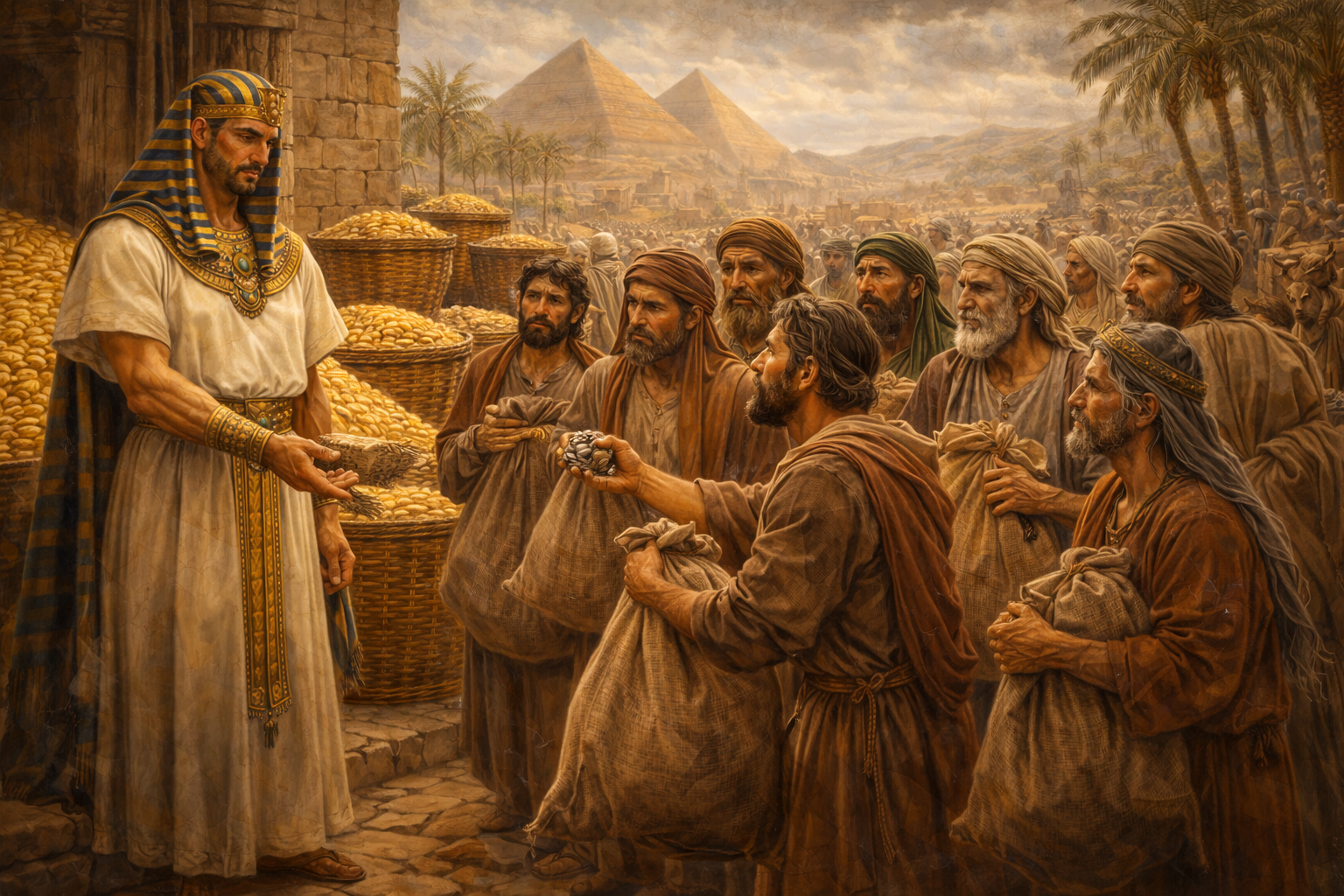
Genesis 42:1-3
Now when Jacob saw that there was corn in Egypt, Jacob said unto his sons, Why do ye look one upon another?
And he said, Behold, I have heard that there is corn in Egypt: get you down thither, and buy for us from thence; that we may live, and not die.
And Joseph’s ten brethren went down to buy corn in Egypt.
By this point the famine has gone on long enough that even Jacob hears there is bread in Egypt. And when he does, he says to his sons, “Why do ye look one upon another?” In other words, “Why are you just standing there? Why are you staring at each other while the answer is sitting down in Egypt?”
That still preaches.
How many people know where the answer is, at least in part, and yet just sit there looking at one another? They talk about the problem. They discuss the pressure. They analyze the famine. But they do not move toward the place where the bread is.
Jacob says, “Get down there, that we may live, and not die.” That is the issue. This is not about convenience. This is not about preference. This is about life and death.
Then the brothers go down to buy corn.
That is where the picture gets interesting.
They are coming to Joseph, but they are coming with the mindset of purchase. They are thinking in terms of buying, earning, paying, securing provision through their own transaction. And that is exactly how the natural man thinks when it comes to God.
We want to pay for it.
We want to deserve it.
We want to contribute something.
We want to feel like we had a hand in it.
That is the instinct of the flesh. It is also the spirit of the law. The law says, “Do this and live.” The flesh says, “Tell me what I owe.” The heart of man keeps leaning toward earning what can only be received.
But Joseph is a picture of Jesus, and the bread Christ gives cannot be bought.
Isaiah says it plainly:
Ho, every one that thirsteth, come ye to the waters, and he that hath no money
come ye, buy, and eat
yea, come, buy wine and milk without money and without price.
Isaiah 55:1
That is the gospel.
Without money.
Without price.
Not because it is cheap, but because Someone else paid.
That is why salvation can never be purchased by human effort. You cannot buy forgiveness. You cannot earn mercy. You cannot pile up enough good works to purchase acceptance with God. The price was too high for you, so Jesus paid it Himself.
And I think that is why people stumble here. Grace offends our pride. We would rather bring something in our hands. We would rather say, “Surely I can contribute a little.” But the Lord keeps bringing us back to the same truth. You do not buy the bread of life. You come empty handed and receive.
The ten brothers can also be seen as a picture of the law, because the law always pushes in the direction of effort. It exposes. It demands. It shows man his need, but it cannot save him by his own performance. And man, left to himself, always wants to turn salvation into a transaction.
But the gospel says otherwise.
Come.
Receive.
Take freely.
Beloved, that is still the issue. A lot of people know there is bread in Egypt. They know the answer is in Christ. But they keep trying to approach Him as though this thing can be bought.
It cannot.
You do not work your way into grace.
You do not purchase the favor of God.
You do not earn the right to be received.
You come to Jesus poor in spirit, empty handed, and needy. And you find that what cannot be bought is freely given.
Jacob was right about one thing. If they wanted to live and not die, they had to go where the bread was.
And if men today would live and not die, they must come to Jesus.
Not bargaining.
Not boasting.
Not buying.
Just coming.