
Genesis 40:14-19
But think on me when it shall be well with thee, and shew kindness, I pray thee, unto me, and make mention of me unto Pharaoh, and bring me out of this house:
For indeed I was stolen away out of the land of the Hebrews: and here also have I done nothing that they should put me into the dungeon.
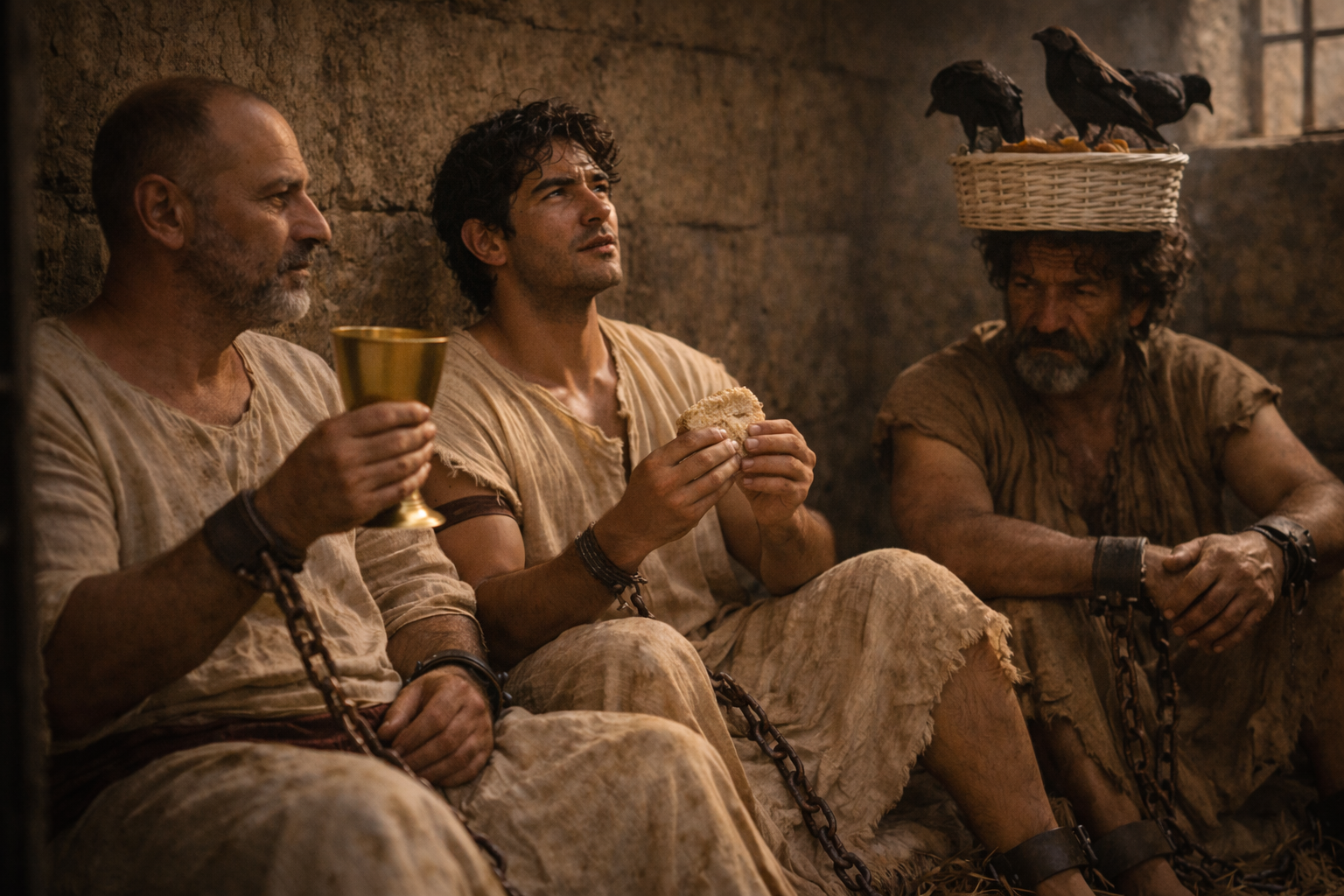
When the chief baker saw that the interpretation was good, he said unto Joseph, I also was in my dream, and, behold, I had three white baskets on my head: And in the uppermost basket there was of all manner of bakemeats for Pharaoh; and the birds did eat them out of the basket upon my head.
And Joseph answered and said, This is the interpretation thereof: The three baskets are three days: Yet within three days shall Pharaoh lift up thy head from off thee, and shall hang thee on a tree; and the birds shall eat thy flesh from off thee.
There is something tender here.
Joseph says to the butler, in effect, “When things get better for you, do not forget me.”
That is a very human sentence.
After all the strength Joseph has shown, after all the dignity, after all the calm faith, you hear the ache underneath it. He wants out. He wants to be remembered. He wants someone on the outside to say his name in the right room.
And that cry reaches forward.
The thief beside Jesus said in Luke 23:42, “Lord, remember me when thou comest into thy kingdom.”
And Jesus, on the night He was betrayed, took bread and gave thanks and said in Luke 22:19, “This do in remembrance of me.”
That matters.
Real fellowship always has remembrance in it.
We remember people we love. We return in heart to what they did, what they said, what it cost them, how they cared for us. And when it comes to Jesus, remembrance is not a sentimental exercise. It is holy clarity. We come back again and again to the Cross. We come back to the body broken and the blood shed. We come back to the price paid to open our prison door.
That is why Communion matters so deeply. It calls us to remember, not vaguely, but personally. He did this for me. He entered my dungeon. He took my guilt. He bore my judgment.
Then Joseph says, “I have done nothing that they should put me into the dungeon.”
Again the shadow of Christ is right there.
Joseph was innocent.
And of Jesus Pilate said in Luke 23:4, “I find no fault in this man.”
Our Lord was not suffering for His own sin. He had none. He was the spotless One, the innocent One, the sinless Lamb. Yet He was treated like the guilty so the guilty could be treated like sons.
Then the scene turns to the baker.
The butler dreamed of a cup.
The baker dreamed of bread.
And right away your mind goes to the Table.
Bread and wine.
The two elements that keep taking us back to Jesus.
The bread speaks of His body given for us.
The cup speaks of His blood poured out for us.
But here is the sobering part. One man hears good news. One hears judgment.
Why?
Because the issue is never just being near the symbols. The issue is what a man does with what they mean.
One may stand near the cup and bread and find life. Another may be close to holy things and still remain unchanged. One receives. Another remains hardened. One entrusts himself to mercy. Another does not.
That is why Paul says in 1 Corinthians 11:28, “But let a man examine himself, and so let him eat of that bread, and drink of that cup.” Communion is not something to handle casually. Not because the Table is closed to needy people, but because it is not meant for careless hearts. It is for those who know they need Christ, those who know His Cross is their only hope.
Think about that.
The same Table that comforts the broken also warns the proud.
The same bread and cup that announce mercy also declare that outside of Christ there is no life.
So when we come to Communion, we are doing more than repeating a church custom. We are saying, “Lord, I remember. I remember what You did. I remember what it cost. I remember that without You I would still be in chains. I remember that You were innocent, yet You took my place.”
Beloved, remembrance is not small.
It keeps the heart soft.
It keeps the Cross central.
It keeps grace fresh.
And every time we truly remember Him, we are reminded that the One who was innocent entered our dungeon so we could be brought into the King’s presence.