
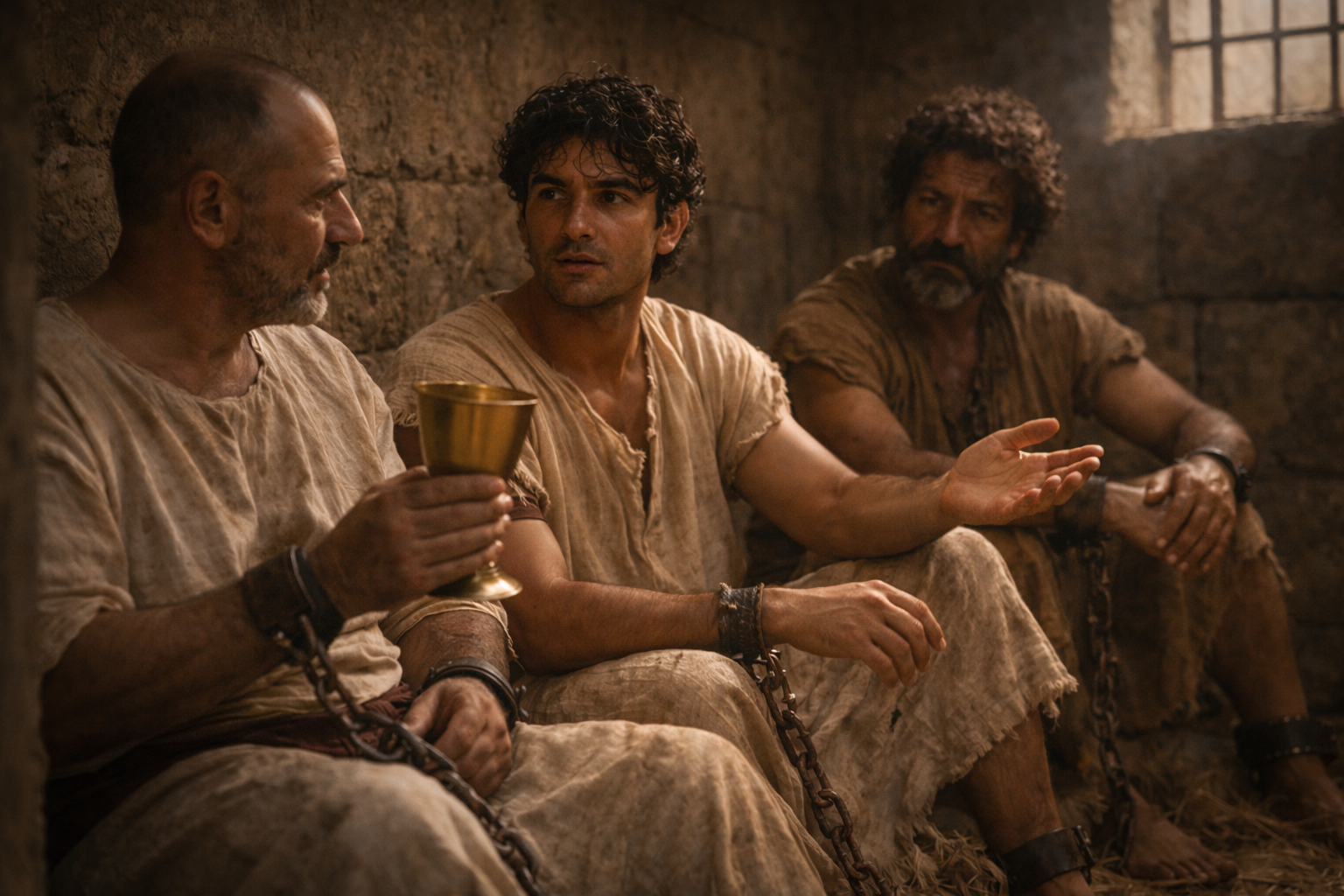
Genesis 40:5-13
And they dreamed a dream both of them, each man his dream in one night, each man according to the interpretation of his dream, the butler and the baker of the king of Egypt, which were bound in the prison. And Joseph came in unto them in the morning, and looked upon them, and, behold, they were sad.
And he asked Pharaoh’s officers that were with him in the ward of his lord’s house, saying, Wherefore look ye so sadly to day?
And they said unto him, We have dreamed a dream, and there is no interpreter of it.
And Joseph said unto them, Do not interpretations belong to God? tell me them, I pray you.
And the chief butler told his dream to Joseph, and said to him, In my dream, behold, a vine was before me; And in the vine were three branches: and it was as though it budded, and her blossoms shot forth; and the clusters thereof brought forth ripe grapes: And Pharaoh’s cup was in my hand: and I took the grapes, and pressed them into Pharaoh’s cup, and I gave the cup into Pharaoh’s hand.
And Joseph said unto him, This is the interpretation of it: The three branches are three days: Yet within three days shall Pharaoh lift up thine head, and restore thee unto thy place: and thou shalt deliver Pharaoh’s cup into Pharaoh’s hand, after the former manner when thou wast his butler.
Joseph is still in prison, but his heart has not turned inward.
That stands out to me.
A lot of us, if we were sitting where Joseph was sitting, would have been so wrapped up in our own pain that we would never have noticed the faces around us. But Joseph walks in, looks at these men, and can tell something is wrong. He is not just surviving. He is still caring. He is still paying attention. He is still available.
That is a beautiful thing.
Pain has a way of shrinking a man’s world until all he can see is himself. But Joseph is not like that. Even in prison, he has room in his heart to ask, “Why are you sad today?”
That sounds like Jesus.
Again and again, even on the road to His own suffering, our Lord kept seeing people. He kept hearing people. He kept ministering to people. Joseph, in this quiet prison scene, is doing the same.
Then notice his answer when they say there is no interpreter. Joseph does not step forward like a gifted man showing off his ability. He says, “Do not interpretations belong to God?” That is Joseph all over again. The Lord is with him, and Joseph knows it. He does not grab the glory. He sends it upward.
That is real humility.
He is useful, but he knows where the wisdom comes from. He is gifted, but he knows the source. And that is one reason God can trust him.
Then the butler tells the dream. A vine. Branches. Blossoms. Grapes. A cup in Pharaoh’s hand. And Joseph says that in three days the butler will be restored. He will stand again in the presence of the king. He will put the cup back into Pharaoh’s hand.
That office mattered greatly. A cupbearer was not just a servant carrying a drink. He was close to the throne. He had access. He stood near the king. He served in a place of nearness and trust.
And it is hard not to see in that cup a faint whisper of Jesus.
In the garden our Lord prayed in Matthew 26:39, “O my Father, if it be possible, let this cup pass from me.” What cup? The cup of suffering. The cup of wrath. The bitter cup that belonged to us because of our sin.
But Jesus drank it.
He took the full weight of it.
And because He drank the cup of suffering, we are handed something entirely different. Psalm 116:13 calls it “the cup of salvation.” Through Him we are brought near. Through Him we gain access. Through Him we come into fellowship with the King.
That is the wonder of the gospel. He took the cup we deserved so we could receive the cup we never could have earned.
And all of that is hinted at here in this prison scene, where a fallen man hears that he will be restored to the king and once again place the cup in Pharaoh’s hand.
Beloved, Jesus does not merely help us survive prison like places. He opens the way back to the King. He brings us near. He restores access. And what He puts in our hand is not judgment, but salvation.